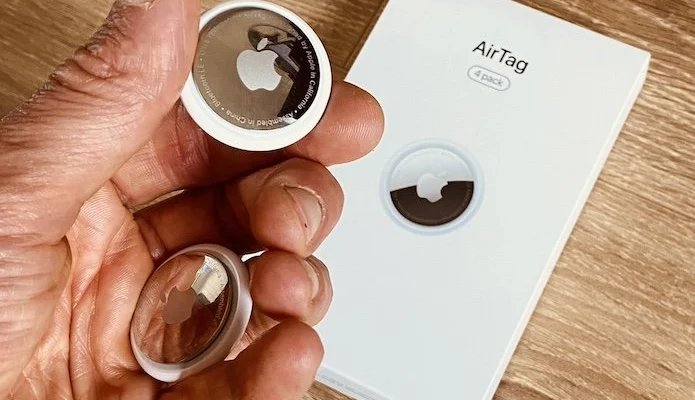
Share the post "Apple AirTag Review: The Ideal Companion for the Modern Cyclist"
For a period of two weeks, our team took a close look at the Apple AirTag, this little technological gem, seeking to unveil its advantages not only in terms of security and location, but also to explore other promising features, such as its use in tracking athletes during ultra-cycling events. Testing an innovative accessory that can provide many services, on the bike… and off it.
Text and photos: Jean-François Tatard
In a world where technology is increasingly encroaching on our daily lives, cyclists are increasingly turning to innovative solutions to improve their experience on the road. It is in this context that Apple AirTags present themselves as an intriguing option, offering the promise of increased peace of mind and a new dimension in tracking and security for riders. We explain…
Before we start, what is an AirTag? An AirTag is a small tracking device designed by the famous American brand Apple to help Apple users exclusively and owners of an iPhone or iPad easily find their lost items. It uses Bluetooth technology and connects to the Find My app on Apple devices, such as iPhone or iPad. Users can attach an AirTag to their keys, backpack, bike, or any other valuable item. The Find My app then allows them to locate the item to which the AirTag is attached with high precision, thus facilitating its recovery in case of loss or theft.
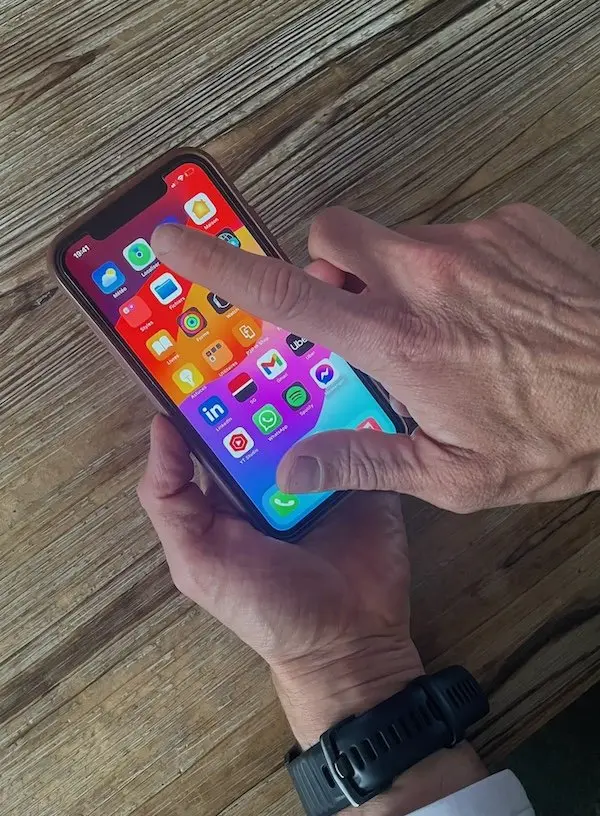
Thus, in the context of how we use it at 3bikes.fr, obviously, one of the main assets of the AirTag is its use as an anti-theft device for a bike, even if the device is not originally designed for that. And moreover, the brand does not claim it at any time.
However, thanks to its small size and compatibility with Apple’s Find My app, you can find your bike if it is stolen. This feature offers an additional layer of valuable protection for cyclists who invest in quality equipment and want to protect it against theft.
The AirTag uses Bluetooth for proximity location and Apple’s extended network to find objects out of range, relying on your iOS device’s GPS to record the last locations. The solution is of course not totally foolproof because it depends on several factors, but it nevertheless provides significant security in the first few minutes after the disappearance of the secured object. We are thinking particularly of mass events, such as sportives or other competitions, where bike thefts can occur around the start and finish areas, for example.
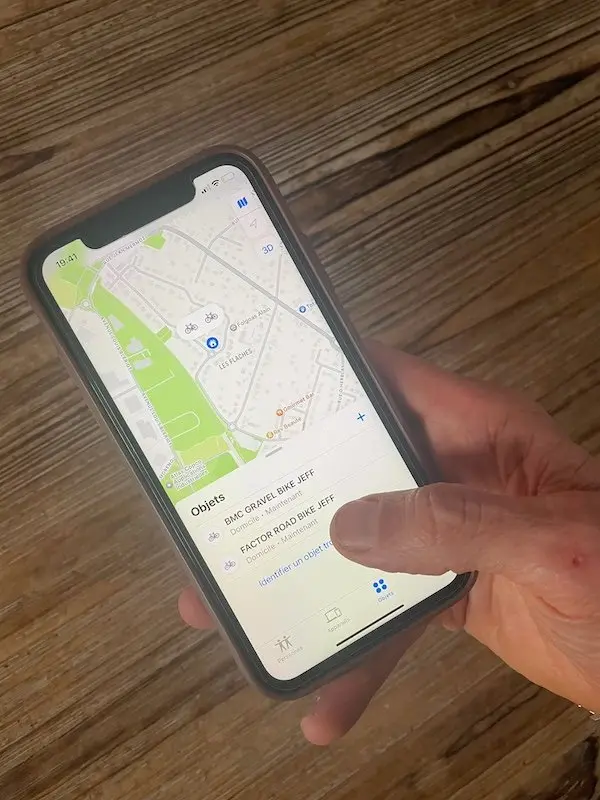
The device is nevertheless distinguished by its operational reliability, as it is perfectly water and dust resistant (IP67 certified). It uses an easily replaceable CR2032 battery, and its autonomy is several months, even a year according to Apple. It can therefore be hidden in a place on the bike that is difficult to access without the need to regularly disassemble it for recharging.
Additional insurance
From our point of view, the use of an AirTag could also have a positive impact on the cyclist’s insurance level. By providing proof of location and ownership of the bike in case of theft, the AirTag could help you speed up the claims process with your insurance company. This can result in potential savings on insurance premiums or faster resolution of problems in the event of a claim. This is a point to clarify with your insurer in any case.
An AirTag is sold for €39, but there is also a pack of four AirTags sold for €129, in order to track several objects if necessary.
To follow and conduct our test, we separately purchased a small case in the AirTag format and placed it under the saddle using a very strong adhesive (€7.89 for four cases on Amazon). And we chose this method to best simulate their actual use. Nevertheless, depending on the diameter of the bike’s seatpost, one can imagine fixing the device in a more concealed way, within the bike frame.
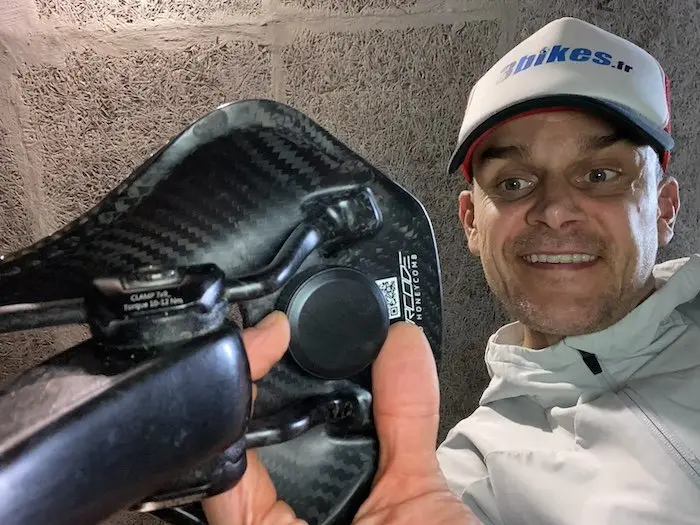
The opportunity to test the AirTags arose during our training rides and also during an endurance competition in the Yvelines. As we prepared for the race, we decided to evaluate their effectiveness in a demanding environment.
From the start of the race, we were able to observe the precision of the AirTags’ location thanks to Apple’s Find My app. Even during the most technical sections and fast descents, we were able to have our support staff, to whom we had given free access to our phone, track our position in real time, offering invaluable peace of mind to everyone.

As the race progressed, we also realized that AirTags could be useful for tracking other competitors and helping them if needed. By attaching an AirTag to a struggling rider’s equipment, support teams could quickly locate and provide assistance, thus improving the safety of ultra-cycling races.
Almost foolproof tool
Back home after the race, we were immediately impressed by the exceptional performance of the AirTags. Their ability to locate the bike with remarkable precision was particularly impressive. From then on, we decided to fully integrate them into our cycling routine, whether during our intensive training rides or our daily commutes.
Throughout our experiences, we discovered that AirTags offered much more than just peace of mind. Their reliability and remarkable versatility make them indispensable companions for any cyclist concerned about the safety of their equipment, or for those who tend to misplace their keys or other important everyday items. More than just a tracking device, AirTags have become for us an insurance against the unexpected.
Imagine: venturing into bustling urban areas with complete confidence, knowing that your precious city bike is always within reach. It is this peace of mind that AirTags offer us, and that is precisely what makes them so valuable to us.
We discovered that AirTags could also be used as tracking and fleet management tools for professional cycling teams. By attaching an AirTag to each bike, sports directors could track the real-time position of their riders during races, thus improving team strategy and communication between members. This innovative use further expands the scope of AirTags, demonstrating their adaptability and potential to meet the varied needs of cyclists, both amateur and professional.
In conclusion, Apple AirTags emerge as a remarkable innovation in the field of portable technology, redefining how cyclists approach the security and protection of their equipment. Their ability to provide precise and reliable location offers invaluable peace of mind, whether during intense competitions, arduous training, or simple daily rides. AirTags therefore prove to be versatile tools, likely to bring real benefit to cycling enthusiasts in their practice.
The Apple AirTag in brief… Pros: precise location, versatility, ease of use, anti-theft protection, battery life, adaptability Price: €39 each, €129 for four Website: www.apple.com |
Share the post "Apple AirTag Review: The Ideal Companion for the Modern Cyclist"