Share the post "Test Ride of the Specialized Roubaix SL8 Expert on the Cobblestones of the “Hell of the North”"
A few months after the launch of the new Specialized Roubaix SL8 and our first test ride of the top-of-the-line S-Works model, we took another look at the American brand’s so-called endurance bike—but this time in its more affordable Expert version, priced at €6,500. That’s still a substantial amount for a highly versatile bike, designed first and foremost to offer a high level of comfort and accommodate wide tires—as we discovered while riding the Roubaix Expert on the extremely challenging cobblestones of northern France.
By Guillaume Judas – Photos: ©Etienne Schoeman/Specialized 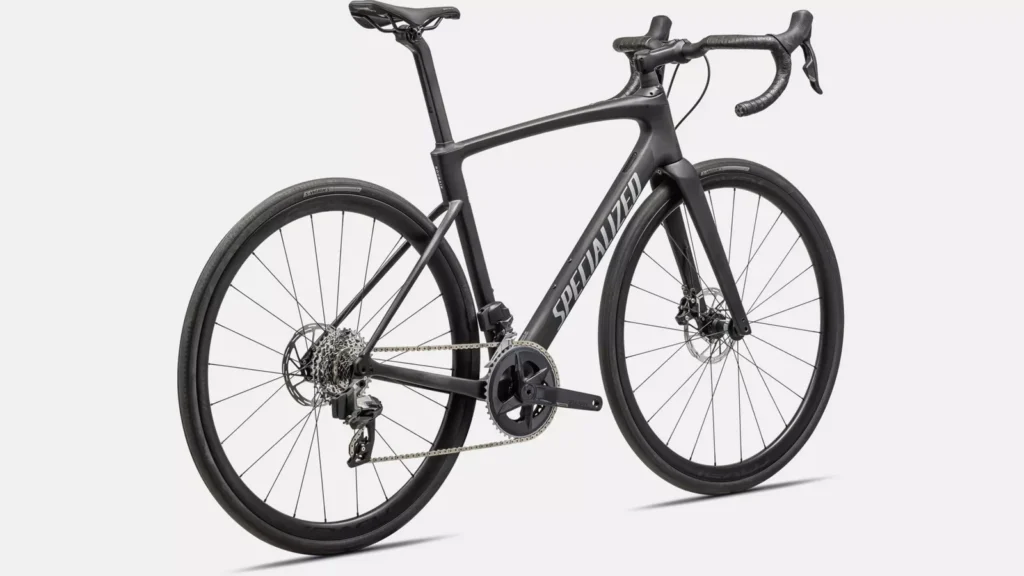 The Specialized Roubaix is available in a full range of models priced from €2,800 to €14,000, with varying levels of features and components. But the philosophy behind the bike’s design remains the same: to prioritize rider comfort and offer great versatility for riding, whether on roads with varying degrees of pavement quality or on trails and paths that aren’t too extreme. The bike’s design is based on a geometry featuring a head tube that is higher than on traditional road bikes, a longer rear triangle, and a front-and-rear suspension system designed to cushion the rider and isolate them from uneven terrain, along with ample frame clearance around the wheel wells to accommodate wide tires. The goal is to provide a stable and relaxed ride that promotes endurance, making the bike suitable for touring, ultra-distance riding, and even specific routes like the cobblestone sections of Paris-Roubaix.
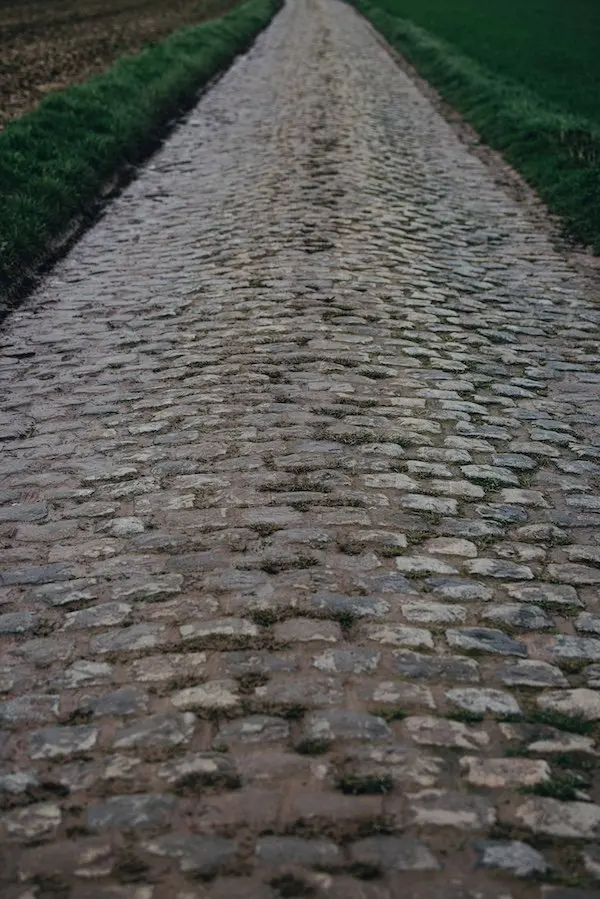
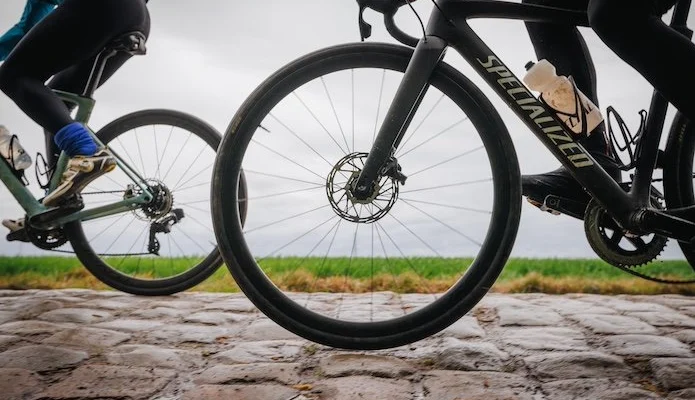
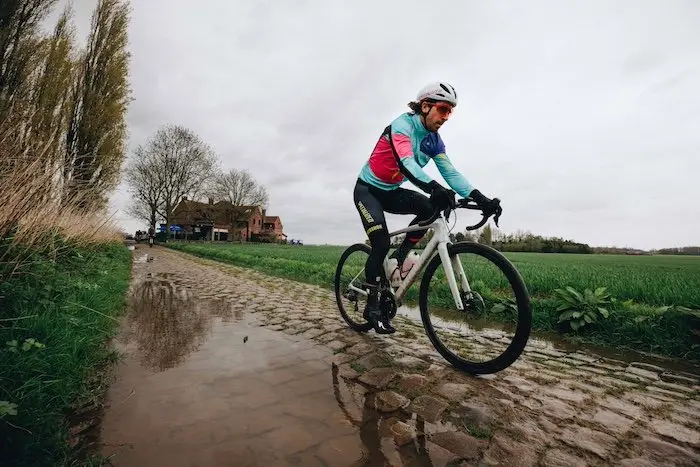
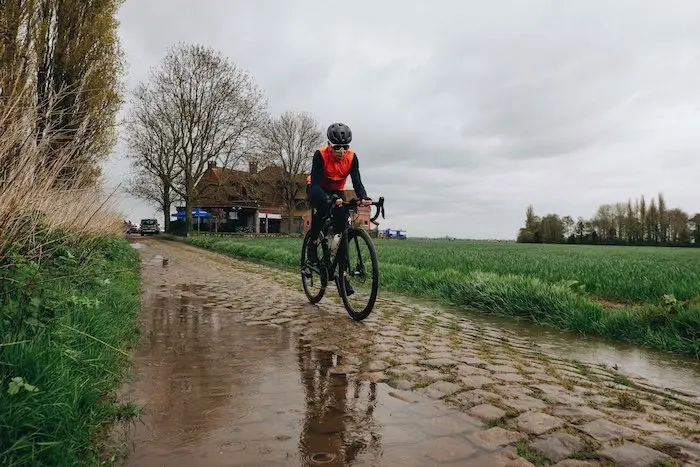
The Roubaix takes its name from the famous cobblestones that have shaped—and continue to shape—the history of cycling, a name that symbolizes the ability to tackle the most demanding conditions. In the middle of the infamous Carrefour de l’Arbre section, with its rounded, loose, uneven, slippery, and wet cobblestones—as well as on other sections that are slightly less dangerous and challenging— I was able to appreciate the bike’s shock-absorbing capabilities as well as the subtle differences brought about by the Future Shock front suspension settings—and, above all, by the tire pressure. Two days immersed in the cobblestones of northern France in the company of Peter Sagan and his invaluable advice left me with no soreness or injuries—proof that the overall design works perfectly.
 Comfort and Performance
The Specialized Roubaix Expert is a mid-range bike that prioritizes comfort without sacrificing performance—far from it. The main difference from the Roubaix S-Works, which we tested six months ago, lies in the frame’s carbon fiber grade—here, Fact 10r instead of Fact 12r, according to the American brand’s nomenclature. In practical terms, this means the frame alone weighs about 100 grams more. I didn’t notice any difference in terms of stiffness or ride quality. In other words, the Roubaix Expert stays lively and dynamic during accelerations and when shifting into a higher gear on the flat. Acceleration is crisp and efficient, and the bike offers positive inertia that helps maintain a good cruising pace. This pace is further enhanced by aerodynamics tested in a wind tunnel, which promise significant gains compared to the previous version of the Roubaix. After all, every little bit counts—even in endurance riding.  At the rear of the bike, a relatively simple seatpost system called After Shock improves comfort while remaining virtually unnoticed in terms of riding feel. It consists of a carbon seatpost mounted very low in the frame at the seat tube, with a clamp positioned 65 mm lower than a traditional clamping system. The length and design of the post allow it to flex slightly backwards as the rear triangle absorbs impacts, soaking up vibrations without sacrificing stiffness or causing a pumping sensation.
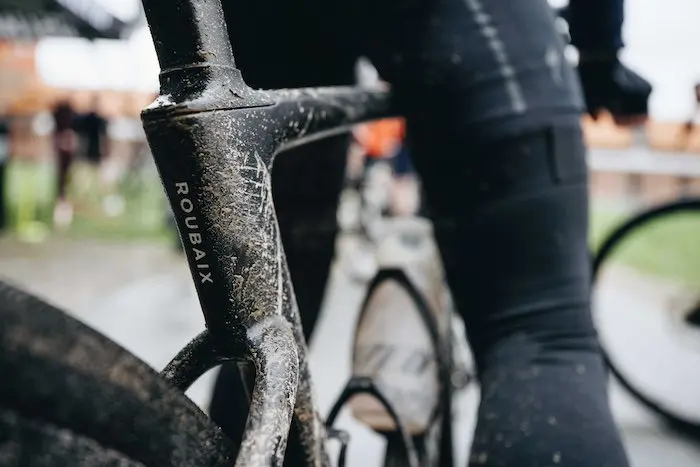
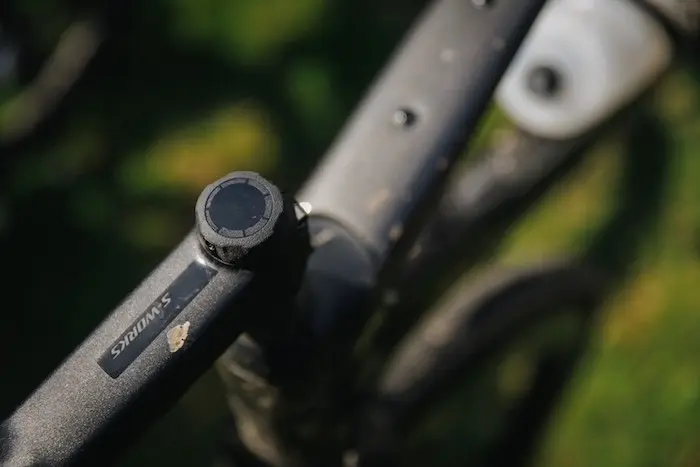
Up front, the Future Shock suspension system sits between the stem and the head tube. It offers 20 mm of travel and significantly cuts down on impacts and vibrations at the handlebars while keeping the front end stiff for precise handling. This Roubaix SL8 features the third generation of Future Shock, which can be easily adjusted so that every rider—regardless of weight or riding position—can enjoy optimal comfort, thanks to three different springs that can be fitted into the system. This new version is offered in three trim levels, and the Roubaix Expert typically comes with the mid-range option, which offers hydraulic damping in addition to the customizable spring, but without the ability to adjust compression. However, as seen here on the test bike, it’s possible to opt for the top-of-the-line system—normally found on the S-Works model—which features five-position compression adjustment while riding, controlled by turning a dial (from fully locked to soft). This €450 option may be worth it, depending on how you plan to use your bike.  In the locked position, the suspension always delivers completely neutral handling, without the slightest hint of float during aggressive accelerations or sprints. In the softest setting, you can feel a slight amount of travel when standing on the pedals at the front of the bike, but the ride feel remains unchanged when riding while seated in the saddle. In terms of comfort, when riding over potholes or very uneven surfaces, the difference between the two extreme settings is, of course, very noticeable. There is significantly less vibration in the hands and arms, and this is also evident in terms of fatigue after several hours in the saddle. Nevertheless, I find that the most relaxed position slightly reduces the sense of control over the bike’s path. I don’t feel fully connected to the bike’s steering, so I can’t tell exactly where to place my wheels. Ultimately, I found the best compromise on cobblestones with position 4/5—that is, almost the stiffest setting but not quite—combined with wider tires, but I’ll come back to that later.
Versatility Thanks to Tire Choice In this regard, the Roubaix SL8 (regardless of trim level) is compatible with tires up to 38 or even 40 mm with light tread patterns. This also depends on the wheels used and the tire’s bulge relative to the rim’s internal width, but the key takeaway is that this bike lets you venture beyond paved roads onto gravel sections that aren’t exceptionally muddy or overly rocky—in any case, different from traditional roads. Thanks to the progress made in this field in recent years, the bike’s versatility has only increased, and these are, in fact, capabilities sought after by more and more riders. A modern take on cycle touring, so to speak. Or the “Swiss Army knife” of bikes, equally at home on asphalt as on loose terrain. It’s also worth noting that since the new Roubaix is equipped with the necessary mounts for panniers on the top of the frame, as well as for fenders or racks, it can, of course, be converted into a bikepacking bike for multi-day adventures.
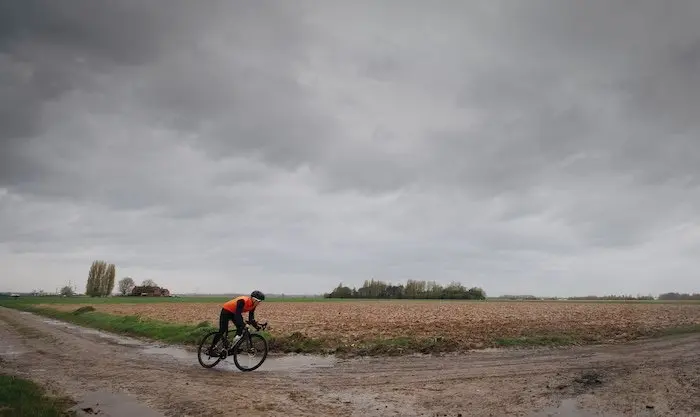
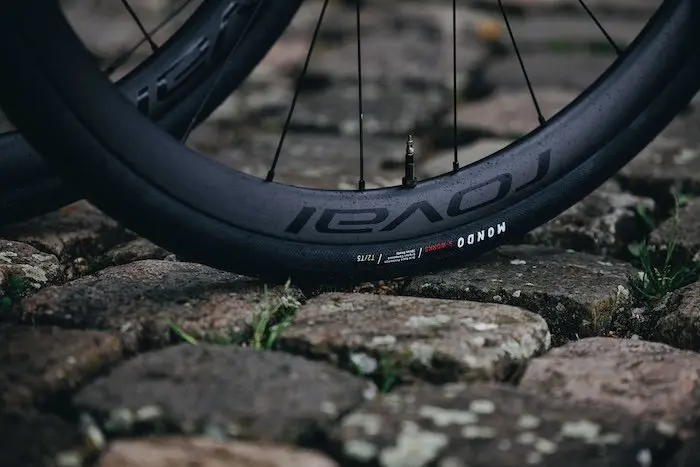
Equipped as standard with 32-mm-wide S-Works Mondo tyres, the Roubaix Expert has plenty of room to spare. With these tyres, however, I didn’t exactly shine on my first run through a wet cobblestone section: despite their already substantial width and a tyre pressure of 3.5 bar front and rear, I felt like I was riding on slick tyres over a layer of black ice. Probably not enough speed or confidence, despite riding tips from Peter Sagan himself—though the champion must weigh at least 20 kg more than I do. And to avoid being tossed around too much and to stay on top of the cobblestones, that’s something that matters. In this setup, vibration absorption isn’t even really the issue, especially since the Future Shock suspension does its job perfectly.  It’s mainly a question of traction here—an area where the Mondo can sometimes be surprising when it comes to the tread, offering significantly less grip than on the tire’s shoulders. That’s the trade-off for good performance on asphalt and long-lasting durability, but on the wet cobblestones at the Carrefour de l’Arbre, it takes a bit of confidence. Still, this is exactly the setup chosen by all the pros sponsored by Specialized in both the women’s and men’s Paris-Roubaix races. And it was with these tires that Lotte Kopecky won the women’s race.
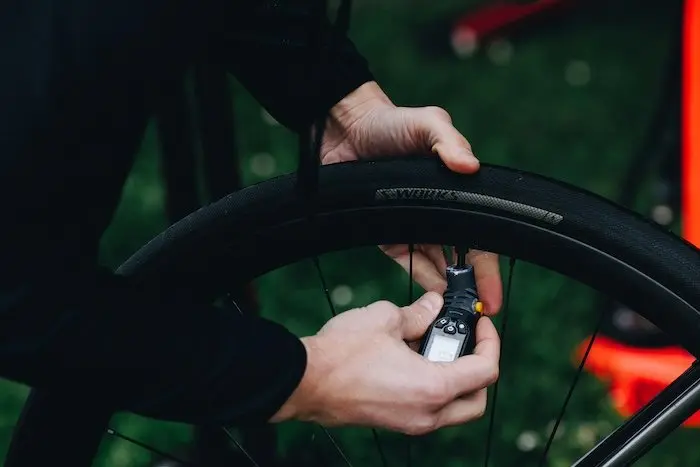
As for tire pressure, the Specialized technician recommended 2.7 in the rear and 2.5 in the front. It’s a whole different world.
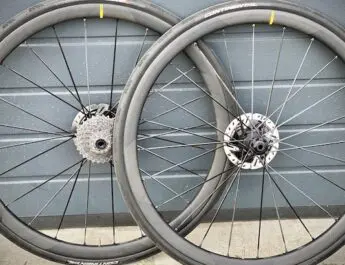
For my part, I went back to the pits and tested another setup, still allowed by the Roubaix. S-Works Mondo tires again, but this time with a 35 mm section—which translates to a good 36 in actual width—on the already fairly wide Roval Terra wheels. As for tire pressure, the Specialized technician recommended 2.7 in the rear and 2.5 in the front. It’s a whole different world. On the road, I can’t really say I felt a noticeable difference in terms of efficiency. They do offer a bit more resistance, to be sure, and you’re probably losing two or three watts at 40 km/h due to less favorable aerodynamics. On the other hand, on wet cobblestones, I felt more confident. I felt less jostled and, above all, found better traction. I lost less speed in turns on cobblestones, so accelerating out of them was less demanding. And on gravel sections, it almost felt like I was riding on asphalt.
Thanks to this setup—and thus the Roubaix’s capabilities in this area—I no longer had to constantly adjust the Future Shock suspension settings; I settled once and for all on a compression damping setting that seemed like a good compromise for sequences of asphalt-cobblestones-asphalt, The 32-section is undoubtedly perfect for pros in race conditions, but for me, the 35-section is much better suited to this type of terrain. Even the day after that first test ride, tackling the cobblestones on dry pavement this time, with just as much suspension travel, but above all more speed and more confidence.
The Specialized Roubaix Expert: a good choice? On the Roubaix Expert I found the riding position to be identical to that of the Roubaix S-Works. On flat terrain the two bikes are very similar in terms of handling, with a riding character truly unique to this model. The efficiency is truly surprising for a bike in this category, no doubt due to perfectly engineered lateral stiffness, only slightly dampened by the flexibility of the wide tyres, which gives the impression of constantly riding on a soft carpet.
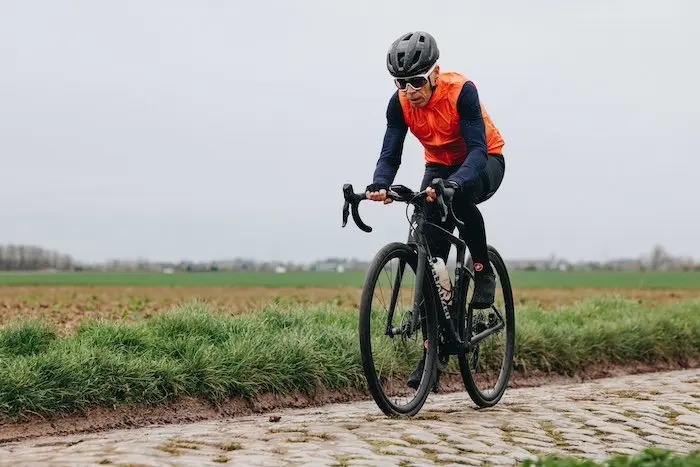 During my test ride of the Roubaix S-Works, I noted that the weight was truly impressive, at 7.6 kg ready to ride, taking into account the 32 mm tires and the weight of the Future Shock system (around 400 g). But we’re talking here about the €14,000 S-Works model, which costs more than twice as much as the Roubaix Expert. The Expert comes in at 9 kg all-in, and perhaps even a tiny bit more with 35 mm tires. The frame is only about 100 grams heavier, but the groupset (SRAM Rival instead of Red), the wheelset (Roval Terra C instead of Terra CLX), the saddle, and the handlebars are also heavier. The bike’s overall performance is identical in both versions, but the Expert does it all while carrying a bit more weight.
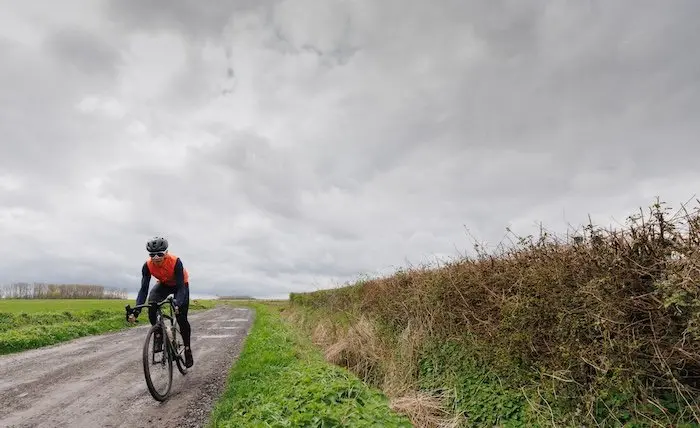
Of course, only racers or Strava KOM hunters will really notice the difference. Long-distance riders, ultra-distance enthusiasts, or touring cyclists looking for an all-around bike won’t complain about a price-to-weight ratio that’s far from favorable. Because the Roubaix’s strength—whether it’s the Sport, Expert, Pro, or S-Works version—is its ability to tackle almost any road. The cobblestones of the North are a perfect example.
The SPECIALIZED ROUBAIX EXPERT at a glance… Pros: versatility, comfort, tire clearance, efficiency Cons: weight, price Frame: Roubaix SL8 FACT 10r Carbon – Suspension: Future Shock 3.2 (3.3 optional) – Groupset: SRAM Rival eTap AXS 12-speed (with power meter) – Wheelset: Roval Terra C – Tires: Specialized S-Works Mondo 700×32 – Saddle: Specialized Power Expert – Handlebars: Specialized Hover Expert – Weight: 8.7 kg (without pedals) – Price: €6,500 Contact: specialized.com |
=> SEE ALSO: All our Test Articles
Share the post "Test Ride of the Specialized Roubaix SL8 Expert on the Cobblestones of the “Hell of the North”"