
Share the post "Muscles for cycling?"
In the world of sport, the ability to build muscle quickly is often perceived as an undeniable advantage. However, in disciplines like cycling, it can also pose significant challenges. Let’s explore the medical and physiological bases of this ability, as well as its specific advantages and disadvantages for cyclists, with tips for managing this dynamic.
By Jean-François Tatard – Photos: All rights reserved
The ability to build muscle quickly is largely influenced by genetics. Some individuals have a natural predisposition to develop muscle rapidly in response to training or muscle stimulation. This is often linked to variations in genes responsible for muscle protein synthesis and muscle growth regulation.
Physiologically, this increased ability to build muscle can be due to increased sensitivity of muscle cells to growth signals, as well as higher levels of certain anabolic hormones, such as testosterone and IGF-1.
The type of exercise also influences how muscle develops. In weight training, for example, medium to long sets with a medium load promote muscle mass gain, whereas very short sets with heavy loads tend to promote pure strength gain.
Advantage or disadvantage for cycling?
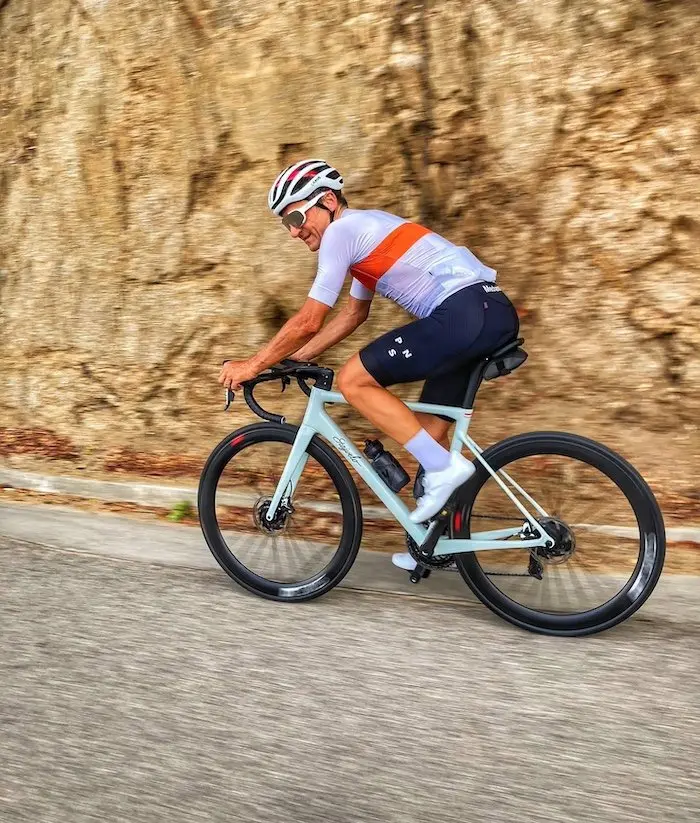
In the context of cycling, where power-to-weight ratio is crucial, the speed with which some individuals can build muscle can be both an advantage and a disadvantage. On the one hand, rapid muscle strengthening can lead to a significant improvement in power and strength, which can be beneficial during sprints or in parts of the circuit where a large gear needs to be pushed. However, the major disadvantage lies in the extra weight that muscle adds to the cyclist. In disciplines where every gram counts, excess muscle mass can lead to decreased efficiency and speed, especially on climbs.
In cycling, excessive muscle development can also lead to additional disadvantages, such as loss of mobility and impingement in the neural pathway. Increased muscle volume can restrict joint range of motion, which can compromise the efficiency of pedaling technique and increase the risk of injury, particularly in aerodynamic positions during time trials. Furthermore, excessive muscle growth can compress peripheral nerves, disrupting the transmission of nerve signals and potentially leading to decreased muscle sensitivity and responsiveness.
It is also important to distinguish between muscular strength and power: strength refers to the ability to exert resistance, while power involves the ability to generate force quickly. Thus, increased muscle volume does not necessarily guarantee increased power on the bike, as performance also depends on factors such as neuromuscular coordination and mechanical efficiency.
=> SEE ALSO: Strength-Endurance Training for Performance Improvement
Some advice for our readers
For cyclists who tend to build muscle quickly, it is essential to find a balance between strength and weight. Here are some tips for managing this dynamic:
1. Specific training: focusing training on power and endurance rather than excessive muscle development can help optimize performance on the bike.
2. Adapted nutrition: adopting a balanced diet focused on the specific needs of cycling, with an emphasis on lean proteins and complex carbohydrates, can promote muscle growth without leading to excessive weight gain.
3. Regular monitoring: monitoring body composition and muscle progress can help adjust training and nutrition to maintain an optimal balance between strength and weight.
In conclusion
The ability to build muscle quickly is a complex genetic trait, offering both advantages and disadvantages to cyclists. By understanding the underlying medical and physiological bases of this dynamic, as well as applying informed advice, cyclists can optimize their performance on the bike while mitigating the risks associated with excessive muscle gain. This reality highlights the importance of finding a balance between muscle strength and mechanical efficiency, thus illustrating the need for athletes to understand their own physiology to excel in their discipline.
=> SEE ALSO: All our Coaching articles
Share the post "Muscles for cycling?"