Share the post "Kask Elemento Review"
The Kask Elemento is one of the most expensive helmets on the market, yet it’s very similar to the iconic Protone, the Italian brand’s best-seller. However, it features a revolutionary design that saves weight while improving ventilation and aerodynamics. Is that enough to make it a new benchmark?
By Guillaume Judas – Photos: ©3bikes.fr
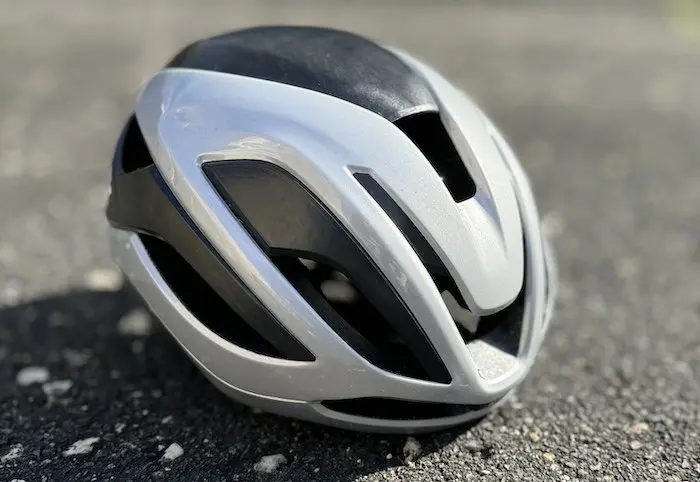
For the past ten years, the Kask Protone has been a staple in amateur and professional pelotons. It’s popular for its look – a feature that matters! – and for its functionality and versatility, especially since its last update with the Protone Icon in 2022. Launched in May 2023 and intended to compete in the same category, the Elemento therefore has a big challenge to live up to, especially since the brand has not hesitated to set the bar very high in terms of price. At €375, we’re starting to reach new heights, even if, as Kask points out, the Elemento is not intended to replace the Protone, but simply to complement it in the range.
A range that still includes the Utopia Y and the Valegro, the most aerodynamic helmet and the most ventilated helmet, each in their own domain. The Elemento therefore faces better options in specific circumstances, but with this model, Kask intends to distinguish itself in terms of versatility and safety. The Elemento’s new design allows it to perform very well in wind tunnel tests for aerodynamic efficiency (approximately 5 watts gain at 45 km/h compared to the Protone according to Kask), in ventilation tests (0.26°C less than the Protone, again according to Kask), and to obtain a 5/5 safety rating from the independent Virginia Tech organization.
New technologies
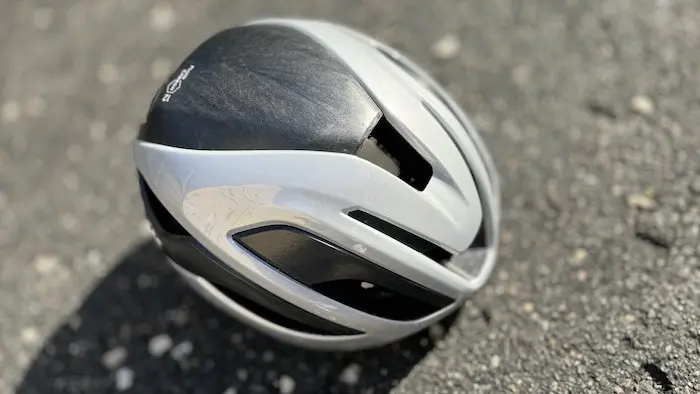
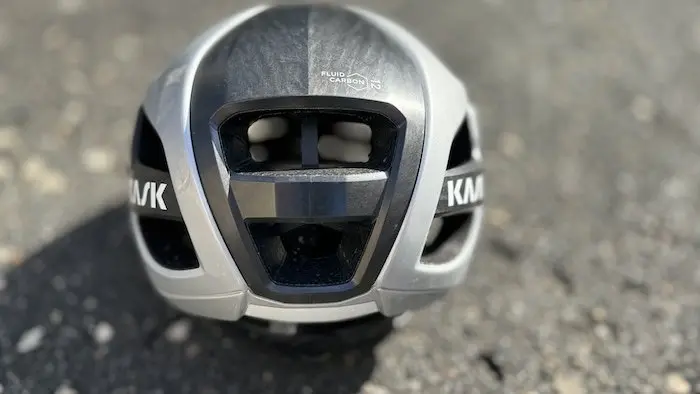
Two main innovations underpin the Elemento’s design. The first is a technology Kask calls Fluid Carbon 12: it consists of a series of carbon plates used in place of much of the EPS foam typically used in helmet manufacturing. These plates create a shell similar to tectonic plates, which articulate together to absorb and share impact forces. The system is thus said to be able to absorb more energy during an impact than traditional materials.
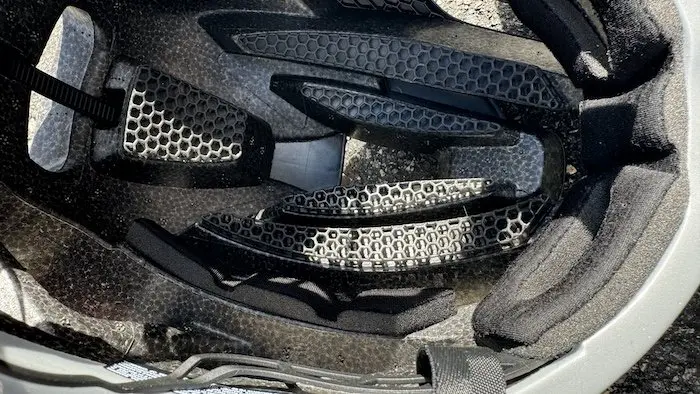
These carbon plates are only one millimeter thick, whereas EPS foam is usually between 25 and 30 mm, which allows for the creation of internal air circulation channels that are much deeper than usual. Despite relatively modest ventilation holes on the front of the helmet, designed to promote aerodynamics, ventilation is excellent thanks to these larger internal channels, which more effectively move air from front to back.
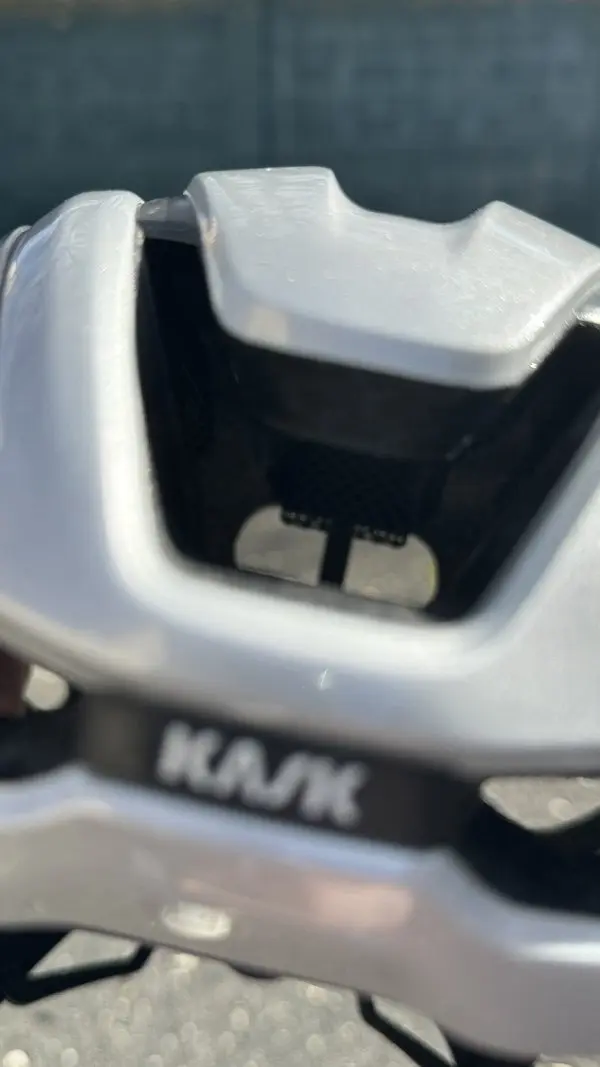
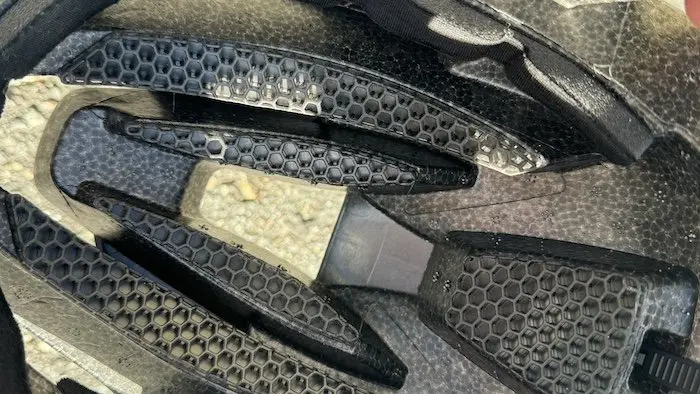
The other innovative technology is in the helmet’s internal padding, which here uses the same principle as the 3D-printed padding found today on saddles. Not only is the system cleaner to use than traditional foams, but the very design of the lattice ensures comfort and safety, with a rigid outer face and a low-density core that guarantees a shearing motion in the event of an impact, thereby reducing rotational impact forces, similar to the famous Mips system.
Wearing the Kask Elemento
The Elemento’s fit is very similar to other Kask models, including the Protone Icon. It is available in three sizes: S (50-56 cm), M (52-58 cm), and L (59-62 cm). I weighed my sample at 254 g in size S, compared to 235 g for the Protone Icon and 216 g for the Protone. For comparison, we also weighed the Valegro at 186 g and the Utopia at 244 g, also in size S. The Elemento is not super light, then, but rest assured, the difference is completely imperceptible once on the head.
At the back of the helmet is the Octofit+ dial, designed for precise adjustment even while riding and with one hand if necessary. The rear tightening system has a vertical adjustment that offers very good adaptation to all neck sizes as well as all hair thicknesses and lengths (even ponytails).
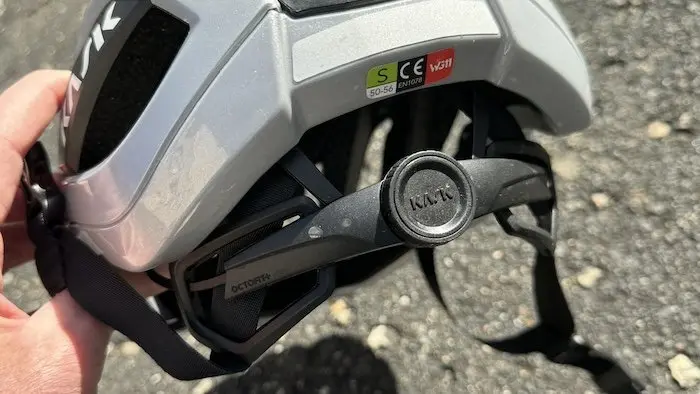
At the forehead, there’s a Merino wool lining, which is supposed to maintain a constant body temperature and dry quickly if wet. I haven’t had the opportunity to ride in very hot weather with the Elemento yet. So I can neither confirm nor deny this feature. I can only confirm the good comfort felt on contact with the skin when putting on the helmet.
With the Elemento, Kask has done away with the synthetic leather lower chin strap, offering instead a slightly thinner and more minimalist system. The buckle has also been refined. All this to provide good retention on the head while maintaining a good feeling of lightness. In short, in addition to being beautiful to look at, as Kask helmets often are, the Elemento is so comfortable that you forget you’re wearing it. I found myself keeping it on in a restaurant during a meal break of almost an hour without realizing it, in the middle of a ride with Anglo-Saxon colleagues who love this kind of stop that seriously makes your legs sting when you get back on the bike!
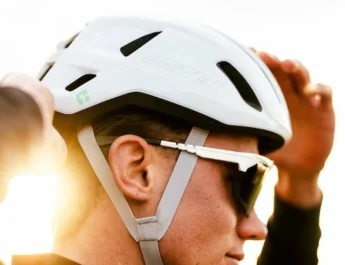
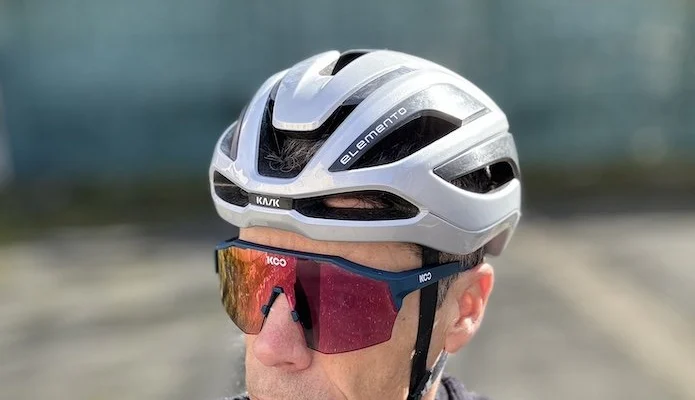
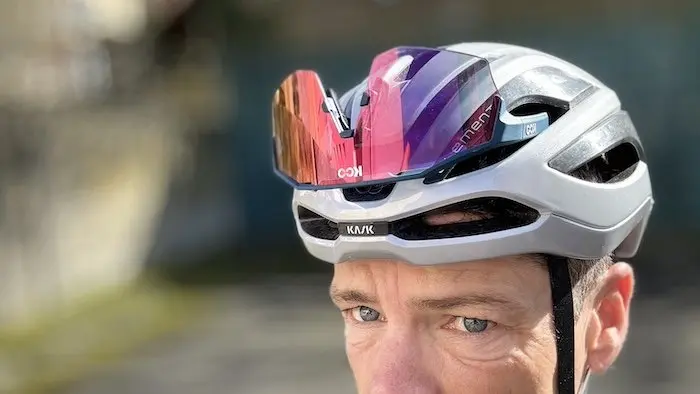
Finally, on the practical side, it should be noted that the placement of the ventilation holes on the front of the helmet does not facilitate placing glasses on the helmet, which can be useful, for example, when climbing a pass in hot weather, or lingering in a restaurant. The holes are either too close or too far apart to perfectly suit the placement of glasses without them risking falling off. And this is true with both Koo brand glasses and Oakley. A shame, but we had to find a flaw in this otherwise excellent helmet.
High-level ventilation
Of course, it was impossible for me to test the Elemento’s aerodynamic efficiency under normal conditions, just as I didn’t want to test Kask’s claims regarding safety in the event of an impact. I hope you understand. What remains is the excellent comfort, as I explained above, both in terms of contact on the head and when tightening. Nothing to complain about.
I would add, however, that I was really surprised by the helmet’s ventilation. I’m used to riding often in winter or late winter with a skullcap under my helmet, with the visor up, to protect myself from the cold air. From the very first ride, I had nothing to say in terms of adjustment or positioning, or even sensations, as I found something very close to the Protone Icon that I had been using until then. On the other hand, the first day I rode without a skullcap, with a nice 17°C on the thermometer, I felt like my hair was in the wind. Then on another ride at a temperature of 13°C, I almost felt cold on my head, clearly feeling the fresh air circulating over my scalp. Then I did a Gravel ride with uphill sections at low speed, again in mild temperatures, with sensations very close to those you can experience with the best ventilated helmets on the market. I think it’s almost impossible to feel overheated with the Kask Elemento, which also has all the features in terms of performance and comfort that you can expect from a high-end helmet.
Finally, the question of price seriously arises. Does the Elemento objectively really justify the €100 more it costs compared to the Protone Icon? No. Is it really worth buying in addition to a Protone Icon, considering its features? Still no. On the other hand, if you’re looking for a high-end helmet that’s comfortable, perfectly finished, and that you won’t even think about once it’s on your head, you can definitely be tempted.
=> SEE ALSO: Buy Kask Elemento for €339.99 instead of €375
The KASK ELEMENTO in brief… Pros: versatility, finish, ventilation, comfort, safety, look Number of sizes: 3 (S,M,L) – Colors: 6 – Vents: 14 vents – Padding: Multipod + Merino wool – Visibility: HiViz reflective strip at the back – Occipital retention: OctoFit+ – Chin strap: chinstrap – Weight: 254 g in size S – Price: €375 Contact: kask.com |
=> SEE ALSO: All our Test articles
Share the post "Kask Elemento Review"