Share the post "25,000 km with SRM X-Power power meter pedals"
In 2024, the market is flooded with power meters, but there’s only one pioneer in the field: SRM. They are the first manufacturer to have created and commercialized power meters, and we had the exclusive opportunity to pre-test the SRM X-Power road pedals. After riding over 25,000 km, here’s our review.
By David Polveroni – Photos: All rights reserved
SRM, specialists in crank spider-based strain gauge power meters, decided to innovate by drawing inspiration from their successful MTB version, the X-Power, produced since 2021. This new generation of road pedals therefore promises unparalleled reliability.
Versions and packaging
This time, SRM abandons the Look system to adopt Shimano’s technology, requiring the use of SPD SL cleats (not supplied). This is excellent news, as Shimano is a benchmark in pedals. With a stable surface and cleats offering several degrees of float (yellow: 6, blue: 2, red: fixed), you’ll benefit from a perfect fit.
SRM X-Power pedals are available in a single version, with only one sensor in the right pedal, but they can be upgraded to a dual version. For our test, we opted for the dual version, compatible with certain cranksets thanks to a 2 mm wider thread. Cannondale or Easton, for example. Furthermore, if you wish to widen your Q factor by adding washers, you can do so, even if it’s not recommended by SRM.
Each pair of pedals comes with 2 magnetic charging cables, similar to Favero’s Assioma. Although sometimes capricious during charging, you just need to plug them in properly. However, it’s regrettable that you have to buy a dual-port USB plug.

Installation
Installation is simple, like for a classic pair of pedals, but with an open-end wrench, like in the good old days! The axle design may seem retro to some, but once mounted on your bike, a crucial step is required: initial calibration.


To do this, download the SRM X-POWER application available on the Apple Store and Android. The procedure is clear and easy to follow. After entering your crank length, place your bike on a horizontal surface and align the cranks perpendicular to the ground, at a 90-degree angle. Then, perform a simple calibration. Nothing complicated, but this step is essential. Then, connect your bike computer via Bluetooth or ANT+ and make sure you have correctly entered your crank length.
On the road
Or rather on your indoor trainer, because we wanted to check the accuracy of the data. Using a Wahoo Kickr Power, whose accuracy is well-established, the pedals, although announced with only a 2% margin of error, matched perfectly, and the comparisons were accurate to the watt. This is an excellent point to highlight, as sensor accuracy can vary considerably from one brand to another.
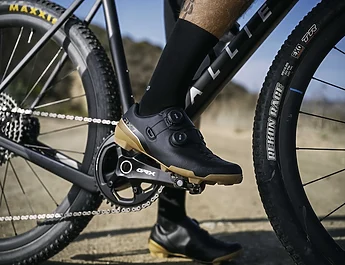
On the road, the SRM X-Power pedals perfectly mimic the feel of original Shimano pedals when pedaling. The tension is adjusted with a spring, just like on a classic Look Keo. They also show a marked similarity in the rear retention arch. The sensations they provide are excellent, with an axle height of only 9.5 mm, measured between the pedal axle and the cleat contact surface. All this with a contained weight of 287 g for the pair, which is only 30 g more than Shimano Ultegra. SRM has achieved a real feat by integrating a power meter into such a light pair of pedals. They are 30 g lighter than Assioma Shi and 40 g lighter than Garmin Rally RS200, with a 3 mm lower axle height.
The aluminum body is both light and robust. It’s important to note that pedals are subject to wear, and although the body is not indestructible, SRM offers a maintenance service to replace parts. We actually had to send our pedals back after these 25,000 km. The body, initially entirely black, quickly shows marks, but the aluminum color quickly takes over. As we mentioned, this is a wear item, so aesthetics can be affected.

The pedals require regular maintenance, especially after every wet ride or wash. Simply apply a drop of oil to the axle to lubricate the bearings. We don’t have more information on the references and quality of the bearings, but they have been put to the test over these kilometers in a multitude of conditions. We must admit, we were disappointed on this point, as the competition does better… However, it remains to be seen if the after-sales service will be effective in resolving this issue.
Another point that may deter purchase is the price, but after all, a gold standard remains a gold standard… SRM is a small company, and all parts are interchangeable, which is a huge advantage for pedals. Overall, in my opinion, these pedals come closest to the feel offered by Shimano SPD pedals, while Assioma increases the Q factor too much. Garmin, on the other hand, represents an economical solution, but they also have the negative points mentioned previously.
So, it’s an investment of €1713, certainly substantial, but when you spend €12,990 or €13,490 on a bike, you might as well be perfectly equipped! SRM is a small company, and that entails certain costs. If you want to take the plunge, this is where it happens: HERE.
The SRM X POWER power meter pedals in brief… Pros: accuracy, lightness, reduced axle height, interchangeability between bikes, compatibility with Shimano SPD SL cleats, ease of mounting Cons: high price, bearing maintenance Weight: 285 g Price: €1007 for single, €1713 for dual Contact: srm.de |
=> SEE ALSO: All our Test articles
Share the post "25,000 km with SRM X-Power power meter pedals"