Share the post "Review of the Wahoo Kickr Core Zwift One: Making Connected Indoor Cycling More Accessible"
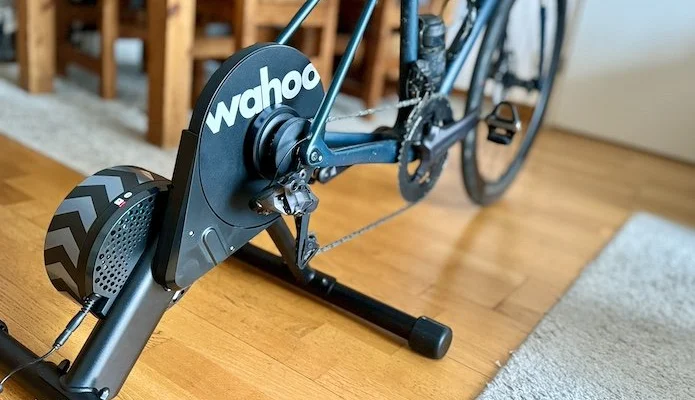
Zwift and Wahoo have unveiled the Wahoo Kickr Core Zwift One indoor trainer, the result of their collaboration. Thanks to the Zwift Cog system and virtual gear shifts—features already seen on the Zwift Hub One indoor trainer launched this fall, which offer compatibility with most bikes equipped with 8- to 12-speed drivetrains— the Kickr Core Zwift One is well-positioned to claim a significant share of a highly competitive market, especially given its price of €599, which includes a one-year Zwift subscription. Ease of use, precision, reliability: 3bikes.fr has already tested it for you. By Guillaume Judas – Photos: ©3bikes.fr

In 2023, a few months after the launch of the Zwift Hub indoor trainer, the American indoor cycling platform introduced a (r)evolution with a single-cog system (Zwift Cog) and virtual gear shifts (Zwift Click) to ensure compatibility with a wide range of bikes, with the goal of making the sport accessible to as many people as possible through the Zwift Hub One. Today, Zwift is partnering with Wahoo, a brand known for its indoor trainers and bike computers, to offer the Wahoo Kickr Core Zwift One, based on an existing mid-range model (the Kickr Core) that has been widely acclaimed by many users, which in turn is equipped with the same Zwift Cog system and controlled by Zwift Click virtual gear shifts. All this for €599, including a one-year Zwift subscription (which usually costs €14.99 per month, or €179.88). That drops the price of the Kickr Core to around €420, whereas it was still selling for €899 just a few months ago.
Beyond the obvious bargain for those looking to equip themselves with a device that perfectly gets the job done for regular and dedicated training on a stationary bike, this unexpected partnership between the two brands ultimately simplifies things significantly in a highly competitive market. By installing the Cog on the Kickr Core, Zwift is rolling out its innovation without having to manage the manufacturing of indoor trainers—which was already outsourced anyway— and Wahoo no longer has to deal with the RGT platform, which it owned and which was intended to compete with Zwift, and which was permanently shut down at the end of 2023.

With the Kickr Core Zwift One, its relatively affordable price, and its broad compatibility with road bikes, time-trial bikes, gravel bikes, mountain bikes, hybrid bikes, and children’s bikes, many cyclists—young and old alike—can access the virtual world of Zwift, enjoying a fully immersive and seamless experience as they feel every change in terrain, explore new routes, or try out training programs to improve their fitness, alongside a global community.
The Kickr Core: A Solid Mid-Range Model
Released in late 2018, the Wahoo Kickr Core is a home trainer renowned for its value for money—even well before this latest significant price drop. With its sturdy and stable steel frame, it inspires confidence and promises solid reliability. Assembling the unit is almost as simple as the Zwift Hub, since you only need to install the two legs using the included tools. Mounting the bike may pose some challenges for inexperienced users, as you need to take into account the frame type and rear wheelbase. All necessary inserts are included, whether for a bike with disc brakes or rim brakes, but you’ll need to consult the manual—unlike the Zwift Hub, which offers a cardboard template to simplify the process. However, a card with a QR code leads directly to a video link with the most basic instructions. Anyone should be able to figure it out.

Be careful when removing the rear wheel from the bike before mounting it on the indoor trainer: the Zwift Cog system requires that the derailleur be positioned roughly in the middle of its usual travel range to align with the single sprocket. You can then fine-tune the derailleur position for perfect chain alignment, but the chain simply won’t derail once everything is set.
Once the bike is set up, simply plug the device into a power outlet. Two indicator lights (one red and one blue) show the status of the Bluetooth and ANT+ connections. The device is compatible with most devices (computers, tablets, smartphones, Apple TV, etc.). It’s recommended to make the initial connection using the Wahoo app on your smartphone to register the indoor trainer, install the latest available update, and, if necessary, perform a manual calibration of the power meter. As I’ve explained before with other devices from this brand, connectivity is truly one of Wahoo’s strengths, and I’ve never experienced a single glitch, whether with a home trainer or one of the brand’s bike computers.
 Connecting to Zwift on the computer is, once again, a breeze. Pairing the trainer to your computer via Bluetooth is straightforward. Once you’ve mounted the Zwift Click button anywhere on the bars for virtual shifting, you also need to trigger accessory discovery in Zwift on the same menu page as the trainer. Zwift’s Click and Cog tech lets you shift silently through 24 virtual gears to match the course. The gear range is very extensive, ranging—to put it simply—from the highest gear typically found on a time-trial bike to the lowest gear found on modern gravel bikes. In short, no matter your skill level, you’ll never be caught off guard on Zwift, and you’ll also enjoy very smooth gear transitions—something that isn’t always the case with a multi-sprocket cassette.
 The Differences Between the Kickr Core and the Kickr
Wahoo offers several indoor trainers in its lineup, including the Kickr Move, which I recently had the chance to test—a model directly derived from the Kickr, the brand’s flagship model. Although equipped here with the Zwift Cog, the Kickr Core has slightly less advanced features than the Kickr, which I’ve listed here:
- A 5.44 kg flywheel instead of 7.26 kg
- Maximum resistance of 1,800 watts instead of 2,200 watts
- A maximum simulated gradient of 16% instead of 20%
- Claimed power accuracy of ±2% instead of ±1%
- It tips the scales at 18 kg instead of 22 kg
- No Wi-Fi connection
- There’s no handle for moving the unit.
- There are no adjustable feet.
- There’s no height adjustment based on wheel size.
- There’s just a single foldable leg.
Note that the Kickr Core Zwift One is also compatible with the Kickr Climb, a device that simulates the bike’s incline based on the slope shown in the app. Like the Kickr and the Kickr Move, it features very smooth, progressive electromagnetic resistance that delivers a highly realistic ride feel. As a result, the difference in flywheel size is imperceptible—as I can attest after switching directly from one device to the other. The Kickr Core is a pleasure to use, and the addition of the Zwift Cog system obviously doesn’t change that. As for maximum resistance, 1,800 watts are out of my reach anyway, even when sprinting, and that’s true even for many professional road cyclists. The maximum gradient of 16% isn’t a huge deal either, considering that the steepest climb on Zwift is a short section at 17%.

The lack of a handle is a bit more of a nuisance, especially if you need to move the unit while using it, as I do. To compensate for the height adjustment based on wheel size—for example, when using a 24- or 26-inch mountain bike—it may be helpful to place shims under the front wheel, although many people will likely not pay attention to this. Finally, while the Kickr’s Wi-Fi connection is a real advantage for ensuring the reliability of the data sent to the Zwift app, I haven’t had any issues with the Kickr Core’s Bluetooth. In fact, with certain indoor trainers, I’ve noticed inconsistent variations in cadence, which of course affect the power data. In such cases, this is a data transfer issue between the indoor trainer and the computer, though it’s impossible to say with certainty which device is at fault. With the Kickr Core, I only saw a few unexplained fluctuations at cadences above 110 revolutions per minute.

 Power Measurement
The accuracy of a home trainer’s power measurement can be an important factor to consider when choosing the best machine. For some people, it doesn’t matter. It doesn’t matter what the machine displays, since they’re looking for the fun aspect of the activity in addition to staying in shape. For others—those committed to following a highly specialized power-based training regimen, or enthusiasts of virtual competitions—it’s essential. To enter certain official Zwift events, you need a trainer accurate to +/- 1%. That describes the Kickr and the Kickr Move, but not the Kickr Core.
I was able to compare the power output of the Kickr Core with Garmin Rally pedals—which had been previously calibrated and verified—against two different Kickr indoor trainers. Even after manually calibrating the spindown in the Wahoo app, the Kickr Core consistently delivers average power readings that are 2 to 3% higher, and sometimes even slightly higher—around 500 watts—during short power spikes, whether during free rides on Zwift (on a climb like the Epic Kom, for example) or during ERG mode sessions with predefined power thresholds. That’s pretty nice for the ego, but more of a hassle when it comes to very precise training tracking based on power data. Note that Wahoo has announced a new firmware update coming soon, which should eliminate the need for this manual calibration process in the app. Nevertheless, the Kickr Core is slightly less accurate than the Kickr, which isn’t really surprising, since it costs half as much!
The Kickr Core is slightly less accurate than the Kickr, which isn’t really surprising, since it costs half as much!
But in reality, I’m far from certain that all the power meters on the market—the ones mounted on the bike—are actually accurate. Or that most riders even calibrate them before every ride, ensuring accurate, reproducible data day after day amid changing outdoor conditions. With that in mind, I think many power meter owners are using them incorrectly anyway—whether they’re using indoor trainers, cranksets, or pedals mounted on the bike—and that power accuracy isn’t a critical factor for them. So the Kickr Core isn’t a device for professionals—that’s a given—but for 90% of people, it will provide the essentials: a reliable indication of exercise intensity. The Noise Level of the Kickr Core Zwift One
As mentioned above, I switched directly from the Kickr Move—equipped with a nearly new 12-speed cassette—to the Kickr Core Zwift One with the single Cog sprocket. Overall, both indoor trainers have a similar operating noise level—that is, very low. When the flywheel is spinning, even at full speed, you can barely hear the air moving around the mechanism. They’re extremely stable and produce very little vibration, which can be significantly reduced by placing the indoor trainer on a mat. Ultimately, the main noise while riding comes from the bike itself and the drivetrain. With the Kickr Move, I was blown away by how quietly the new cassette and chain operated. With the Kickr Core Zwift One I can hear a tiny bit more resonance as the chain wraps around the sprocket, but it’s still very reasonable. In short, you shouldn’t have any issues with your neighbors while riding the Kickr Core.

The best value for money on the market. Admittedly, the Wahoo Kickr Core Zwift One doesn’t quite match the performance of a Kickr, a Garmin Tacx Neo 2T, or an Elite Direto XR-T—particularly when it comes to power measurement accuracy or certain practical aspects (such as the lack of a handle). But its build quality, quiet operation, simplicity, and—above all—the riding experience it delivers on Zwift make it the best value for the money on the market. The combination of all these features with the Zwift Cog single-sprocket system and Zwift Click gear shifting makes the unit even more affordable for a wider range of riders. It could even be the one and only indoor trainer for the whole family. Finally, note that the Wahoo Kickr Core Zwift One is sold alongside the Kickr Core, which was recently launched with a choice of 8/9/10/11/12-speed cassette, which also comes with a one-year Zwift subscription via zwift.com and wahoofitness.com. => SEE ALSO: Buy the Wahoo Kickr Core Zwift One with a one-year Zwift subscription
The WAHOO KICKR CORE ZWIFT ONE at a glance… Pros: compatibility, pedalling feel, smoothness, realism, quiet operation; Cons: no handle for moving it, power meter accuracy Dimensions: 50.8 x 58.4 x 48.3 cm – Weight: 18.14 kg – Resistance: electromagnetic, up to 1,800 watts – Maximum simulated gradient: 16% – Flywheel: 5.44 kg – Power accuracy: +/- 2% – Communication: ANT+ FE-C, ANT+ Power, Bluetooth Smart Trainer Control, Bluetooth Smart Power – Compatibility: all 8- to 12-speed bikes, with the Zwift Cog (Zwift Click included) – Price: €599.99 (includes a one-year Zwift subscription) Contact: zwift.com or wahoofitness.com |
=> SEE ALSO: All our Test Articles
Share the post "Review of the Wahoo Kickr Core Zwift One: Making Connected Indoor Cycling More Accessible"