Share the post "Wahoo Kickr Move Indoor Trainer Review"
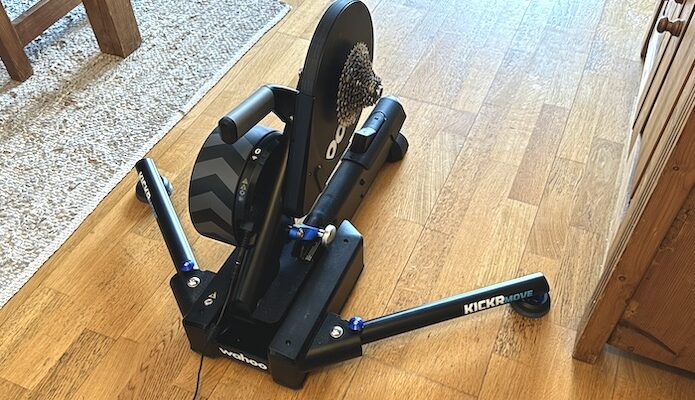
The new Wahoo Kickr Move is a very high-end indoor trainer that combines the recognized precision and robustness of the American brand’s devices with a floating chassis, for more natural movements during indoor training sessions. The product is also extremely quiet. The holy grail of indoor trainers?
By Guillaume Judas – Photos: ©3bikes.fr
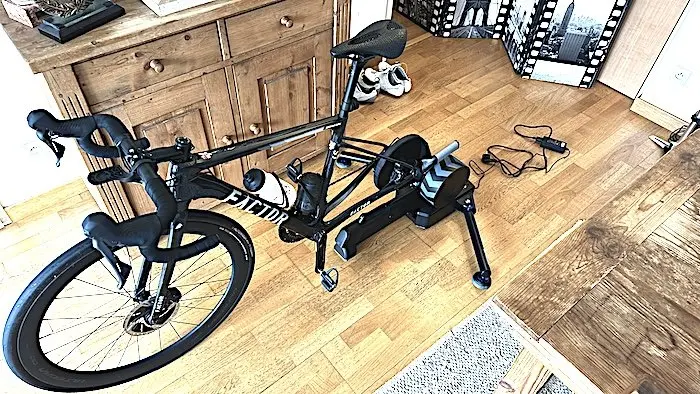
Launched in autumn 2023, the Kickr Move is very similar to the latest version of the Wahoo Kickr indoor trainer, which itself is very similar to the previous version we tested in early 2019. The brand’s indoor trainers boast a solid and high-quality appearance, with a steel frame and legs that ensure strength and stability. The Kickr is known for the precision of its power measurement, and the Kickr Move is no exception, as we will see later. It also benefits from an automatic calibration system, which is very practical for avoiding too many questions about the accuracy of the information it provides. Equipped with an electromagnetic resistance and now a 7.25 kg flywheel, it provides sensations close to reality on a simulated course, on any application. Finally, it surprises with its silence, because even during intense effort, only the sound of the chain on the cassette is perceptible. With a new chain and cassette, I was even able to do a solid training session with the Kickr Move one evening at 10 p.m., in an apartment building and without disturbing anyone.
=> SEE ALSO: Buy the Wahoo Kickr
The Kickr’s compatibility is total with ANT+, Bluetooth Smart, WiFi, and Ethernet (with Direct Connect accessory) communication protocols. This makes the device compatible with all the most popular training applications, and most of the devices you would want to use them on: computer, tablet, smartphone, or Apple TV. It is also possible to control the indoor trainer with a bike computer/GPS to follow preloaded workouts, whether it’s following a GPS track with slope variations, or following a training program in ERG mode (with the indoor trainer automatically adjusting resistance to the target power).
Regarding basic specifications, the Wahoo Kickr(s) offer high-level performance with a claimed power accuracy of +/- 1%, a maximum simulated slope of 20%, and a maximum resistance of 2200 watts (at 40 km/h).
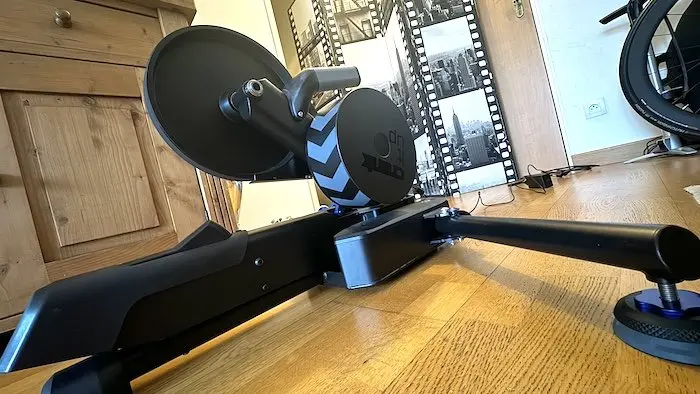
A floating chassis for even more realism
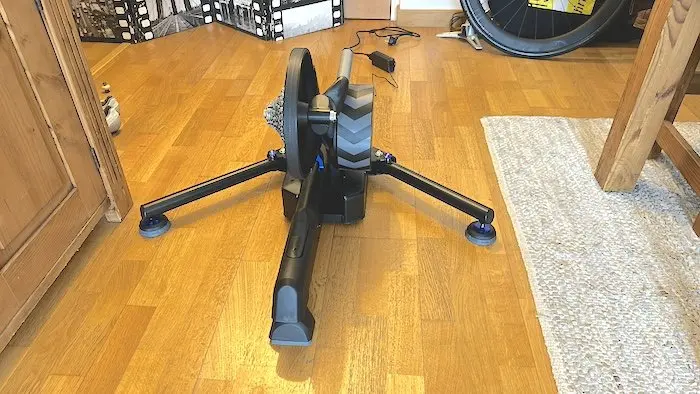
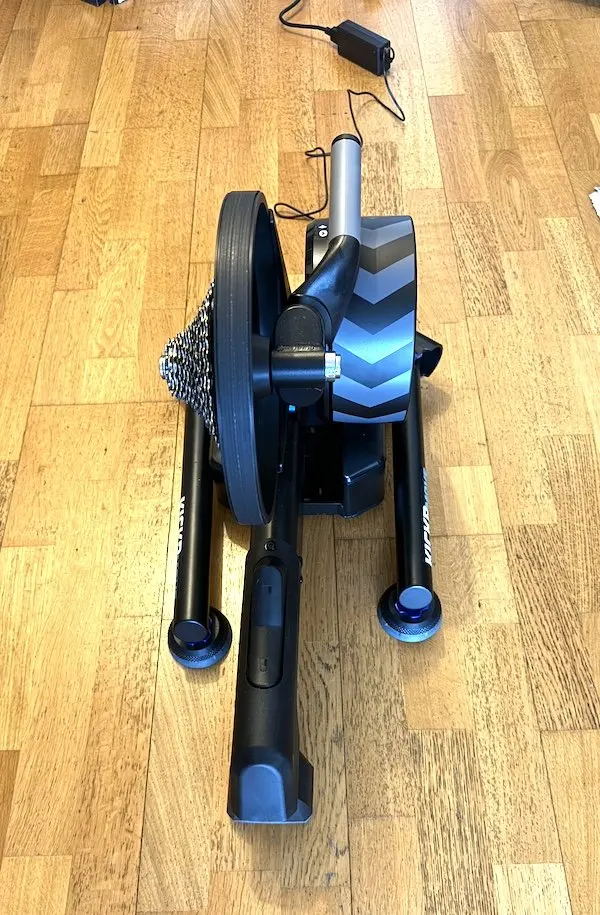
Compared to the Kickr, the Kickr Move adds a floating chassis, a few kg, and an additional €300 to the price. Is it worth it? We frankly ask ourselves this question every time the device needs to be moved. Although relatively compact with its two foldable legs, the beast weighs almost 29 kg. Yes, 29, and even almost 37 with the box before unpacking. Suffice to say, it’s better to be two if you have several floors to climb without an elevator. Fortunately, the device is delivered ready to ride, and you just need to slide the inner box where the Kickr Move is perfectly secured outwards and carefully grasp the upper handle to move it without injuring your back. Already assembled with an 11-speed cassette on an HG freehub body (fortunately compatible with 8, 9, 10, and 12-speed Shimano), it is also adaptable to many different bikes, both in terms of attachments and wheel height, as the chassis can be adjusted for 650, 700, or 29″ wheels.
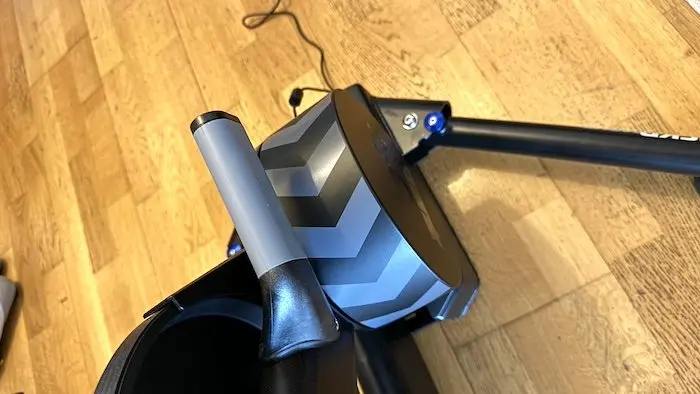

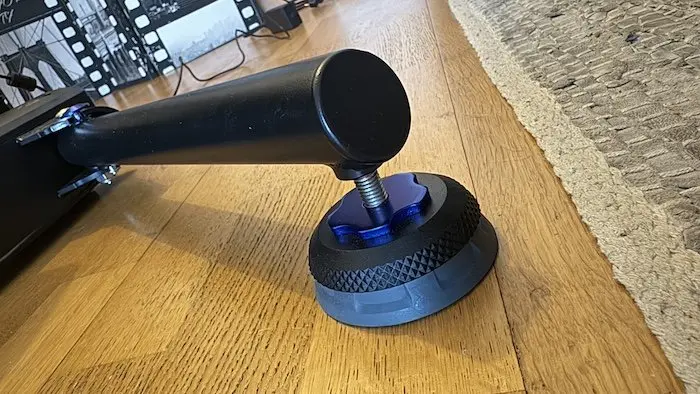
In use, the floating chassis, slightly curved at the ends, offers 7 cm of fore-aft movement in each direction. This means that when pedaling on the indoor trainer, the bike can make subtle small movements in both directions, barely a centimeter when pedaling normally, but much more pronounced during sharp accelerations, or by more naturally allowing the possibility of riding out of the saddle. The curved shape of the rail within which the chassis moves allows the bike to return to a central position when you resume a normal rhythm on the saddle. The Kickr Move also offers slight lateral freedom, thanks to both the chassis and the two foldable legs, each of which has an adjustable buffer depending on the user’s weight. To get an idea of the freedom of movement offered by the Kickr Move, you can watch the short video below:
This floating chassis therefore provides more natural pedaling sensations than with any other fixed indoor trainer, allowing you to train your muscles in conditions closer to those on the road. This freedom of movement also significantly relieves the crotch, especially during long sessions, by reducing pressure on the saddle. Finally, this system also relieves the bike frame, which is subjected to much less stress during intense efforts.
=> SEE ALSO: Buy the Wahoo Kickr Move on sale for €1499
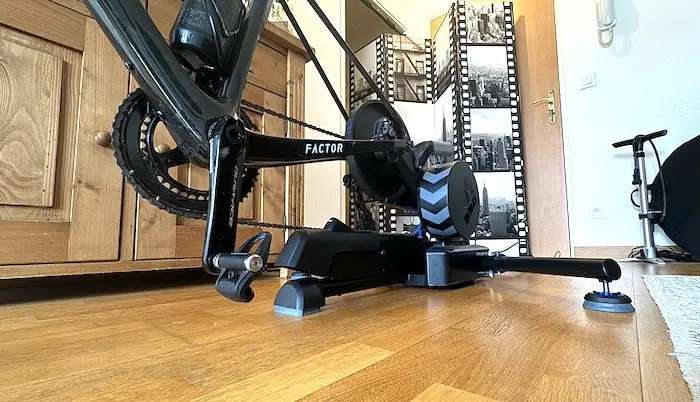
The Kickr Move is, of course, compatible with the entire Wahoo ecosystem, whether we’re talking about bike computers like the Elemnt Roam, or the Elemnt Bolt (but it’s also possible to control the indoor trainer with a Garmin), as well as the Kickr Climb (with an adapter, sold for about forty euros), the device that simulates slope inclinations. It is also, of course, perfectly suited for use on Zwift, whether following training plans with ERG mode, or in free mode, in response to the simulated terrain. I primarily tested this indoor trainer on Zwift, just like all the indoor trainers we test on 3bikes.fr, because it is highly probable that you will also use it on this application. Moreover, Zwift even offers a promotion by directly selling the Wahoo Kickr Move, but with a one-year subscription to the application included.
=> SEE ALSO: Buy the Wahoo Kickr Move with a one-year Zwift subscription
High-performance connection of the Wahoo Kickr Move
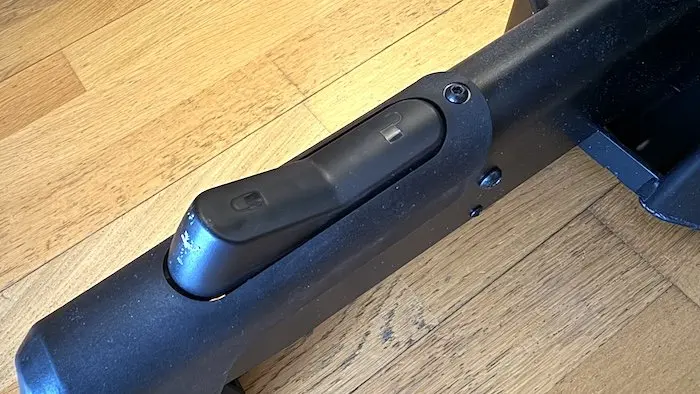
Before starting to pedal, you need to install the indoor trainer in the desired location, by unfolding the two side legs, then adjusting the left-right balance using the adjustable end caps. It’s best to use a spirit level on the saddle to avoid pedaling crooked. I actually had some issues with this, noticing that on the unit I received for testing (not entirely new), there was a significant offset between the two feet. It should also be noted that for perfect use of the pads that contribute to the bike’s lateral freedom, it’s better for them to be placed on a hard floor, not on a mat. Regarding the floating chassis, it has a locking system, simple to engage or disengage, even with your foot once on the bike. This allows you to get on the bike without risking being unbalanced by longitudinal movements, and also to move the device a little more easily.
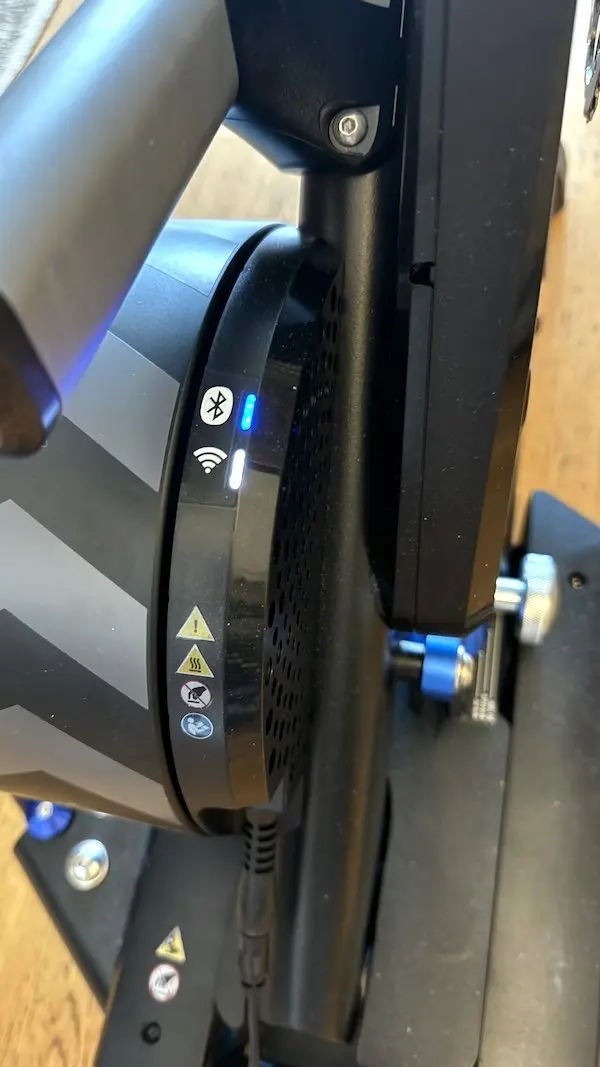
Next, it is advisable to download the Wahoo Fitness app on your smartphone, in order to register the device and perform the latest available update. And as usual with Wahoo, a few seconds after plugging the indoor trainer into the mains, the device is recognized. This is truly one of the brand’s strengths, which in my opinion is far ahead of the competition in this regard. Whether with a Wahoo bike computer or indoor trainer, I have never experienced a connection failure to date, on my smartphone or on my computer.
Finally, you have the option, via the application, to connect the indoor trainer to your home’s Wi-Fi. This is not mandatory for use, as the device communicates via Bluetooth with the computer, but it is more efficient and reliable. It limits the risk of certain bugs, particularly random data transmissions of power or cadence during intense effort.
When you connect to Zwift – and I assume it’s pretty much the same on other training apps – the Kickr Move appears on the home page as a power source, cadence source, and speed/resistance control. Some may prefer to use their usual power meter (on the crankset or pedals), and it’s obviously also possible to connect it instead of the Kickr Move, keeping the latter for speed control. But frankly, given the reliability of this indoor trainer’s power measurement, it’s not very relevant.
To finish, simply choose a free ride, a virtual group ride, a virtual race, or a structured workout on the Zwift menu page, and get started. Be careful if you’re new to the app, because by default, the indoor trainer’s difficulty setting in the parameters is set to 50%. This means that the difficulty of the slopes on virtual courses is halved. This is not cheating of any kind, as only the power you actually provide allows you to move forward on Zwift, but it’s simply as if you had a cassette with larger cogs. For my part, I set all indoor trainers to a difficulty of about 80%, which in my opinion offers more realism, but also forces you to change gears more often than with a setting of 50 or below to produce power at a comfortable cadence. And that leaves me a little room to spin on the 16% sections, the most difficult slope found on Zwift.
Power and precision of the Wahoo Kickr Move
I was able to compare the power delivered by the Wahoo Kickr Move with the Garmin Rally power meter pedals, themselves calibrated and validated by a cross-test with another user, on another sensor and another Wahoo Kickr indoor trainer! While it’s difficult to compare the power displayed on the computer (with the Wahoo) and on the bike computer (with the connected pedals) to the exact second, tests on efforts of 30 seconds, five and ten minutes, as well as over an entire session, are conclusive: I never found more than three watts of difference between the two, regardless of the duration. Overall, we are always within the claimed precision range of +/- 1% between the two sensors, for easy efforts or sustained efforts. Ultimately, I believe I can say that the Wahoo Kickr Move is very precise, and that it could even be sufficient as a power meter itself, for those who want to do structured training regularly without going crazy with their data on all outdoor rides. This is undoubtedly a good reason to also justify the very high price of this indoor trainer.
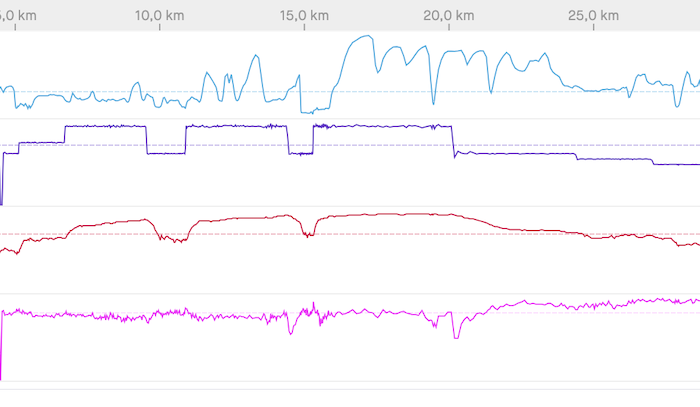
Regarding structured training in ERG mode, the device also ideally meets my expectations. By pre-setting the constraint to the desired number of watts, I notice a small latency of three to four seconds before the indoor trainer’s resistance adapts to the session’s instructions. But then, the resistance is perfectly smoothed to the desired value. In this mode, the Kickr Move always provides the desired resistance, depending on the cadence. If the cadence decreases, you must necessarily produce more force, and vice versa if you increase the cadence.
Improved sensations with the Wahoo Kickr Move
The Wahoo Kickr Move is the most high-end indoor trainer I’ve tested, and this is fortunately reflected in terms of sensations during indoor training. Thanks to the floating chassis, I find pedaling more natural than with a fixed device. At first, I felt jerks while pedaling, with a rather pronounced back-and-forth movement with each pedal stroke. But it must be said that in the middle of two freezing weeks outdoors, the muscular sensations were not great anyway. Gradually, I had the impression that my movement was freed, with my pelvis also participating in the pedaling movement, as on the road, and unlike what can happen when using a more classic indoor trainer.
The Kickr Move undoubtedly makes riding out of the saddle on the indoor trainer easier. On Zwift, small hills are tackled more naturally, by lifting off the saddle. On longer climbs, however, it remains less easy to ride out of the saddle than in real life, mainly because the bike’s lateral movements are limited. Saddle sores, however, are much, much less present here than with other indoor trainers, especially on sessions longer than an hour.
Very fluid when pedaling and changing resistance, the Kickr Move is also extremely quiet – I repeat myself – with a drivetrain in good condition. A few years ago, I had problems with neighbors when doing big indoor trainer sessions in the middle of the day. That era is completely over with this type of device. Those who train at 10 p.m. will be delighted. The electromagnetic resistance and the large flywheel ensure minimal noise and very realistic resistance variations… except in simulated descents. Unlike its most direct competitor, the Garmin Tacx Neo 2T, the Kickr Move does not simulate descents at the flywheel level. Concretely, when you arrive at a descent on Zwift, the indoor trainer’s resistance decreases very sharply, but you don’t have the sensation of being pulled along with the possibility of putting on the 11-tooth cog and spinning. Moreover, in normal use and even when setting the indoor trainer’s difficulty to 80%, it is difficult for me to ride with a gear ratio higher than 53/13, at least with a normal cadence, even on virtual descents. I would say that today this is the only flaw I find with the Wahoo Kickr Move – considering its price – which is otherwise super robust, very easy to connect, and with very high-performance power sensor accuracy.
So yes, the Kickr Move doesn’t offer anything more in terms of precision, silence, and reliability than the Kickr. The added Move system means a higher price of €300. But in my opinion, if the indoor trainer is an essential part of your preparation and you use it a lot, the price difference is worth it.
The WAHOO KICKR MOVE in brief… Pros: fluidity, power accuracy, realism, silence Format: L 68.6 cm x W 88 cm x H 67.6 cm – Weight: 29 kg – Resistance: electromagnetic, up to 2200 watts – Max simulated slope: 20% – Flywheel: 7.26 kg – Power accuracy: +/- 1% – Communication: ANT+ FE-C, ANT+ Power, Bluetooth Smart Trainer Control, Bluetooth Smart Power – Compatibility: all training software and applications – Price: €1599.99 Contact: wahoofitness.com |
=> SEE ALSO: All our Test articles
Share the post "Wahoo Kickr Move Indoor Trainer Review"