Share the post "Comprehensive Review of the Shimano GRX 12-Speed Mechanical Groupset"
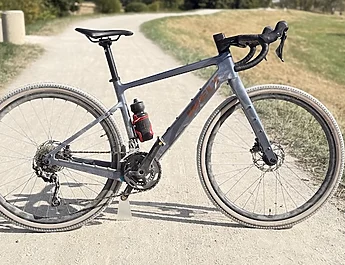
Unveiled in late summer 2023, the new Shimano GRX 12-speed groupset is designed for gravel riding, with certain features specific to the discipline. To keep things accessible and relatively simple, Shimano has launched three versions of the GRX: a cable-shift model, a single-chainring version, and a double-chainring version. We put the dual-chainring version to the test over nearly 3,000 km, mostly in weather that was very harsh on the equipment. By Guillaume Judas – Photos: @3bikes.fr / DR

In the world of road cycling, Shimano initially chose to develop 12-speed groupsets with Di2 electronic shifters for the Dura-Ace, Ultegra, and 105 lines. This caused some discontent, given the move upmarket (and the resulting price increase) that this entailed for many users. Then the Japanese manufacturer returned to a more accessible technology by launching the 105 12-speed with a cable-operated drivetrain in late summer 2023, a system the brand has mastered perfectly, given the legendary precision and smoothness of the mechanical shifting found in previous generations of groupsets.
Alongside the mechanical 105, Shimano simultaneously launched three versions of the new 12-speed GRX groupset for gravel riding, also featuring mechanical shifting. This is a different strategy than for road bikes, since a 12-speed GRX Di2 is expected to arrive a little later, replacing the current 11-speed GRX Di2. For this discipline, the brand has focused on the practicality and accessibility expected of gravel drivetrains, which are subjected to rough terrain and sometimes extreme riding conditions—whether on long-distance rides, on little-traveled trails, or in the middle of nowhere. Finally, this new GRX groupset occupies a prominent position in the gravel market, positioning itself in the mid-to-high-end segment, between entry-level drivetrains and the electronic drivetrains from competitor SRAM, in particular. With an official price of €1,630, the Shimano GRX groupset is found on gravel bikes priced between €3,000 and €4,000.

For these three versions of the GRX, there are two 1x options—with a 40- or 42-tooth chainring and a 10-45 or 10-51 cassette—each requiring a derailleur of a specific length, and one double-chainring option, with 48-31 teeth up front and an 11-36 or 11-34 cassette. We chose to test this last version. It offers the advantage of a wide gear range while maintaining moderate gaps between each gear. The 11-tooth cassette can be fitted to any wheel with an HG freehub body, while the 10-tooth cassette needs a specific freehub.

Gear ratios for each option in the Shimano GRX 12-speed groupset 42-tooth single chainring and 10-45 cassette: 4.2 to 0.93 across 12 gears 42-tooth single chainring and 10-51 cassette: 4.2 to 0.82 across 12 gears |
=> SEE ALSO: The Evolution of Drivetrains and Tires: How to Calculate Your Gear Ratios?
To summarize, both types of setups offer a similar range of gear ratios, but the double-chainring setup provides a more progressive shift, which tends to appeal more to riders coming from road cycling, as is my case. Single-chainring setups are simpler to use and a bit lighter, making them more appealing to riders coming from the off-road scene or adventure enthusiasts. On the other hand, the double-chainring setup can be used more easily on the road, even with a more traditional 11-30 cassette, for example. That’s what I did for much of the winter with this groupset.

The GRX 12-speed rear derailleur for double chainrings has a maximum capacity of 36 teeth, and—like the other two derailleurs for single chainrings—it features a built-in Shadow RD+ chain stabilizer, which significantly reduces chain flutter on rough terrain. The front derailleur is light and compact, offers several cable-routing options to fit a wide range of frames, and provides slightly more clearance around the tire path, allowing for wider tires. Set 2.5 mm further outward than a traditional road derailleur, I thought it wouldn’t work with a road crankset. But in reality, even with an 11-speed Shimano road crankset, it works without a single issue after adjusting the limit stops.

 Brakes have also been redesigned
The improvements to the new GRX groupset aren’t limited to a twelfth sprocket on the cassette; Shimano has also updated the brake calipers, which are more compact than the previous version and feature a new bleeding system that simplifies the process—just like with the new Dura-Ace and Ultegra models— as well as 10% more spacing between the pads and the rotors. In practice, this helps reduce friction noise slightly after hard braking or after riding through sections covered in sand or mud.

As for the controls, Shimano has also redesigned the brake and shift levers, specifically engineered for the Japanese brand’s flared gravel handlebars. The shape of the grips is meant to reduce pressure points and increase the contact area for the hands, taking advantage of the angle created by the handlebar’s flare. Since I (deliberately) use a classic road handlebar on my gravel bike, I wasn’t able to verify this claim. The rubber shift levers provide a secure grip even with wet hands or gloves, and they seem durable. The levers are coated with a non-slip texture that greatly improves grip when braking, even under very challenging conditions. Their shape makes it easy to brake with your hands positioned on the brake levers. This is a real plus for control and mastery of the bike on rough terrain. 

We weighed the components during the bike build and found each part very close to the claimed weights—as is typical with drivetrain manufacturers. The only variations stem from specific dimensions.
FC-RX820-2 Crankset
- Available crank lengths: 170 mm, 172.5 mm, 175 mm
- Tooth counts: 48-31
- SHIMANO HOLLOWTECH II construction
- Weight: 716 g (172.5 mm)
 RD-RX820 Rear Derailleur
- SHIMANO SHADOW RD+
- Maximum capacity: 36 teeth
- Weight: 270 g
Front Derailleur FD-RX820
- Multiple cable-routing options.
- Chainline is +2.5 mm compared to a conventional road derailleur
- Integrated cable tension screw
- Weight: 95 g
CS-R8101-12 Cassette (Ultegra)
- 11–34 teeth
- For cassette bodies of type: HG and HG+
- Weight: 349 g
Hydraulic DUAL CONTROL ST-RX820-R/L levers
- Non-slip coating on the hoods
- Weight: 587 g
 BR-RX820 brakes + brake hoses
- With brake fluid
- Weight: 333 g per pair
RT-CL800 rotors
- Weight: 119 g (160 mm)
- Weight: 108 g (140 mm)
Housings + derailleur cables
- Weight: 80 g (uncut)
CN-M8100 chain
- Weight: 279 g (uncut)
Total: 2,936 g, plus the bottom bracket (137 g in my case with a Rotor BB Right bottom bracket for a 24 mm axle). For comparison, during our last test of a groupset with mechanical shifters in early 2021, the Shimano Ultegra Disc 11-speed, we found a weight of 2,817 g—that’s 119 g more for the GRX, which has one additional sprocket and components specifically designed for gravel riding. Not bad, but it’s still nearly 600 g heavier than a high-end groupset with electronic shifting. Obviously, we’re not talking about the same price range. => SEE ALSO: 2023/2024 Prices and Weights of Road and Gravel Groupsets
The Shimano GRX 12-speed groupset in use In the field, the shifting feels similar to what we’re used to with the Ultegra 11-speed Disc groupset. The feel of the shifters is similar, with large levers that are easy to grip. The amount of travel required when pulling the main lever to shift up one gear on the cassette is, as far as I can recall, very close to that of the mechanical Ultegra. Of course, you have to get used to the feel of mechanical shifting, which is different from Di2. Note that by moving the lever all the way inward, you can shift up to three gears at once. When shifting down, however, it’s one gear at a time. For both of these actions, the motion differs from Di2, where you simply hold down a button to cycle through all the sprockets on the cassette. But while I quickly got back into the swing of things with mechanical shifting, I constantly missed the connectivity with the bike computer/GPS. In fact, on the Di2, the small button hidden under the brake hood can be programmed to scroll through the bike computer’s pages without taking your hands off the handlebars. A very handy feature, especially for gravel riding.

As for the grips, I appreciate the texture of the brake hoods—they’re comfortable and provide a secure grip, whether I’m wearing gloves or not, and whether my hands are dry or wet. Similarly, the texture of the lever—slightly matte and very slightly rough—is pleasant to use, as it provides a fairly secure grip for the fingers. However, I find the finish on the inner part of the levers a bit too sharp and blunt. Beneath the grips, the mechanism is visible and unprotected. And the inner part of the levers has somewhat pronounced edges.
 The lever coating can be a bit fragile. While writing this article, I noticed that a small piece of the surface was missing, perhaps due to repeated friction. It doesn’t affect functionality, of course, but it’s a bit of a shame from an aesthetic standpoint.
 Smooth and responsive, the rear derailleur performs flawlessly even under very challenging conditions. On bumpy terrain, I can feel a very clear difference compared to the 11-speed Dura-Ace derailleur that was previously mounted on my gravel bike. It’s more precise and stable with the GRX, because the chain doesn’t skip—thanks to the built-in stabilizer, a technology inherited from mountain biking. There’s virtually no risk of the chain skipping, and—most importantly—less rattling noise from the rear derailleur. This proves that the groupset has been perfectly engineered for the purpose it’s intended for. However, the system does make the derailleur a bit harder to operate by hand—for example, when removing the wheel to mount the bike on a home trainer. I also appreciate the derailleur’s compact design, which takes up very little space outside the frame. This helps reduce the risk of snagging on branches when riding off-road.


As for the front derailleur, its efficiency is even more impressive, with extremely smooth chainring shifts—you don’t even need to ease up on the pedals when shifting from the small to the large chainring. Yet there’s a 17-tooth difference, a record for Shimano. I didn’t use the small chainring much, since the terrain isn’t really suited for it, but it was necessary on a few technical, muddy sections with steep gradients. The lowest gear ratio of 31/34 is sufficient in many conditions, except perhaps for long climbs on surfaces that are a bit too slippery. Overall, I find the gear spacing on the cassette and chainrings to be quite good for gravel riding—progressive and well-suited to the terrain you typically encounter, at least in northern France.

In terms of weight and stiffness, the GRX crankset is on par with Ultegra. It ensures both good power transfer and extremely crisp and fast shifts between chainrings. There’s a slight disappointment with the finish here as well, since after a very muddy ride with high-top shoes specifically designed for gravel riding—and repeated friction from the inside of my foot, which was caked in mud—the anodized finish on the cranks is permanently marked. A protective film seems essential here, as it does on most Shimano cranksets, which suffer from this aesthetic fragility.

After several proper wet, dirty, and muddy gravel rides, I decided to switch back to slick tyres—at least for a while—for winter training. For road riding, after a few rides, I chose to reinstall a crankset with larger chainrings. Shimano does not guarantee compatibility due to the difference in the front derailleur’s chainline, which is designed to be slightly wider outward. I should add that the crankset I installed is an 11-speed Shimano model. And yet it worked perfectly after just a quick adjustment of the front derailleur’s height and limit stops. This was yet another opportunity to note how smoothly the derailleur cables and housings operate—they’re still intact after 3,000 km of particularly wet riding.

Although the GRX brakes feel slightly softer than Dura-Ace and Ultegra, they are nonetheless very effective, whether on the road or off-road. The shape of the shifters provides a good grip when your hands are on the hoods, allowing you to activate the levers effectively. For a low grip with hands at the bottom of the handlebars, access to the end of the lever is made easier by the ability to adjust its distance from the handlebars using a small screw located under the lever body. Braking is powerful and modulable, but remains noisy in the rain. As for the brake pads retracting into the caliper after hard braking, this generally happens quickly, resulting in very little friction noise when accelerating again. However, in very cold conditions, the retraction has occasionally been slightly slower, though this has had no real impact.

As for the rotors and pads, they seem far from reaching their wear limit. This depends, of course, on riding conditions, but also on the region and the rider’s weight. With this GRX groupset and despite this intensive test, there’s still plenty of life left in them.

No miracles when it comes to chain wear, however. Normally, I replace my chain every 5,500–6,000 km or so on the road during peak season. Here, with heavy use in tough conditions, the chain was worn out after 3,000 km. It started getting pretty noisy after about 1,500 km, and shifted less precisely after a little over 2,000 km. I do think, however, that its slightly premature wear is due to the first 500 km of pure gravel riding. With a new chain installed, the drivetrain is once again quiet and shifts precisely, without it being necessary to replace the cassette just yet.

A Groupset for Adventurers Ultimately, the Shimano GRX 12-speed groupset has established itself as a reliable choice for long-distance riders, true gravel enthusiasts, and those who love cycling adventures. Ranked roughly on par with the previous 11-speed Ultegra Disc groupset, the GRX 12 is lighter than the new 105, while offering features specifically designed for riding on challenging terrain. Above all, it brings back the legendary smoothness and precision of Shimano’s mechanical shifting. Simple, effective, and reliable, its only drawback is the fragile anodized finish on certain components.
The SHIMANO GRX RX820 12-speed groupset at a glance… Pros: smooth shifting, reliability, compatibility with other Shimano components, gear ratio range Cons: weight, finish on the shifters, fragile anodized finish on the crankset and levers Groupset available in single-chainring (€1,590) or double-chainring (€1,630) – Cranksets available in 170/172.5/175 mm – Brake lever options for dropper seatposts – Weight of the double-chainring groupset: 2,936 g without bottom bracket. Contact: bike.shimano.com |
=> SEE ALSO: All our Test Articles
Share the post "Comprehensive Review of the Shimano GRX 12-Speed Mechanical Groupset"