Share the post "Wahoo Elemnt Roam V2 GPS Bike Computer Review"
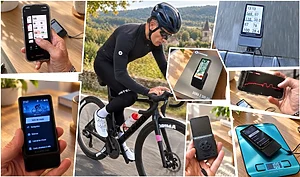
The Elemnt Roam is Wahoo’s top-of-the-range bike computer/GPS, available in their catalog for several years now, with its super easy-to-use interface and very simple buttons. This latest version, launched in late 2022 and updated in recent weeks, benefits from several improvements such as a screen with more colors, a more powerful dual-band GPS chip, a USB-C charging port, and some interesting new features. It is a very credible alternative to Garmin bike computers.
By Guillaume Judas – Photos: ©3bikes.fr / ©Wahoo

The philosophy behind Wahoo bike computers/GPS units is based on a certain form of ease of use, and it can be said that the Elemnt Roam succeeds rather well in its mission despite its many features. Unlike its competitor Garmin, Wahoo has not succumbed to the siren call of the touchscreen and retains buttons (six in total) on the left and right sides and on the front face. It must be acknowledged that when used in difficult conditions (rain, cold, splashes, mud…), it is much simpler than having to tap on a screen, especially since on this latest version the buttons on the front face are now convex and not concave as before. Access to the various functions is also very easy to integrate.

Finally, the bike computer is connected to a smartphone application that is also very intuitive and powerful. It is through this application that you can customize the different pages of the bike computer to choose the elements you want to display. It is also via this application that you download ride summaries, which are instantly found on Strava or any other previously chosen platform. Communication between the bike computer and the application is very fast and has never failed for me, which is not always the case with Garmin Connect.

A direct consequence of this non-touch screen is the size of the Elemnt Roam, slightly larger than the Garmin Edge 840, for a screen of roughly equivalent size (2.7” vs 2.6”). The weight of the Wahoo is also higher, verified at 99 g vs 81 g for the Garmin. On the other hand, Wahoo claims that the Elemnt Roam has an aerodynamic design, and that its shape saves a few watts compared to other bike computers. Given its front profile and its perfect integration with its mount, we are willing to take their word for it. Note that the stem mount is attached with zip ties, which is not practical if you use several bikes.

=> SEE ALSO: Buy the Wahoo Elemnt Roam V2 on sale for €349.99
In the Wahoo range, there are only two bike computers/GPS units. The Elemnt Bolt, sold at €279, and the Elemnt Roam, sold at €399. The difference between the two models mainly lies in size (the Bolt is smaller) and storage capacity for embedded mapping. And just like the second generation of the Elemnt Bolt that we had already tested, the new Elemnt Roam benefits from several interesting updates:
- a dual-band GPS for better performance in difficult environments
- a 64-color screen (compared to 16 previously), with high contrast for always very good visibility
- a USB-C charging port (for very fast charging)
- convex buttons
- Summit Freeride and Summit Segments functions similar to Garmin’s ClimbPro, which indicate at the foot of a climb its duration, percentage and gradient variations, as well as a predictable time, whether for a Strava segment, on a programmed route, or even on a free ride when the bike computer recognizes the proximity of a hill
- 32 GB storage capacity, for using maps from all over the world
- Wahoo SYSTM structured workout synchronization
- Supersapiens technology support for those monitoring their blood glucose

The essentials of the Elemnt Roam V2
The Elemnt Roam V2 retains the main features of the first version, namely ANT+ and Bluetooth Smart connectivity for many types of sensors, even those from competing brands, such as Garmin Rally power meter pedals, a Garmin Varia radar, and a Polar H10 heart rate sensor for me. The bike computer can also connect with Sram, Campagnolo, and Shimano electronic drivetrains, with the ability to change bike computer pages by pressing the hidden buttons on the Japanese brand’s hoods.
Again, I appreciated how easily the bike computer recognizes the different sensors to connect. It’s simple and fast, and this can be easily verified thanks to the new Ready to Ride function launched in one of the latest system updates. This is a new menu at the start of the bike computer that offers quick and intuitive access to all frequently needed functions before a ride, such as sensor connection status, route loading, and battery status.
The user interface remains the same as the first version, with just as much simplicity. Through the application, it is possible to configure the desired number of screens, with up to eleven data points on each. This configuration is instantly sent to the bike computer via Bluetooth. Each screen on the bike computer has a zoom function by pressing one of the buttons on the right side, which allows you to progressively display the most important data, in order of preference when they have been previously ranked. I mainly used this function with mapping, as it allows you to zoom in or out on the map easily and quickly, which is not as simple when riding with the touchscreen of a Garmin 830 or 840.

The Elemnt Roam also has two rows of flashing LEDs, on the left and top sides. They serve as indications accompanied by an audible signal in GPS guidance mode, or to relay information from the rear radar. But they can also be customized via the application to indicate an intensity level in power or heart rate, for example. Practical for those following a GPS track but wanting to continue to gauge their effort level! Note also that on any page of the bike computer, it is possible to assign a background color to heart rate or power, depending on your intensity zones. I really like this function, which allows me to quickly visualize which heart zone I am in (blue, green, yellow, orange or red) at a glance.

To return to the buttons, the one on the left side allows you to turn the bike computer on and off with a long press, or to go back in a menu with a short press. The three buttons on the front face allow you to start an activity, pause or end it, start a lap time, or change pages. It’s always very clear and it’s almost impossible to make a mistake. Unlike Garmin, however, you can only scroll through pages in one direction. I usually ride with six different pages (general, elevation, map, power, segments, lap). So I have to press the button six times in a row to return to the main page.
Regarding the structured workouts offered by the Elemnt Roam, TrainerRoad, TrainingPeaks, and Today’s Plan are fully integrated into the bike computer. It is possible to view a training plan, follow it, and automatically send the data back to the various applications. On a Wahoo Kickr indoor trainer, the resistance is automatically modified to match the target power of each interval. These are functions that I have not tested and do not usually use.

The announced battery life remains 17 hours, as on the previous version. This seems entirely realistic given my usage. The new USB-C port offers several advantages: very fast charging (possible even during a ride for long-distance enthusiasts, for example, without losing too much time) and the universality of this type of port, which is found on more and more devices. This means you only need to carry one charging cable.
Among other important features, note the presence of a screen covered with Gorilla Glass for durability and to limit scratches. I can confirm the excellent aesthetic condition of the bike computer after six weeks of use, often in very difficult conditions.

Less feature-rich than Garmin?
The Wahoo Elemnt Roam is less expensive than the Garmin Edge 840, which is roughly equivalent in size. But besides the touchscreen and (partial) solar charging of the top-of-the-range Garmin version, the latter also offers a few more features, some of which may be considered more or less essential by cycling geeks. For example, the Garmin offers a VO2 max estimate after each ride (provided you ride with a power meter), an estimate of recovery time, energy level, and even hydration needs. These are all functions not offered by the Wahoo. Regarding mapping, I noticed a small difference in accuracy on gravel rides, with more trails indicated on the Garmin map than on the Wahoo. However, I did not see any significant difference for road use.
Following a route with the Elemnt Roam
This latest version of the Elemnt Roam benefits from a hardware upgrade with the introduction of a dual-band GPS, for improved performance. However, I noticed that the bike computer could take a very long time to acquire a GPS signal at the start of a ride. I live in the city, and sometimes I have to wait almost three minutes for my track to be recorded. In another region, by the sea and with a clear horizon, acquisition only takes about thirty seconds, but that’s still longer than with a Garmin 840. The fact remains that once the signal is acquired, it doesn’t move. And by zooming in on the activity maps, the track is quite clean. Finally, in six weeks I haven’t experienced a single bug, whether during activity or on return, or even when connecting with the Wahoo application. I find the system ultimately more reliable than the one offered by Garmin.

To follow a route, it’s very easy to integrate a course from a platform like Strava. Simply create a course, save it, and it’s automatically synchronized with the Wahoo app and sent to the bike computer within seconds. Of course, it’s also possible to create a route from a file, a previous course, return to the starting point, or place a location on the map. But in the latter case, you have to use your smartphone, as it’s not possible to enter an address directly on the bike computer, for example.

The guidance mode is clear and quite effective on the road. The screen colors facilitate visibility while riding, regardless of the weather. And if you take the wrong road or choose a detour, the bike computer recalculates a new route to get you back on track. Changes of direction are indicated on the map with a succession of small chevrons, and the distance to the next intersection is constantly displayed. In short, on the road, I see no difference in performance in guidance mode with the Garmin 840. Things get a little more complicated when venturing off-road, with less precise mapping than the Garmin. It also seems to me that in certain very wooded conditions, the Elemnt is a tiny bit slower. And since fewer paths are displayed, navigation is not as effective as it should be. In these conditions, the Elemnt Roam seems closer to a Garmin 830, with which I have already experienced this kind of hesitation on certain Gravel routes.
Where the Wahoo is far superior to the Garmin, however, is in elevation calculation. Even today, none of the Garmin bike computers can handle rainy rides. At some point, the bike computer stops calculating positive elevation, and when uploading the ride to Garmin Connect, Strava, or any other platform, terrain variations disappear from the profile. None of this with the Wahoo, which can be very slightly optimistic in bad conditions, but only by a few percent.

Finally, the Summit Freeride function is on par with the competition. It brings a real plus to using the bike computer, especially in unfamiliar terrain. And it’s not necessary to have downloaded a GPS track to benefit from it, as the device indicates the proximity of a climb wherever you are. As with Hammerhead or Garmin, one can always discuss the judiciousness of choosing certain climbs or their starting point and summit, but overall the function works well by providing interesting indications to know where you are going.
User-friendliness and simplicity on the agenda
Ultimately, I really appreciated this latest generation Wahoo Elemnt Roam bike computer/GPS, even if it’s not perfect. The brand has corrected some of the flaws of the first version and added new functions. I like the simplicity of the interface and the convenience of the buttons in the middle of winter compared to a touchscreen. I like the beauty of its screen, the color nuances, and its readability. And I love its super-efficient connectivity, whether with third-party devices or the Wahoo application, which is also simple, practical, and effective.
Of course, it lacks some functions that will seem essential to some users. But Wahoo has deliberately chosen to focus on the essentials. However, I didn’t even want to test everything, especially the training programs, which shows that it’s unnecessary to be too greedy. The only area where Wahoo will still need to improve is the responsiveness of the GPS, at the time of signal acquisition, and in certain difficult environments, where the Elemnt Roam seems a bit too slow to me. However, we can hope for some improvements with future system updates.
=> SEE ALSO: Buy the Wahoo Elemnt Roam V2 on sale for €349.99
The WAHOO ELEMNT ROAM V2 in brief… Pros: interface, ease of use, user-friendliness, buttons, color screen, accurate elevation calculation Main features: Dimensions: 58.4x89x17.8 mm – 6.9 cm (2.7”) screen – 64-color screen with Gorilla Glass – Ambient light sensor – Dual-band GPS with extended navigation functions – Preloaded maps for North America, Europe, Asia, Oceania, and South America – Satellites: GPS, Glonass, BeiDou, Galileo, and QZSS – Connectivity: Bluetooth, ANT+, Wi-Fi, and ANTI+ FE-C Control – Quicklook LEDs (2 rows) – Battery life: 17 hours – Mounts included: out-front and stem – iOS and Android compatibility – Elemnt Companion App – Strava Live Segments – Summit Freeride and Summit Segments functions – Software integration (Strava, Best Bike, Split, Komoot, Ride With GPS…) – Notifications, calls, and SMS – Live tracking – Kickr indoor trainer control – Weight: 99 g – Price: €399.99 Contact: wahoofitness.com |
=> SEE ALSO : All our Test articles
Share the post "Wahoo Elemnt Roam V2 GPS Bike Computer Review"