Share the post "Drivetrain and tire evolution: how to calculate your gear ratios?"
Gear ratios have always led to passionate discussions among cyclists. With the almost universal adoption of 12-speed cassettes on most recent drivetrains, we might have thought everything would be even simpler. But that’s without considering the paradigm shift from two of the three main groupset brands, which now offer cranksets with smaller chainrings, and the increase in tire size on modern bikes. To help you navigate this, here’s how to calculate and choose the gear range that suits you.
By Guillaume Judas – Photos: ©Cervélo / depositphotos.com
In less than 40 years, we’ve gone from five to 12 cogs at the rear on most drivetrains. Talking about “speeds” as we all do is actually a misnomer, since the number of cogs on the wheel is associated with the number of chainrings on the crankset. The six-speed freewheel dates back to the early 80s, then we moved to seven cogs before the 90s, eight cogs around 1992-1993, nine cogs in 1996-1997, ten cogs in the early 2000s, and 11 cogs just before 2010. And it was a little less than ten years later that 12-speed drivetrains (more often called “12-speed”) appeared, before gradually becoming widespread at almost all price points. Two single-chainring groupsets are even available today with 13 cogs (Rotor and Campagnolo Ekar), but these are more for gravel use.
=> SEE ALSO: 2023/2024 Road and Gravel Groupset Prices and Weights
Until the late 2000s, the three main drivetrain brands (Shimano, Campagnolo, and Sram – only on the road market since the mid-2000s) offered numerous cassette options, several chainring options (even if the concept of compact chainrings is only about twenty years old), and above all, there were many equipment manufacturers who offered compatible chainrings, so that a custom gear combination could be set up, depending on the terrain, habits, or level of each rider.
Gear ratio, ratio, development, speeds: what are we talking about?
|
With 11-speed and even more so with 12-speed cassettes, manufacturers have primarily sought to make drivetrains increasingly versatile, capable of taking you on flat terrain as well as in high mountains. Adding extra cogs has allowed for an extended gear range on a single cassette, but at the expense of some comfort for those who ride all year in a specific region and never use all the cogs offered. By optimizing the shifting speed of their entire drivetrains, manufacturers have also progressively limited the number of compatible third-party chainrings, thus locking users into a kind of ecosystem from which it is difficult to escape.
=> SEE ALSO: All About Shimano Di2
At Shimano, for example, there is no 12-speed cassette with a large cog smaller than 30 teeth. Someone who lives on flat terrain and is properly trained therefore never uses the last two or even three cogs on their 12-speed cassette, or they keep the large chainring on all the time and never shift to the small one.
=> SEE ALSO: Long-term Test of the Shimano Dura-Ace Di2 12-speed Groupset
At Sram, there is a cassette with a large cog of 26 teeth (in addition to cassettes with a maximum of 28, 30, 33, or 36 teeth), but this is necessarily associated, like all Sram cassettes, with a small cog of 10 teeth and smaller chainrings than with Shimano. The 10-tooth cog extends the gear range, but the difference in development with the 11-tooth cog is such that shifting between the two is not always very comfortable. Depending on the size of the front chainring, the difference in development is about one meter per pedal stroke between the 11 and the 10, whereas it is only about 80 centimeters between the 12 and the 11. Such a difference in development between two cogs is comparable to what one feels when shifting from 15 to 17 teeth or from 17 to 15 on the cassette with the large chainring.
=> SEE ALSO: Sram Red AXS Groupset Test
Finally, Campagnolo with its new Super Record WRL groupset offers a well-spaced cassette from 10 to 25 teeth (in addition to 10-27 and 10-29), but again with a 10-tooth cog and smaller chainrings than we’ve known until now.
=> SEE ALSO: Test of the New Campagnolo Super Record WRL Groupset
Obviously, for most novice cyclists or those who simply ride for leisure, this increased versatility is an advantage. They are content with the drivetrain offered on the bike at the time of purchase, and they don’t ask questions. The bike is suitable for Sunday rides, and also for an occasional mountain getaway once a year, without changing anything. For those aiming for performance, adaptation is sometimes necessary. But the most frustrating thing is undoubtedly having so many possibilities with increasingly high-performance drivetrains, without using all the available gears.
Increasingly larger tires
Added to all this are changes in habits regarding tire size. Again, a brief look back is necessary. In the 80s, people rode with 19 or 20 mm tubulars. The 23 mm became popular from the mid-90s, remaining the reference for a very long time, at least until the early 2010s. Then the 25 mm appeared, first for comfort, then for efficiency, along with the phenomenal evolution we’ve seen in a few years in tire efficiency, then tubeless, which have almost completely dethroned tubulars, even among professional racers. The 28 mm section eventually became the norm since the generalization of disc brakes, to offer more grip on the road during braking. But we also see 30, 32, or even 35 mm for those seeking endurance and comfort, with tires that allow them to occasionally venture off paved roads.
What are the consequences in terms of gear ratios? While modern road rims still have the same circumference (700c or 28”), their widening allows for the use of larger tires, which increases the total wheel circumference, and thus the development. For each pedal stroke with a defined ratio, you go further with larger tires.
Calculating gear ratio equivalence
It is therefore possible to easily compare gear ratios with each other, regardless of the cassette used, and regardless of the chainrings, provided it is done with the same tire size. To do this, simply divide the number of teeth on the chainring by the number of teeth on the cassette. This gives us a ratio, which then allows us to compare the different combinations.
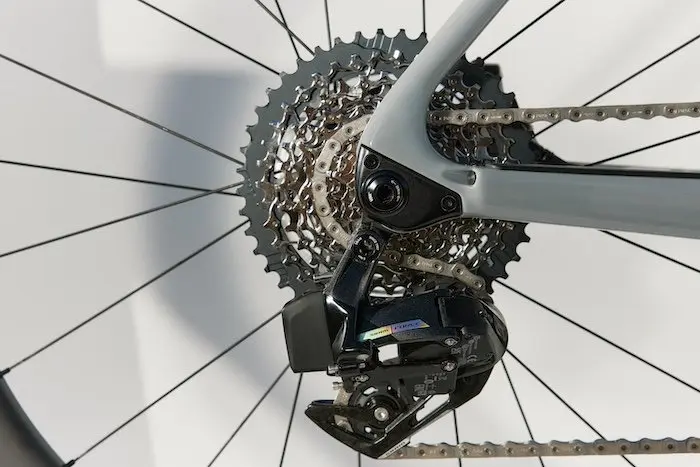
Example: 50/10 (with Sram or Campagnolo) = 5:1. To have the same 5:1 ratio with Shimano, you need a 55/11. At the other end of a gear range, a 36/36, a 34/34, or a 30/30 are always equivalent to a 1:1 ratio. This means that in this case, one pedal stroke equals one rear wheel revolution.
These are extreme developments, but you can apply these calculations to the entire range of gear ratios offered by your drivetrain, which can be useful, for example, if you switch from the chainring combinations offered by Shimano to those of Sram or Campagnolo, or vice versa.
To compare the influence of tire sizes
If you want to compare developments with different tire sizes, you need to perform a more complex calculation that takes into account the circumference of the complete wheel. And there, you might be surprised.
Circumference of a complete wheel depending on tire size
|
To calculate an exact development, you must therefore repeat the same operation as before by dividing the number of teeth on the crankset by the number of teeth on the cog, but multiplying by the circumference of the complete wheel. For a 53/11 gear ratio, for example, the development is 10.28 m – (53/11)x2.135 – per pedal stroke with a 25 mm tire, and 10.45 m with a 32 mm tire. This is approximately like shifting to a 54/11 (to within 3 cm) with your 25 mm tire. And this obviously applies to the entire range of gear ratios. Fortunately, the smaller the ratio, the less important the influence of the wheel’s circumference. For the famous 1:1 ratio, which allows one pedal stroke for one rear wheel revolution and is dear to high-mountain touring cyclists or gravel riders, the actual difference in development between a 25 mm section tire and a 40 mm tire is only 6.5 cm.
The overall increase in tire size used on modern bikes therefore has less influence on our habits than the evolution of the proposed tooth combinations. However, it remains easy to compare gear ranges to choose the one that best suits you.
=> SEE ALSO: All our Feature Articles
Share the post "Drivetrain and tire evolution: how to calculate your gear ratios?"