Share the post "Review of the Giant Propel Advanced Pro 1"
Aerodynamic, stiff, stable, and easy to handle, the Giant Propel Advanced Pro 1 stands out for its attractive price-to-specs ratio, even if it’s a bit heavy on the scale. How does it really stack up in terms of performance?
By Guillaume Judas – Photos: ©Vincent Lyky

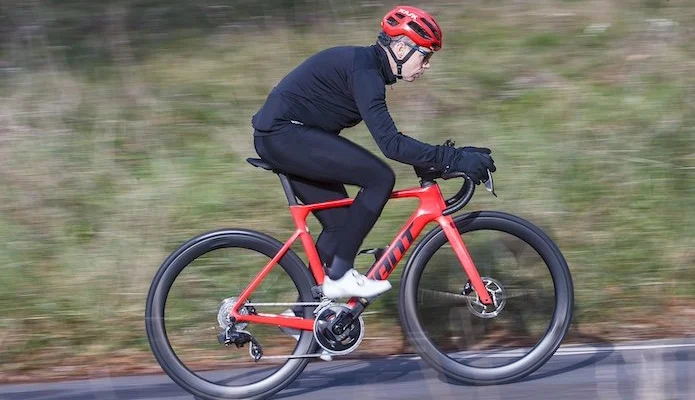
With its massive, tapered tubes, the Giant Propel Advanced Pro 1 exudes efficiency on the road. Even though it seems less extreme than the previous version it replaced in 2022, at no point can you imagine it giving way under the relentless attacks of the most athletic riders. This is a characteristic that becomes evident from the very first ride. The bike is stiff, but also exceptionally stable regardless of speed or terrain. And, surprisingly, comfort isn’t left behind. It’s a performance-oriented bike, though this version proves to be a bit demanding due to its weight, which is slightly above average.

As the aero-focused model in the Giant lineup, the Propel is available in three trim levels for the frame kit: Advanced for the entry-level model (starting at €3,000 for the complete bike), Advanced Pro—like the mid-range model tested here—featuring higher-grade carbon fiber (starting at €5,600 for this bike with SRAM Rival AXS and carbon wheels), and Advanced SL for the top-of-the-line version ridden by the pros on Team Jayco AlUla, which is one of the lightest aerodynamic bikes in the World Tour peloton (starting at €9,200).
The Advanced Pro itself comes in three trim levels:
- Advanced Pro 1 with SRAM Rival AXS at €5,600
- Advanced Pro 0 Di2 with Shimano Ultegra Di2 at €6,500
- Advanced Pro 0 AXS with SRAM Force AXS for €6,900
All three models come equipped with Giant SLR 1 wheels featuring a 50 mm rim height, as well as the same Giant Gavia Course tires, the same Giant Feel SL saddle, and the same Giant Connect SL handlebar and stem. The only difference is the groupset. And although it performs flawlessly compared to the brand’s higher-end groupsets, the SRAM Rival AXS weighs about 215 g more than the SRAM Force and 330 g more than the Shimano Ultegra. As a result, weighing in at 8.3 kg on the scale without pedals or bottle cages in size S, the Advanced Pro 1 is far from being a lightweight. Fully loaded, with water bottles, a repair kit, and a computer, the bike easily approaches 10 kg.

But it would be a mistake to reduce the Giant Propel Advanced Pro 1 solely to its weight. First, because it features a drivetrain that offers all the functionality you’d expect from a modern drivetrain, with 12 speeds, electronic and wireless shifting, and hydraulic disc brakes. And it’s even fair to say that in terms of speed, smoothness, and precision, the SRAM Rival AXS is on par with the Force and Red groupsets that sit above it in the lineup.
Second, the Propel offers full integration of the brake lines into the frame and head tube, along with a well-designed cockpit featuring an adjustable handlebar and stem. It’s beautifully executed; there’s hardly anything sticking out, and the system remains practical to use, especially for adjusting your riding position. Overall, the bike’s finish deserves nothing but praise.

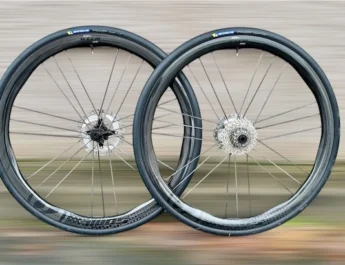
Finally, even though this new Propel seems to have slightly more conventional tube shapes than its predecessor, it benefits from truncated profiles that are just as—if not more—aerodynamically efficient, while offering less crosswind drag and lower weight. According to Giant, the gain is approximately 6 watts at 40 km/h for the entire bike compared to the previous Propel. Even though it’s a mid-range model, this Propel Advanced Pro 1 comes equipped with 50-mm tubeless carbon rims (for aerodynamics) without rim hooks, along with the matching tires. Once again, the bike benefits from the latest trends in technology—which Giant seems to have mastered perfectly, as demonstrated by the Gavia tires that can be inflated to around 6 bar despite the absence of hooks on the rim. The result is a perfect fit with the rim walls, optimizing the wheels’ aerodynamics and stability—a combination that’s very hard to fault.

Comfort and Handling
At €5,600, this Giant Advanced Pro 1 proves to be an attractive option given its advanced technology and accessible handling. Unlike some competing aerodynamic road bikes, the Giant Propel remains agile, with crisp and precise steering combined with the stability I mentioned earlier. The bike is easy to handle, even on a very windy day. Lane changes are precise, and the bike’s handling is reassuring. It doesn’t veer off course despite strong crosswinds, and weaving through city traffic is never a problem in terms of responsiveness. The steering feels just a tiny bit heavy due to the high stiffness of the bike’s front end and the considerable weight of the handlebars and brake levers positioned directly above the front wheel. But input at the handlebars is quickly translated into action, always giving you the feeling that you know exactly where the wheel is positioned.

The most surprising aspect is the bike’s ride comfort, with tires that hum softly on the pavement and fairly thin seatstays that seem to absorb some of the vibrations you might feel on rough pavement. The Propel doesn’t shake excessively and is quite pleasant to ride, even after several hours on the road. Thanks to its weight, it doesn’t bounce and always feels firmly planted on its two wheels, offering solid traction even on the slippery roads of this particularly wet fall. The only annoyance (or perhaps not) that might disrupt this bike’s smooth ride comes from the noise of the freewheel body, which is really, really noticeable as soon as you stop pedaling for a few moments.

An easy-to-adjust riding position
The Propel shares the same riding position dimensions as the TCR, the brand’s lighter and more versatile model. This makes it possible to use the same settings on both bikes, even though the Propel has a much less sloping top tube, which is straighter.

Despite the integrated brake hoses, adjusting the position is fairly easy—partly thanks to the handlebar that’s adjustable inside the stem, and partly thanks to the spacers located under the stem, which consist of two interlocking parts. This makes it possible to raise or lower the handlebar setup without completely removing the stem from the fork steerer tube—and, of course, without having to disconnect the brake hoses. You can also change the stem easily. These same hoses run in front of the D-shaped fork steerer tube, which also makes it impossible to mount the stem at an angle relative to the front wheel. It is therefore always aligned with the axis.

Remarkable in-house components
The bike comes with a power meter integrated into the crankset, which is yet another impressive feature given its price. Giant offers its own Power Halo sensor, located in the crank spider, which measures left/right balance and boasts an accuracy of +/-1.5%. I wasn’t entirely convinced by this sensor, which gave me readings that weren’t really consistent despite calibrating it on my bike computer before every ride. But to be honest, I didn’t take the time to dig into the dedicated Giant RideLink app to see if there were any updates to install or a specific calibration procedure, since that wasn’t the focus of this bike test. Nevertheless, this is something to look into further in the future.

In addition to the positioning components (saddle, seatpost, stem, and handlebars), the Propel is also equipped with Giant wheels and tires that stand out not only for their stability but also for their comfort and traction. Listed as 700×25, the Gavia tubeless tires actually have a 28-mm width on the SLR 1 50 Carbon Disc wheels. They certainly aren’t the lightest or highest-performing on the market, but paired with the 1,600-gram Giant wheels, they form a well-balanced package for this price point, with a rim and tire profile that seems ideal for controlling the bike’s unwanted movements. When it comes to tackling the wind—whether head-on, from the side, or from behind—the brand clearly knows its stuff.
For those who love to push the limits:
Stiff, stable, and precise, the Propel Advanced Pro 1 still can’t quite make you forget its weight on the road, which holds it back during accelerations and changes in pace on hills. Of course, it’s all a matter of perspective, but the difference is clearly noticeable compared to a bike that’s a good kilo and a half lighter—the kind found in the top-of-the-line models from most brands. This is hardly surprising, but it’s something to keep in mind.

In the same price range, the Giant is 300 g heavier, for example, than the Girs Solo or the Canyon Aeroad—to cite two bikes I’ve recently tested. If we compare the Giant to the Canyon—since both are equipped with the same groupset, aero carbon wheels, and a frame designed to slice through the air—I find the Giant to be a bit stiffer and perhaps ultimately a bit more demanding, even though it’s easier to handle. But both bikes share the same goal: to offer a high-performance bike under certain conditions at a “reasonable” price. The Giant Propel Advanced Pro 1 is therefore aimed at athletic riders, triathletes, and those who are used to pushing their bikes hard by shifting into higher gears. It isn’t necessarily suited for criteriums, climbs, or any sections where you need to change pace. But it impresses with its comfort, stability, and build quality.

Overall, the Giant Propel Advanced Pro 1 is an attractive option for anyone looking for a bike that’s safe, reliable, comfortable, and reassuring to ride. To get the most out of it, however, you’ll need to have a few extra watts in reserve—and, above all, ride it in relatively flat terrain.
The Giant Propel Advanced Pro 1 at a glance… Pros: stiffness, stability, handling, comfort, wheels Frame: Advanced-grade composite Disc – Fork: Advanced SL-grade composite Disc – Stem: Giant Contact SL Aero – Handlebar: Giant Contact SL Aero – Brakes: SRAM Rival hydraulic 160/140 mm – Front derailleur: SRAM Rival AXS 12-speed – Rear derailleur: SRAM Rival AXS 12-speed – Shifters: SRAM Rival AXS 12-speed – Cassette: SRAM Rival 10-30 – Chain: SRAM Rival AXS 12-speed – Crankset: SRAM Rival AXS 12-speed 48-35 (with Giant Power Halo power meter) – Wheels: Giant SLR 1 50 Carbon Disc 50 mm – Tires: Giant Gavia Course 1 700×25 tubeless – Saddle: Giant Fleet SL – Seatpost: Giant Vector – Weight: 8.3 kg in size S without pedals – Number of sizes: 6 – Price: €5,600
Contact: www.giant-bicycles.com |

=> SEE ALSO: All our Test Articles
Share the post "Review of the Giant Propel Advanced Pro 1"