Share the post "Zwift Hub One indoor trainer review: compatible with (almost) all bikes"
Barely a year after the launch of the Zwift Hub indoor trainer, the American brand is introducing the Hub One version, with a drivetrain system compatible with almost all bikes on the market. The device can thus be easily shared between several bikes or several family members, and it is sold for €599 with a one-year subscription to the Zwift app for indoor training. Let’s review the improvements made to one of the most interesting indoor trainers on the market, easy to install, stable, quiet, and more accurate than the first version.
By Guillaume Judas – Photos: ©3bikes.fr
Zwift is a virtual training application that really became popular in 2020 during the first lockdown, as it combines physical conditioning with a social experience. But Zwift also has its work cut out for it with competition that is not letting up the pressure in terms of virtual courses offered or immersive sensations, such as Bkool, Trainer Road, Wahoo Systm, RGT, Kinomap or Rouvy for example. Far from resting on its laurels, the Californian company is choosing to open up to a larger number of users to remain the market leader, first by multiplying the organization of virtual events (races, gatherings, group training, challenges), then by offering an easy installation with a branded indoor trainer and now a very wide compatibility.
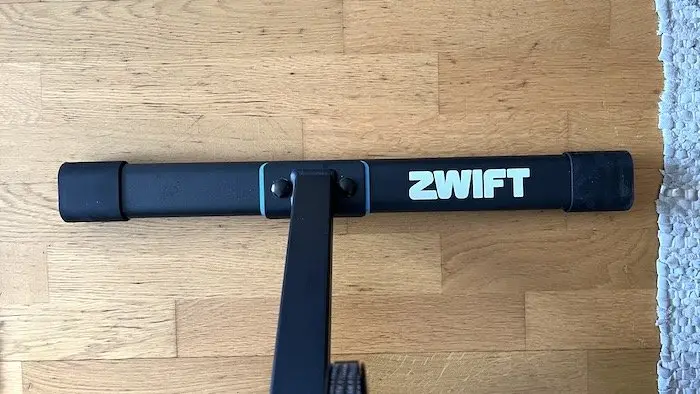
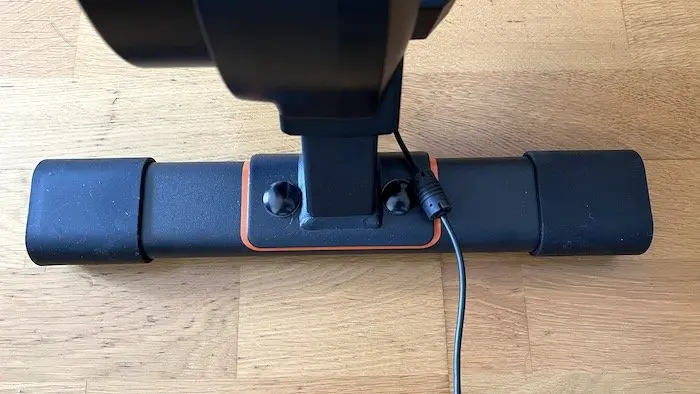
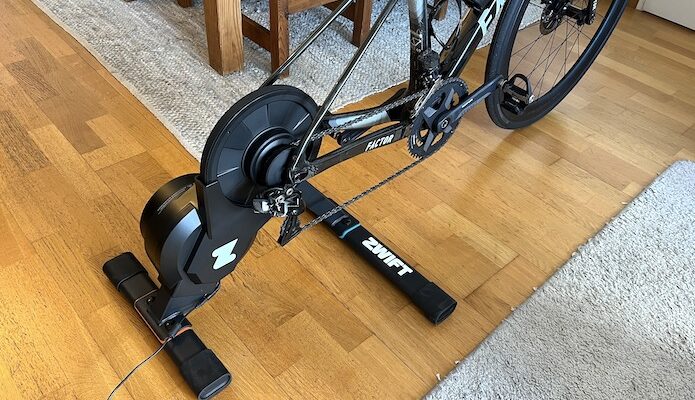
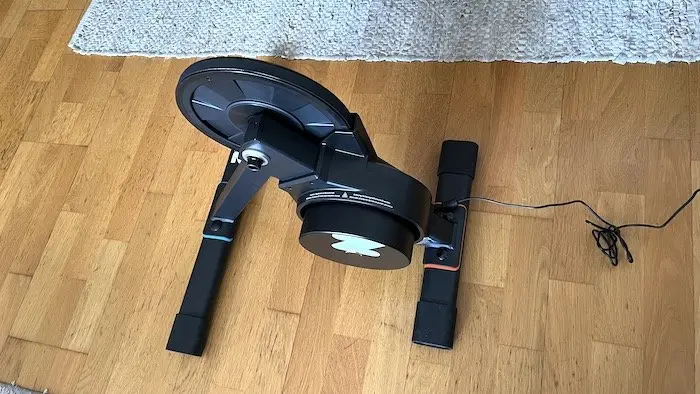
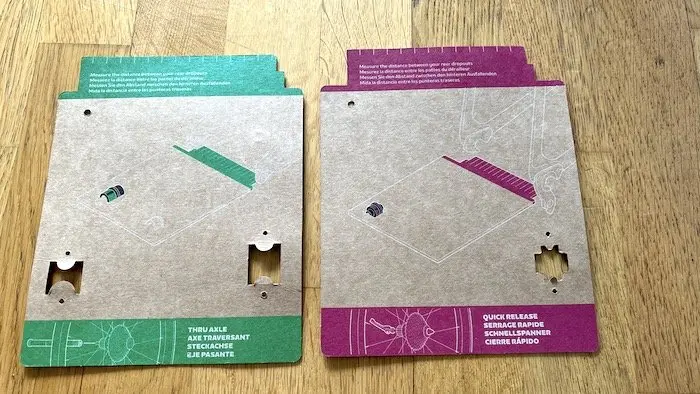
During our Zwift Hub review published at the very beginning of the year, we had already highlighted the extreme simplicity of installing the device once it was received. Well, easy, that remains relative given the weight of the product, at 16.5 kg once unpacked, and its lack of a handle, which makes moving it around the house or apartment quite a workout. Nevertheless, the Hub comes with two easy-to-assemble feet, a pre-installed cassette (the number of speeds depends on your prior order) and a cardboard template system to correctly identify the rear wheel spacing of the bike and thus the necessary adapters for attachment, since the Hub is a direct-drive indoor trainer that therefore takes the place of the rear wheel. Connecting to the Zwift application is then super easy and intuitive, if you have the minimum useful equipment (computer, tablet, smartphone or Apple TV) to run the software and communicate with the device.
Compatibility with almost all bikes
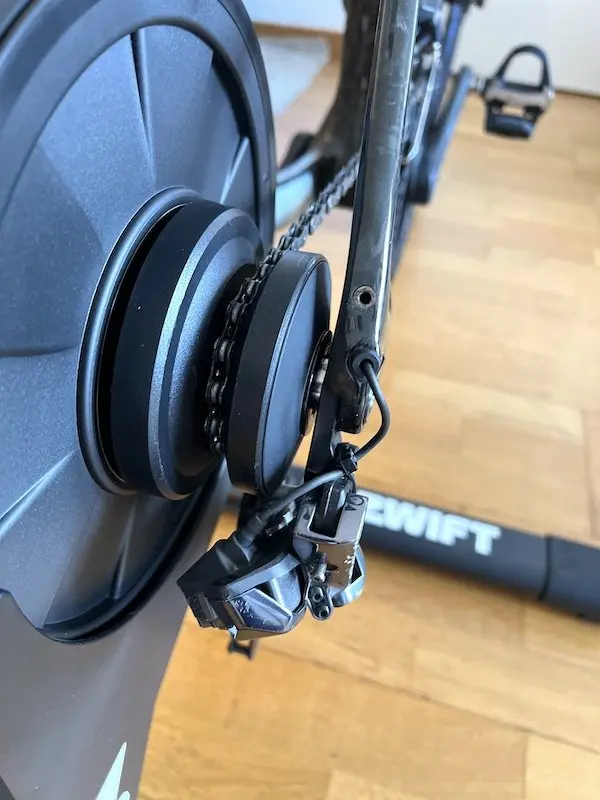
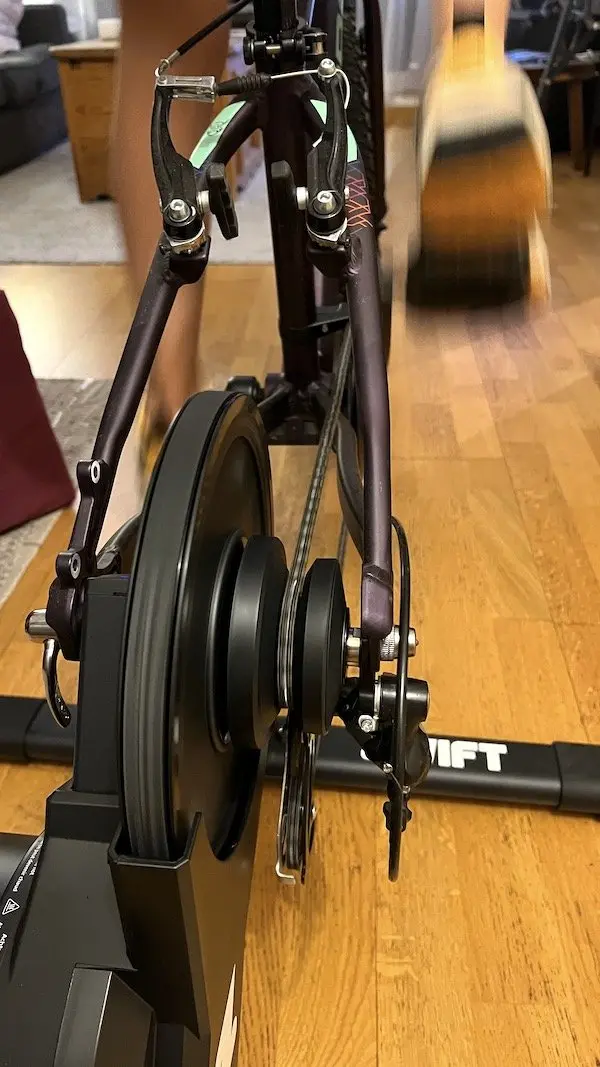
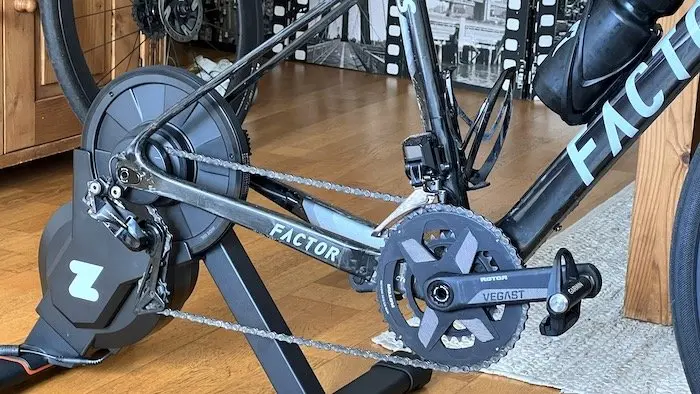
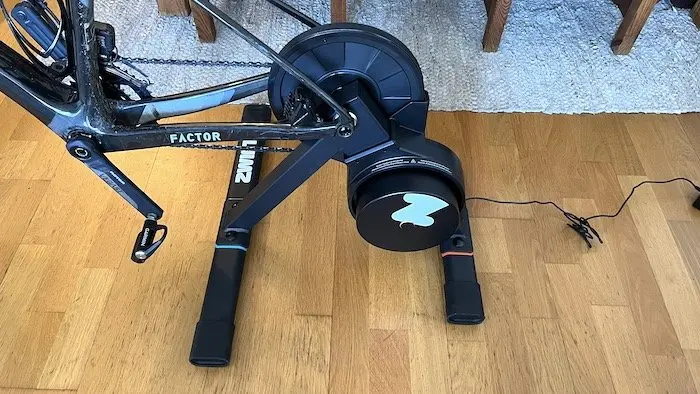
This new Hub One version is actually the same device, but with a single-cog system called Zwift Cog instead of the 8, 9, 10, 11 or 12-speed cassette. This 14-tooth cog with sharp, very thin teeth is placed approximately in the middle of the cassette’s designated location, ensuring a very good chainline with the large chainring of the crankset for a traditional road bike. It is surrounded by two plastic cones that prevent any derailment or chain skip. When installing the bike, simply adjust the rear derailleur to roughly the middle of the drivetrain, and possibly fine-tune it to achieve ideal alignment on the cog, regardless of the bike’s number of speeds. And all this for a particularly quiet operation.
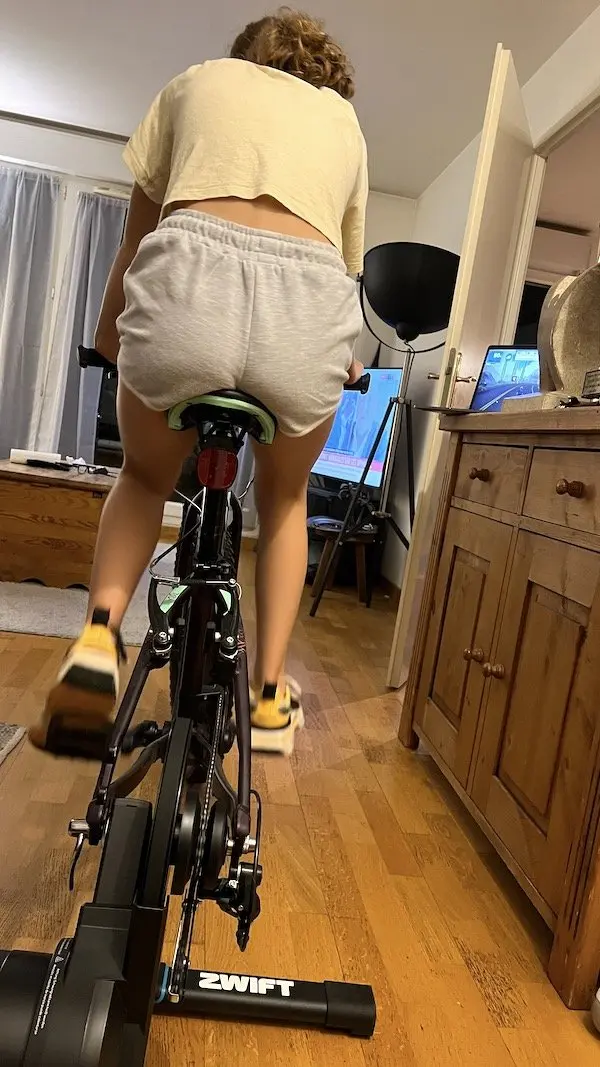
This innovation makes the Zwift Hub One compatible with almost all bikes equipped with a derailleur, and even some fixed-gear bikes, except track bikes with a 1/8” wide chain. On our end, we tested the Hub One with a 12-speed drivetrain, an 11-speed, and even with a 24” mountain bike and a 7-speed drivetrain without the slightest problem. This allows a pre-teen child to try Zwift right after their parents’ workout, on the same device, and with the bike they use to go to school.
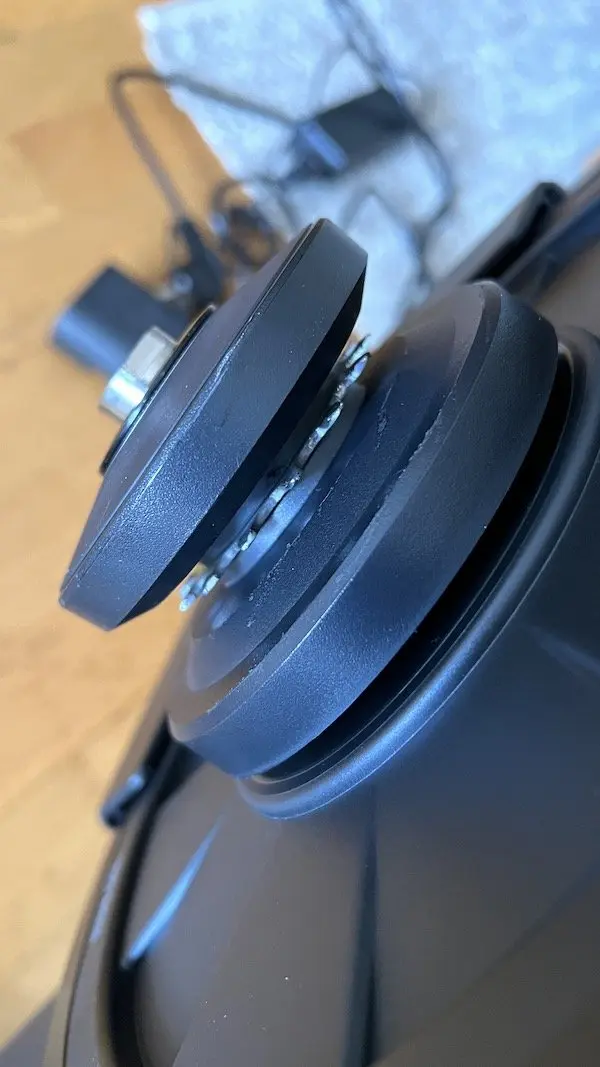
And quite surprisingly but not without interest, the Zwift Cog system is available individually for €79.99 (currently €59.99), to upgrade a previously purchased Zwift Hub. An affordable price, just like the complete indoor trainer, sold for €599, including a one-year Zwift subscription. The app subscription is then €14.99 per month, but without commitment, which allows you to unsubscribe during the summer, for example, before re-subscribing for intensive use during the winter. Finally, note that a child’s subscription up to 16 years old is free.
Virtual gear changes
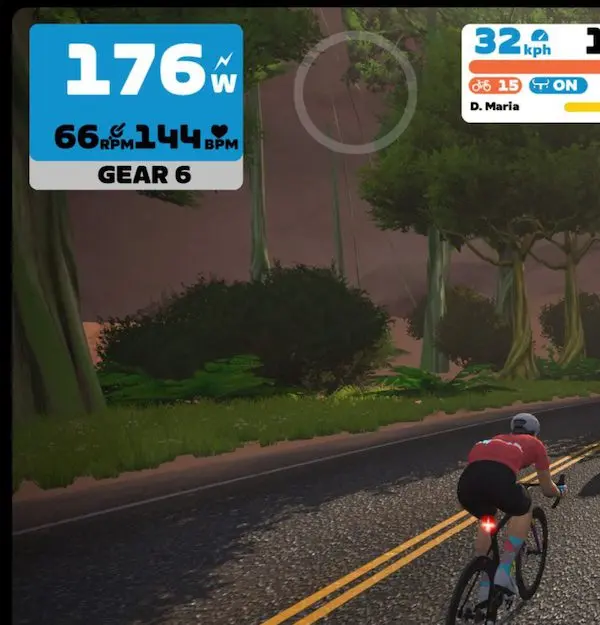
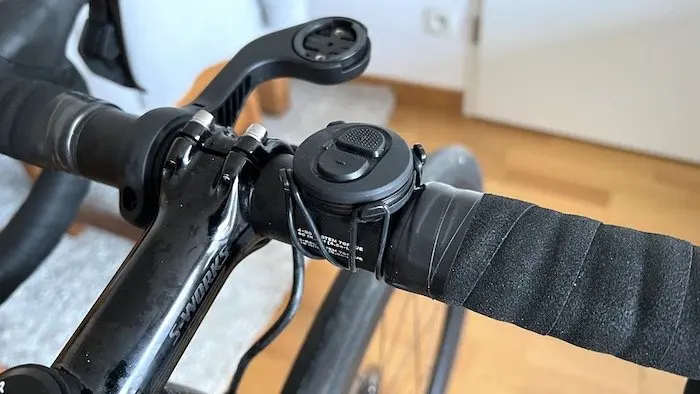
On the Zwift Hub One indoor trainer, it is therefore no longer possible to use the rear derailleur of the bike installed on the device. But to change gears in the application, Zwift associates a small wireless device called Zwift Click which can be easily positioned anywhere on the cockpit, with an elastic system, much like a Garmin bike computer mount. This device has two buttons, “+” and “-“, which allow you to change gears, from “Gear 1” (gear 1) to “Gear 24” (gear 24) in a very progressive manner, just like a very sophisticated smart trainer would. The gear number is indicated in the upper left of the application, below watts and heart rate, once the Zwift Click is connected. For comparison, for a base training session at a relatively comfortable pace on the flats in the application, I rode with gears 15, 16, and 17, which correspond approximately to gear ratios of 52/17-19-21. With gear 24, I felt like I was riding with a larger gear than the 52/11 on my usual indoor trainer, and with gear 1 I was able to ride at 6 km/h uphill while spinning my legs at 70 revolutions per minute without getting tired. At the beginning of each activity, the Hub One calculates the actual gear ratio of the bike used from the cadence and flywheel speed.
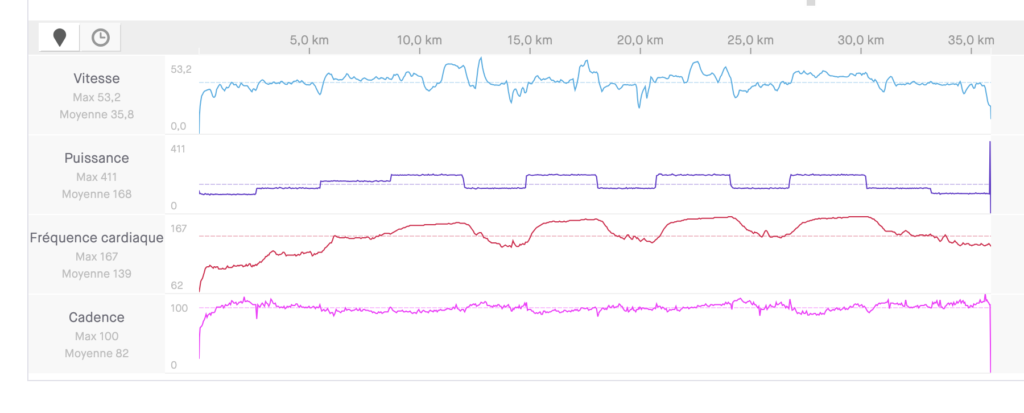
The Zwift Click does not communicate directly with the indoor trainer, but with the application, which in turn sends the information to the device. As a result, the indoor trainer with the Zwift Cog is not compatible with any application other than Zwift, except in ERG mode. This means that while the Zwift Hub is compatible with all other training applications thanks to its communication protocols, the Hub One version does not allow gear changes in these applications. However, if you program a workout in ERG mode (a setting that fixes the power by automatically adjusting the resistance to match the pedaling cadence), it is the application that controls the resistance of the indoor trainer, and it is therefore unnecessary to change gears. On Zwift and in ERG mode following a programmed session (e.g., 5′ at 250 watts, 5′ at 180 watts, 5′ at 250, etc.), the Click is no longer used to change gears, but simply to increase or decrease the pre-set resistance.
In addition to compatibility with almost all bikes on Zwift, the combination of the Zwift Cog and the Zwift Click offers very progressive gear changes during a virtual race or group ride, or during free training sessions. But the system stands out especially for its (relative) silence, which only reveals the sound of the chain on the cog, regardless of the bike used. It is therefore barely necessary to turn up the TV volume during a session, and this avoids many conflicts with neighbors or other occupants of the house.
More precision
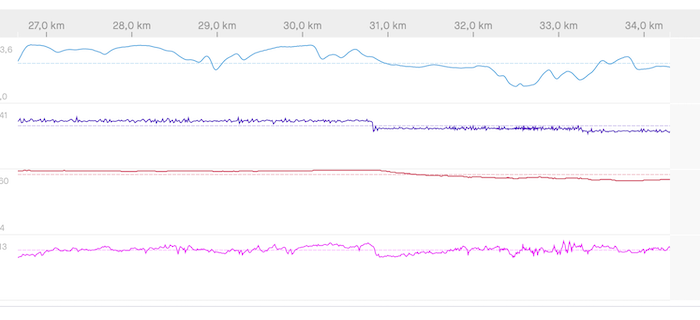
During the Zwift Hub review, I appreciated its stability, the sensations provided by the flywheel, and its very high-quality appearance. But I noticed its lack of power accuracy, comparing it repeatedly to a Quarq power meter mounted on the crankset or a pair of Garmin Rally pedals. This new Zwift Hub One version seems to have corrected some of this inaccuracy, following a software update. I tested the indoor trainer directly out of the box, and my first session resulted in very fluctuating data, particularly a pedaling cadence that frequently fluctuated while the power meter data mounted on the bike was perfectly stable. Then I performed an update of the device, using the Zwift Companion application, to get the latest firmware version. After that, I no longer had any problems with inconsistent data. I noticed a slight difference with the Garmin Rally pedals, 4 to 5 watts in favor of the Hub One, but always consistent, regardless of the intensity of the effort. In terms of cadence, I saw a difference of 2 revolutions per minute in favor of the Garmins on several occasions, but without knowing precisely which of the two devices is ultimately more accurate.
During ERG mode workouts, the resistance offered by the Zwift Hub One is fluid and stable, much like what is felt on a lab device during a stress test. The watts displayed on the application are less fluctuating than with the first version of the Hub. The transition between different intensity levels is fast, around two to three seconds, which is ideal for successfully completing a structured interval workout with a predefined load.
Regarding free sessions or group rides, the responsiveness of the device is also very pleasant, offering a realistic feel to indoor training. Virtual gradient changes are felt almost instantly and quickly require gear changes.
An indoor trainer close to perfection
With a price of €599 that includes a drivetrain system compatible with multiple bikes, a virtual gear shifting system, a one-year subscription to the Zwift application, and now significantly improved power accuracy, the Zwift Hub One stands as one of the best indoor trainers on the market.
Of course, some models from competing brands are known for even greater precision, or other features that make indoor training even more realistic, such as a floating chassis to simulate bike movements, or a change in inclination to simulate pedaling on a slope. But they are much more expensive.
If we stick to the essential features for serious and regular indoor training, the Zwift Hub One now has the necessary assets to compete with the big players, whether in terms of stability, low noise, resistance, and now resistance management, which is better than that of the first version. It also adds the widest compatibility on the market for almost all types of bikes with a totally innovative drivetrain system, even if this compatibility is only total on the Zwift application. Those who would like to use the Zwift Hub with a traditional cassette to maintain full compatibility with all training applications on the market can still choose the Zwift Hub Classic, the new name for the first version, which also benefits from the software update that now makes it more accurate.
The ZWIFT HUB ONE in brief… Rating: * Pros: price, build quality, easy assembly and installation, fluidity, stability, pedaling sensations Dimensions: 497 x 612 x 461 mm – Weight: 16.5 kg – Resistance: up to 1800 watts – Max simulated slope: 16% – Flywheel: 4.7 kg – Communication: ANT+ FE-C, ANT+ Power, Bluetooth Smart Trainer Control, Bluetooth Smart Power – Compatibility: all training software and applications – Supplied with: Zwift Cog for compatibility with almost all bikes and Zwift Click for virtual gear changes – Price: €599 (with one year of Zwift subscription) Contact: zwift.com |
=> SEE ALSO: All our Test articles
Share the post "Zwift Hub One indoor trainer review: compatible with (almost) all bikes"