Share the post "Opinion: Should E-MTBs Be Allowed in the Forest?"
Electric mountain bikes are sometimes singled out by purists on ethical grounds, or because of their deviance or philosophy. But in this article we wanted to examine another aspect that worries us. Indeed, while they have become the new stars of the cycling world for their neutral impact on the environment, and because they are designed to make it easier to stay fit with less effort, e-MTBs are not without danger. Let’s try to explain…
By Jean-François TATARD – Photos: depositphotos.com / DR
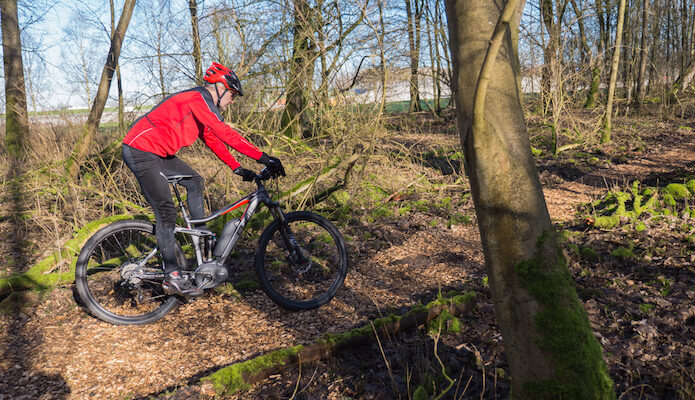
Electric mountain biking has grown rapidly in recent years, and more and more of them are showing up in the forests. E-MTBs have everything going for them. Their many attractions, whether for ease of getting around, for health or for leisure, make this two-wheeler a very popular means of transport.

Demand keeps rising, and riders span every age. Children, adults and seniors, even very senior riders, have swung a leg over this new type of bike. And sometimes without really considering the accident risks, or the fact that their reflexes are often out of step with the situation, cognitively speaking.
This article actually grew out of an accident we recently had on a gravel human-powered bike (or human propulsion, call it what you like) in the Saint-Germain-en-Laye forest, when we collided head-on with a septuagenarian who happened to be riding an e-MTB. The rated power of the electric motor fitted to this type of two-wheeler reaches 250 watts when it is within the rules. And sometimes riders remove the limiter and ride at moped speeds.
In most cases, the motor assistance makes it possible to ride above 25 km/h, except that some places are not suited to it. And even though pedal assistance only works when the rider is pedaling, beginners on this type of bike should absolutely follow the trail markings and go cautiously on the singletracks. And we won’t open the debate on banning motorized vehicles from most forests in this article. Because, indeed, is an e-MTB a motor vehicle?

To go beyond our reflection: even if it must be admitted that this type of bicycle is a good way to get people back into the saddle who do not practice, or no longer practice, any sport, our analysis is that many of the people we met on the trails are not prepared from a neuromuscular point of view. Indeed, did you know there is a cognitive communication between the muscles and the brain?
Now, with electric assistance, neurological communication is disrupted and the neuromuscular connection is therefore skewed. There is a disconnect between mind and muscles, because the muscles have almost no information (or at least far less) to send to the brain, since they are significantly less engaged. This would explain many of the accidents involving e-MTBs in the forest.

What is the neuromuscular connection? It is simply the mind-muscle connection, or Mind Muscle Connection in English. Our brain and muscles are connected. If you contract your thighs, glutes and calves, the brain must first send signals through the central nervous system to the corresponding muscle.
These impulses trigger a contraction and a reaction tied to what is appropriate in a given situation. So the quality of the connection between your mind and your muscles controls the intensity of your muscular work. And vice versa. Except that here, it is as if there were no transmitter left.
With an e-MTB, the effort is artificial, so proprioception is significantly impaired.
In neurology, there is a synchronization between the muscle, the brain and proprioception. This is a kind of deep, generally unconscious sense of the position of the body’s different parts, based on the starting information. It works thanks to numerous muscle and ligament receptors and to the nerve pathways and centers involved. Except that with an e-MTB, the effort is artificial, so proprioception is significantly impaired. Sensory receptors do not keep pace with the speed or with the situation when facing an obstacle. It is a kinesthetic problem that prevents the normal reflex that would have occurred if the muscle had been engaged normally, if we had been pedaling with leg power.
Finally, sharing trails between MTB or gravel riders and e-MTB riders does cause some problems on forest paths, where respect is not always the rule, because having artificial power at the pedals sometimes unconsciously makes you less competent and weakens your reflexes. In short, don’t get us wrong: don’t pass off motorboats as sailboats. So here is a kind of conclusion that I hope will encourage some reflection, because it is important to head in the right direction and not reinvent the all-terrain motorcycle.
So, it is important to ride in an environment suited to this mode of transport, with the right safety equipment, and to have good visibility and allow an adequate reaction time to avoid an unpleasant surprise.
=> SEE ALSO: All our MAG articles
Share the post "Opinion: Should E-MTBs Be Allowed in the Forest?"