Share the post "Girs Solo Review"
With the Solo, Girs aims to make performance and versatility accessible to everyone by offering a safe, efficient, and relatively affordable machine, built on the experience the French brand has gained over the past 25 years. The result is impressive.
By Guillaume Judas – Photos: @Vincent Lyky 
Girs is a French brand founded in the late 1990s by two brothers, Guillaume and Alexandre Girout, who were barely out of their teens at the time. A few years later, they each spent a year racing professionally, further honing their skills. At the same time, the family business evolved, gradually establishing itself as a leading distributor in France for renowned brands such as Zipp, Speedplay, SRAM, Ceramic Speed, and today Castelli, Factor, Goodyear, Maurteen, and Pillar. In short, Dagg—as the company is now known—is well established in the cycling world, but it hasn’t forgotten the brand that marked its beginnings, the one that put it on the map. Following the famous G-Star and G-Max models, which at the time (in the mid-2000s and early 2010s) demonstrated the Girout brothers’ capacity for innovation with revolutionary technical solutions (such as the G-Star’s Twin Flex rear triangle to enhance comfort and traction, or the G-Max’s reversible bottom bracket to offer an adjustable geometry), Girs has stayed in the game with more mainstream models like the Oscar or the Gravel RNR, which almost round out the Factor bike lineup—with which they now share a bit of DNA.

Simplicity and Modernity Launched in 2022, the Solo follows the same trend, positioning itself as a relatively affordable bike with a frame kit priced at €1,690 and a complete bike starting at €3,250, yet it doesn’t skimp on the latest technological advancements, featuring aerodynamic tubes, disc brakes, fully integrated cables, housings, and hoses, and wheel clearances that accommodate tires up to 32 mm in width. The frame isn’t particularly light at just over 1,000 g (300 g more than the top-of-the-line models on the market, which sell for more than three times the price), but the brand emphasizes the sturdiness of the design—a selling point that’s sure to appeal to parents of young aspiring messengers, triathletes who travel the world, and amateur riders who battle it out every Sunday on roads that aren’t always in the best condition.

Made from Toray T700 and T800 carbon fibres and an EPS mould—guarantees of strength and stiffness—the Solo features layered materials designed to optimise both comfort and performance. But it’s obviously the tires—with the option here to fit 32 mm tires—that are most likely to improve vibration absorption, or conversely, to give the bike a sharper feel, such as when fitting 25 mm tires.

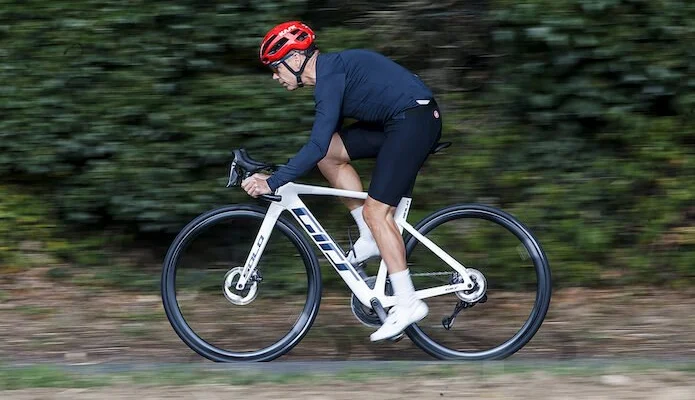
Despite its massive, profiled tubes—and thus generous wheel clearances—the Girs Solo retains sleek, balanced lines, even in smaller sizes. Since I usually ride a bike that falls between two sizes (between 49 and 52 or between XS and S, depending on the brand), I had a hard time accepting that Dagg had sent me the smallest of the five sizes currently available for this test. I had to check the bike’s measurements several times—particularly the seat tube angle (which is quite upright on the small size) and the head tube angle—to adjust my riding position. The brand has announced that it will soon be launching two smaller sizes (44 and 46) to make this model available to an even wider range of riders.
 Custom Build
From mechanical 12-speed Shimano 105 to Dura-Ace Di2, including SRAM Force and Rival AXS, Girs offers a wide selection of drivetrains for the Solo, which is also available in three colors. The same goes for the wheelsets, ranging from the aluminum Fulcrum Racing 900 to the Black Inc., including the full line of Sonic carbon wheels—such as the Super 3, which are fitted to the test bike here. For the cockpit, you can pick either classic Ritchey aluminium stems and bars or the Sonic Super carbon combo fitted here, which boasts carefully sculpted ergonomics. Finally, two types of saddles (Selle Italia) and tyres (Goodyear) are available, and you can even order the bike with a pair of Assioma power-meter pedals.

With the Shimano Ultegra Di2 12-speed groupset, carbon wheels, and Sonic cockpit, the Solo is priced at €5,970, but those who want to treat themselves or can afford it can spend up to €10,000 on a Dura-Ace build with the pricey Black Inc. Five wheels.

 Stability and Safety
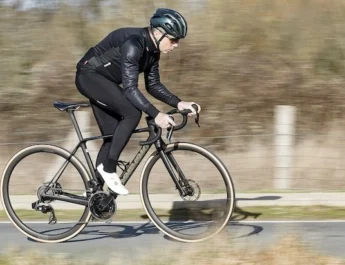
As equipped, the test bike isn’t very light, weighing just under 8 kg without the pedals. The 71.5° head tube angle on this small-size frame doesn’t exactly contribute to the bike’s responsiveness. As a result, the Solo feels a bit sluggish during accelerations and changes in pace over the very first few kilometres, which I rode in the city and on a challenging route with many false flats. But once I’m properly warmed up, I begin to appreciate the lateral stiffness that enhances the bike’s overall efficiency, as I can see from the numbers on the speedometer. As the speed picks up, the Solo seems to come to life, displaying a dynamism comparable to much higher-end bikes.

That said, these initial impressions need to be refined after the first ride, so I decide to review all the position adjustments, particularly the placement of the brake levers, which I find much too low on the test bike. By raising them on the handlebars by a few millimeters (thus bringing them closer to me), not only do I feel more securely seated in the saddle without the sensation that my arms are pulling my hips forward, More importantly, I lighten the front end of the handlebars and feel less weight directly above the front wheel. As a result, the steering feels lighter right away, and the Solo seems to regain its responsiveness as soon as I lift my hips off the saddle.

On climbs, the Solo isn’t exactly the bike that will turn you into a winged climber, but its stiffness more than makes up for its slight heft. Whether pedaling at a steady cadence or pushing harder, you maintain the feeling of being one with the bike. Even when putting out a lot of watts, no part of the frame, wheelset, or handlebar setup seems to falter. And with the highly versatile 35-mm rims fitted to the test model, the wheelset is far from being a hindrance when the road climbs.

On flat terrain, I would obviously have preferred taller rims with a bit more inertia, but the Solo is far from falling apart when riding at a sustained cruising speed. Thanks once again to the frame’s stiffness and aerodynamics, it’s possible to ride for long stretches in a high gear without losing momentum. And above all, crosswinds have little effect on the bike, which holds its line perfectly thanks to the reasonable wheel profile and a geometry that prioritizes stability.
 The Right Price
Ultimately, the Girs Solo demonstrates very sound handling, emphasizing stiffness and stability to ensure the necessary safety for those new to competition or, conversely, for those who want to push themselves to the limit in situations they don’t always have under control. Although it lacks the razor-sharp responsiveness of top-of-the-line bikes—mainly due to its 8 kg weight—this bike, as equipped, delivers the essentials: performance, comfort, durability, reliable disc brakes, and the enjoyment of an electronic drivetrain. For many riders, there’s really no need to spend more.

The GIRS SOLO in brief… Rating: ***** Pros: build quality, value for money, stability, stiffness Cons: weight Frame: Girs Solo T700/T800 monocoque carbon – Fork: Girs full carbon – Handlebar: Sonic Super carbon – Brakes: Shimano Ultegra 160/140 mm – Rear derailleur: Shimano Ultegra Di2 12-speed – Shifters: Shimano Ultegra Di2 12-speed – Cassette: Shimano Ultegra 11-30 – Chain: Shimano Ultegra 12-speed – Crankset: Shimano Ultegra 12-speed 52-36 – Wheelset: Sonic Super 3 – Tires: Goodyear Eagle Sport – Saddle: Selle Italia Model X – Seatpost: Girs Solo Carbon – Weight: 7.970 kg in size 49 without pedals – Sizes available: 5 (soon to be 7) – Price: €5,970 (in this configuration) – Frame kit: €1,690. |

=> SEE ALSO: All our Test Articles
Share the post "Girs Solo Review"