Share the post "Review of the new Specialized Roubaix SL8 S-Works"
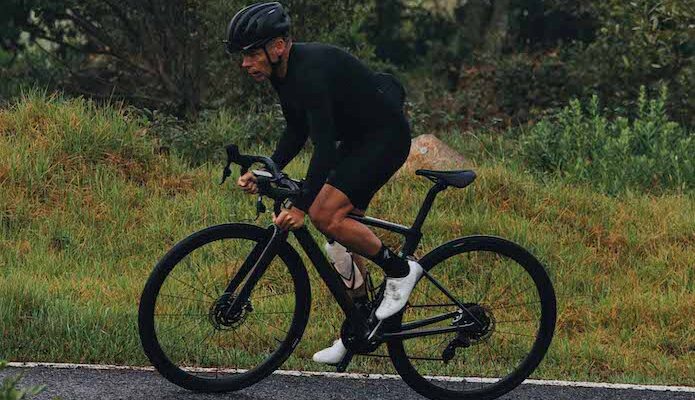
Following the new Tarmac SL8 launched in early August, Specialized introduces the latest evolution of its other iconic model: the Roubaix. This all-new Roubaix SL8 doesn’t revolutionize the endurance bike category and only evolves in details in terms of aesthetics. But the S-Works version we tested is lighter, faster, more accessible, and more versatile than the previous Roubaix, notably featuring a new customizable Future Shock 3.0 front suspension system, and even more compatibility with larger tire widths.
By Guillaume Judas – Photos: ©Etienne Schoeman/Specialized

Along with the Tarmac, the Roubaix is the other important bike at Specialized. It is offered in a complete range from €2800 to €14000, using the same level of components as the American brand’s flagship model. The Roubaix was even the first all-carbon Specialized bike, conceived over twenty years ago to be capable of devouring long distances. At the heart of the original model’s design was already a geometry with a higher head tube than traditional bikes, and longer chainstays, to offer a more stable and relaxed ride. This is how so-called endurance bikes were born. With the Roubaix.

Today, while the Aethos stands somewhat apart among Specialized road bikes, with a record weight, a very airy feel, and a character that destines it more for cycling epicureans, the Roubaix truly evolves in parallel with the Tarmac in terms of performance. It is a bike that makes very few concessions to efficiency, even if it is designed to ride on poorly paved roads, and in doing so, provide comfort so that the user can preserve their energy as long as possible over long distances. In this S-Works version, the new Roubaix remains a competition bike with a geometry that provides comfort, while offering even more versatility than its predecessor.

Another vision of comfort
According to Specialized, a comfortable bike offers more control, less fatigue, and ultimately more speed than a bike that is too stiff or that would be too harsh on the rider, at least regarding impacts. But if comfort objectives are achieved at the expense of efficiency, with a bike that is too flexible to transmit the user’s power, it is also not interesting from a performance point of view. With this seventh generation of Roubaix (despite the SL8 name, it is actually the seventh Roubaix since the first model was released), Specialized further optimizes the concept of suspending the rider on the bike, and not the bike itself, thanks to two suspension systems located at the stem with the new Future Shock 3.0 and at the seatpost with the After Shock. The idea is to allow the rider to float confidently and comfortably above the chaos, while the bike remains agile and laterally stiff to maintain excellent power transfer and good handling.
To further improve the bike’s comfort and increase its versatility, the new Roubaix now accepts tires up to 38 mm wide (for gravel tires with less pronounced knobs). Thanks to the significant progress seen in tubeless tires in recent years, it is now possible to combine good efficiency with comfort and grip by adjusting tire pressure.
The evolution of Future Shock
The Future Shock suspension system was integrated with the fifth generation of the Roubaix in 2016 and quickly became successful with two consecutive victories at Paris-Roubaix in 2018 and 2019 with Peter Sagan and Philippe Gilbert. Placed between the stem and the steerer tube, the system offers 20 mm of travel and significantly reduces impact and vibrations at the cockpit, while keeping the front of the bike stiff to maintain precise handling.

With the new Roubaix SL8, Specialized introduces a third version of the Future Shock, which can be easily adapted so that every cyclist, regardless of their weight or position on the bike, can benefit from optimal comfort. Three different springs (firm, medium, and soft) are available and adaptable in the system, with up to five preload washers. It thus becomes possible to adapt the comfort of the front part of the bike according to many parameters, especially the terrain on which the cyclist intends to use their bike.

The new Future Shock comes in three levels:
- The Future Shock 3.3 offers hydraulic damping, with compression adjustable while pedaling with a turn of a dial in five positions (from fully locked to soft). It is found on the new Roubaix SL8 S-Works and Pro.
- The Future Shock 3.2 offers hydraulic damping in addition to the customizable spring, but without adjustable compression. It is found on the new Roubaix SL8 Expert and Comp.
- The Future Shock 3.1 is a spring system, customizable and responsive, without adjustable compression. It is found on the new Roubaix SL8 Sport 105, Sport Apex, and Base.
A proven After Shock system at the rear
The Future Shock system offers a perfect ride balance when paired with the After Shock at the rear, a relatively simple but perfectly effective seatpost system already integrated into the previous generation of the Roubaix. The carbon Pavé seatpost is fixed very low in the frame at the seat tube, with a suitable seat clamp, called Dropped Clamp, placed 65 mm lower than a traditional clamping system. The length of the post and its design promote a slight deformation towards the rear during impacts sustained by the bike’s rear triangle, so as to absorb vibrations, but without altering stiffness or even giving a pumping sensation when pedaling.


Enduring, yet aerodynamic
The previous Roubaix was already announced as more aerodynamic than the Tarmac SL6 at its launch. The new Roubaix SL8 is said to be even more optimized in this area according to Specialized, thanks to a new fork shape and a slightly redesigned down tube, as well as lowered seatstays, a design that adds to a head tube whose leading edges are designed to facilitate airflow around the bike. The brand thus announces a gain of four watts in drag, or 11 seconds over 100 km compared to the previous version.

The Roubaix does not benefit from the integration of brake hoses at the head tube, simply because this would involve too many compromises with the Future Shock system in terms of volume to accommodate the suspension, bearings, and various cables.

Reduced weight
As with the new Tarmac SL8, and thanks to the progress already made in the field with the launch of the Aethos, Specialized has managed to reduce the weight of the Roubaix frame by 50 g compared to the previous version. The brand thus announces a weight of 828 g for the frame alone in size 56 in the S-Works version, which is consistent with the data we were able to collect on the ground, with 7.600 kg for the complete bike with pedals and bottle cages, in size 52.

This weight must be put into perspective given the bike’s capabilities, tire clearance, and the slight modifications this implies in terms of geometry, fixings for luggage, mudguards, and bottle cages, and of course the integration of suspension systems. For the complete bike, the 32 mm tubeless tires must also be taken into account. Because yes, the bike is also designed for bikepacking, which adventure enthusiasts will appreciate. In short, the Roubaix S-Works SL8 is both lightweight and versatile, as we were able to confirm on the road.

The Swiss Army knife of bikes
When I first got on the Roubaix SL8, I was naturally surprised – and a little disconcerted – by the position of the cockpit, raised by about two centimeters compared to my usual bike. This less aggressive posture, induced by a higher handlebar, immediately seemed less efficient when facing a headwind, or for climbing a reasonable gradient with force. It’s a matter of the angle between the back and legs, I imagine. I would even say that when riding out of the saddle, the higher-than-usual placement of the brake levers made me feel less fluid in my movements. Another important change: the gearing. With two chainrings of 46 and 33 teeth and a 10-33 12-speed cassette, this Roubaix S-Works is clearly intended for long rides with elevation rather than intense and nervous outings. In terms of feel, the 46-tooth large chainring doesn’t offer the same efficiency as a 52 or 53, and the cassette has a gear spacing with some annoying gaps in the range of developments.

Despite a very good level of efficiency (I’ll come back to that), my first contact with the Roubaix SL8 left me with a slight feeling of discomfort, but it’s obviously a matter of details. For the handlebar, the bike comes with a handlebar raised by one centimeter, which is all the easier to change as the brake hoses are much more accessible here than with an integrated cockpit. The stem can also be easily replaced by a model with a -17° angle, which allows you to find a position identical to that of an aero bike, thanks to the Future Shock system which does not require a special stem. And for the range of gears, we all know that it must first be adapted to the user’s level and routes.

However, I must admit that at the end of the first ride, I felt less sore than usual, and that over the kilometers I became familiar with the handlebars, which allowed me to feel less tense in my shoulders and neck, and which prevented the numbness I often feel in the palms of my hands at the end of a ride. It sounds like an advertisement for the Roubaix, but that’s what I felt. And without having touched the Future Shock adjustment, which I left in its stiffest position.

I’d add that after a few steep, dripping ascents, I also had to tackle technical, wet descents, and that the bike’s handling was marvelous in these conditions. Stable and reassuring, its steering is much less nervous than the Tarmac. The bike is less lively, but also less demanding because it requires less constant attention. And that also affects fatigue.

A second, longer, more varied, and also drier ride allowed me to discover a little more of the bike’s capabilities. I couldn’t test the Roubaix without riding some cobbled sections. Whether on the flat or uphill, the machine performs much better than all current race bikes. In a seated position, the seatpost prevents bouncing on the slightest irregularity of the terrain and provides a smoother pedal stroke with fewer jolts. At the front, the suspension significantly reduces felt impacts, but bike control remains total as no floating is discernible between the wheels and the frame. You always know where the wheels are placed, while being much less tense than with a stiffer bike.

The S-Works Mondo 32 mm tires that come with the bike also play a decisive role in terms of comfort. With less than 4 bar of pressure, they partly absorb shocks, while offering grip and – more surprisingly – efficiency! This tubeless version provides low rolling resistance, even on good asphalt. Mounted on wide rims (25 mm internal width here), they don’t flatten on the sidewalls when you stand on the pedals. Above all, they allow you to leave paved roads and venture onto gravel paths. So be careful. I’m talking about light gravel, on dirt roads or rural paths between fields, but not sand, mud, or scree. But by slightly increasing the tire width (35 mm), this bike could perfectly do the job on gravel routes in the regions north of the Loire, between April and October. In any case, the Roubaix SL8 offers many possibilities, such as getting lost while following a GPS track!

Back on the road, I appreciated the stiffness and lightness of the Roubaix in this S-Works version, which ultimately give it a rather astonishing dynamism. Despite the 32 mm tires, the position that was a little too upright for me, and gearing more suited to gravel than to a real road training, the bike goes straight and fast if you put in some effort. I felt little to no difference in efficiency compared to the Tarmac on steep climbs, which I was even able to tackle with more peace of mind given the bike’s versatility. It was on the flats or gentle descents that I felt more like I was hitting a wall a bit, that the bike wasn’t carrying as well, but I think that’s more a question of position. What is certain, however, is that the variety of routes and roads I tackled left me with a big smile and the desire to go back.

The new Roubaix SL8 is ultimately not so different from its predecessor. But it performs a little better everywhere, even in this S-Works version where it is lighter and seems easier and more responsive, therefore more accessible. I can’t say what it is about the new generation Future Shock suspension system, the greater tire capacity, or simply the well-balanced geometry that makes this machine a bike with such a wide range of action. But if you could only have one, this is the one you need.
| The new SPECIALIZED ROUBAIX S-WORKS SL8 in brief… Rating: * Pros: efficiency, comfort, rolling qualities Models and prices S-Works Pro
Expert
Comp
Sport Apex Sport 105 Roubaix SL8 S-Works frameset: €5,500 NUMBER OF SIZES: 8
Contact: www.specialized.com |


=> SEE ALSO : All our Gear articles
Share the post "Review of the new Specialized Roubaix SL8 S-Works"