Share the post "Long-term test: Enve SES Tubeless Ready tires"
A few weeks ago, we introduced an advanced American tire designed to most effectively improve efficiency and grip. Two months after putting the Enve SES Tubeless Ready Souple Vectran tires with tan sidewalls through a much more extensive test, and after 2500 km in all weather conditions, we wanted to give you an even more precise verdict here.
By Jeff TATARD – Photos: All rights reserved
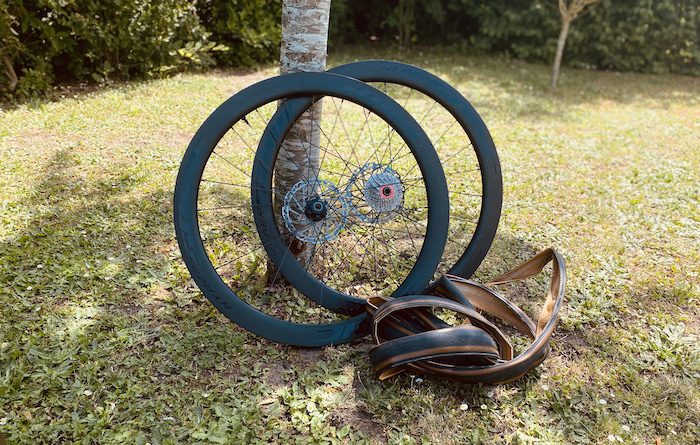
A few weeks ago, we presented the tire after a short initial test. All that remained was to explore it a little more in depth, and it was well worth it. Aside from a technology that is expanding but not yet fully mastered by most riders (tubeless), what we wanted to share with you here are the results of the overall behavior during intensive use.
Mounting
Unlike many other tires called Tubeless that absolutely require the addition of sealant to ensure a seal between the tire and the rim, Enve tires are true Tubeless tires that can be used without sealant.
Nevertheless, the advantage of sealant is that it’s a system that automatically seals small punctures, allowing you to keep riding as if nothing happened, and it saved us three times during the 2500 km test.
The weight advantage
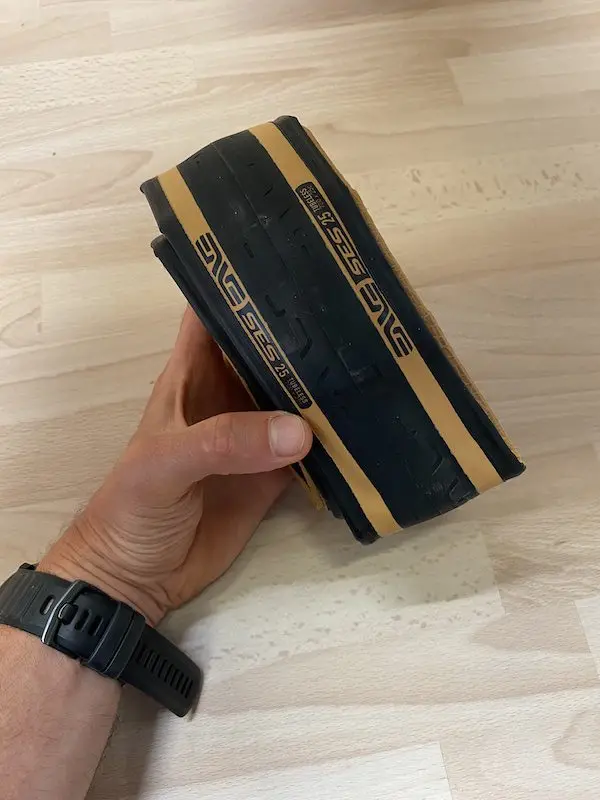
Our Enve tires weighed in at 245 g in 700×25, to which we can add about 30 ml of sealant, making a total weight of less than 280 g. And this is ultimately lighter than our GP 5000 with inner tubes (220 g + 70 g) mounted on our second pair of wheels.
Before mounting, you must first install the airtight valve on the rim. The upper part of the valve must fit into the rim’s groove. This same groove is used to slide the tire bead, to facilitate mounting.
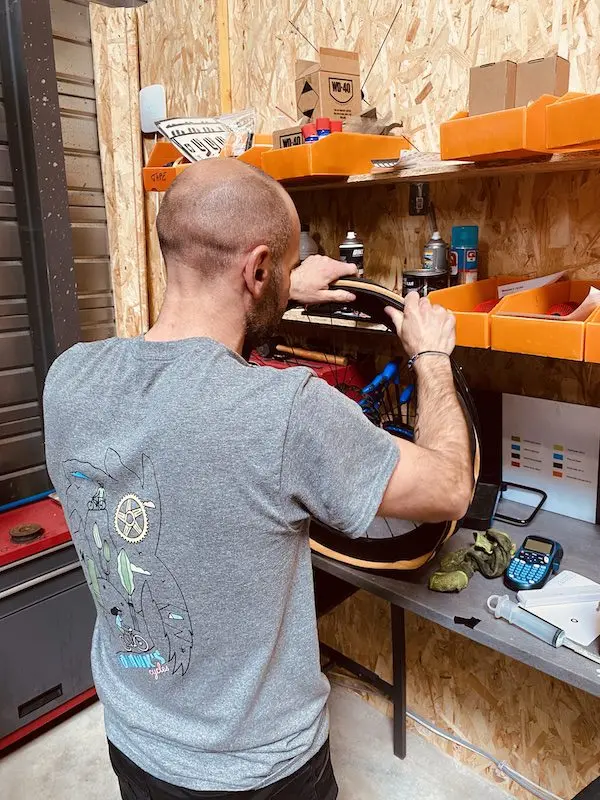
On our Hyper Sonic wheels, as with all other compatible wheels, mounting is always done in two steps, given the very small tolerance allowed by the system to ensure its airtightness. You must first start on the side opposite the valve, and always slide the tire bead into the groove present in the rim bed.
We finish mounting by hand on the valve side, otherwise it’s almost impossible to slide the tire inside the hooks due to very strict dimensional tolerances. Michael from Mohawk’s taught me that.
Normally, with practice, tire levers are not needed. Once both beads are installed on the rim, the tire must “pop” onto the rim, meaning the beads must seal against the hooks. And I realized that a floor pump is not enough. For our part, we had to use a compressor that allowed a large volume of air to be sent in a short time.
Finally, once the tire is properly installed, we choose to insert sealant to seal the mounting and then self-repair in case of a small puncture. To do this, unscrew the valve core and slide in 30 ml of liquid. Then spin the wheel freely to distribute the liquid evenly inside.
Following this mounting, I nevertheless noticed pressure losses. About 1 bar less each morning compared to the previous evening.
The constraints of Tubeless
We had three punctures in 2500 km, and even if the sealant did its job every time, when the last cut was too big for the sealant to really work, I sprayed that delicious chemical product all over the peloton I was riding with.
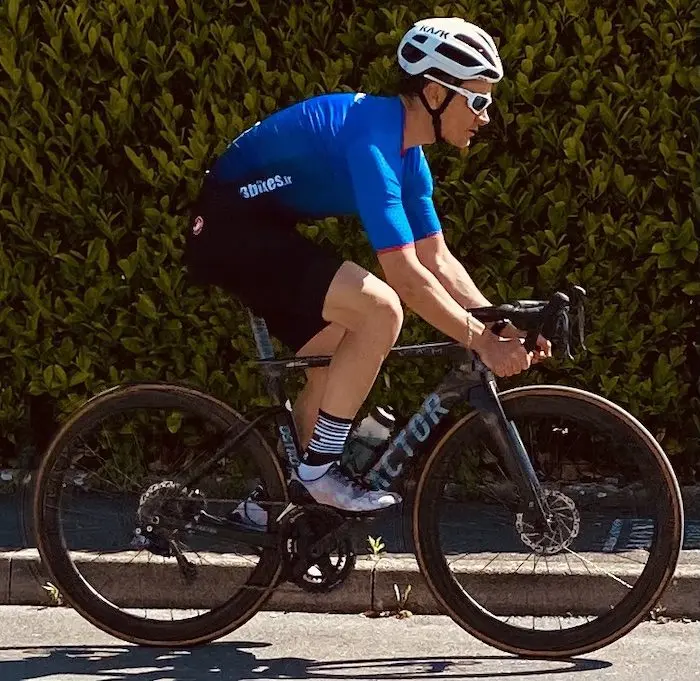
In short, what you should remember is that Tubeless is not flawless, nor a miracle technology to avoid punctures. But the real advantage is probably elsewhere…
Comfort and efficiency
In 2500 km of riding, we therefore experienced three punctures, including one that could have left us stranded on the side of the road to the point of hating them! And judging by the condition of the bike after this adventure, which also took place in a race, one can imagine that there was not a single ml of liquid left in the tire. Yet, we had the reflex to measure the loss and the consequences on the ride. And surprisingly, with 2 bar of pressure (compared to 6 at the start), the efficiency was still rather good.
The rear tire was well marked by various surface cuts on the tread, but despite low pressure, the tire still offered comfort and low rolling resistance. No vibrations either. Probably linked to the absence of an inner tube, and to a slightly greater thickness of the structure which allows riding with less pressure in the tire, but without it deforming excessively.
It’s quite surprising to realize that it’s possible to ride with 2 bar without feeling the sidewalls collapse excessively when you push down out of the saddle. And that made me understand that it wasn’t necessary to inflate harder to gain efficiency.
This is just a test and therefore a very subjective assessment, but this tire is the most performing I have ever tested. Whether on dry or greasy and wet roads, as happened to me twice in a race without having reduced the initial pressure. But at the same time, it is also one of the least durable. I therefore think it should be kept for competition use. What also struck me was a feeling of ease regardless of the road surfaces and terrain. The central band is quite firm but perfectly smooth. The sensation is very pleasant when riding. It’s a nice surprise that matches the high-end image I had of this American brand.
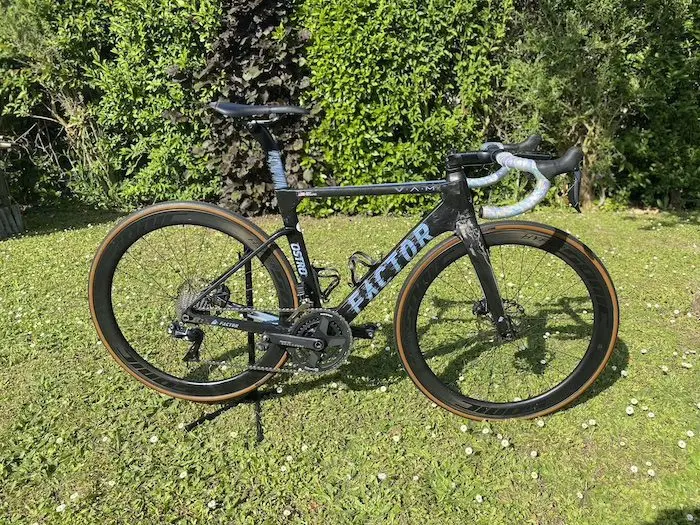
In short, beyond its wear rate, which will mathematically cost you almost 10 cents per kilometer, the Enve SES 700 mm Tubeless Ready Souple Vectran inspired me and met my performance requirements.
The Enve SES 700 mm Tubeless Ready Souple Vectran tires in brief… Rating: ***** Pros: versatility, grip, ease of mounting, weight Smart ENVE Forme system and aerodynamically optimized tread – Natural and synthetic rubber compound with silica – Tubeless Ready – Compatible with hookless and hooked rims – Rim internal width compatibility: 25c (17-21mm) 27c, 29c, 31c (17-25mm) – Vectran™ protection barrier – Weight: 245 g in 700×25 – Price: €92 (per unit) Contact: www.mohawkscycles.fr |
=> SEE ALSO: All our Gear articles
Share the post "Long-term test: Enve SES Tubeless Ready tires"