Share the post "Review of the Specialized S-Works Romin Evo Saddle with Mirror"
At €470, the Specialized S-Works Romin Evo saddle with Mirror is practically one of the most expensive on the market. It promises a very high level of comfort, thanks to a 3D structure that brands are increasingly adopting for their high-end models—and which is put to excellent use here. Let’s put it to the test to see if our behind is worth such an investment. By Guillaume Judas – Photos: ©3bikes.fr Let’s start by stating the obvious: choosing a saddle is, above all, a personal matter—just like choosing a pair of shoes. It’s perfectly reasonable to focus on materials or technical specifications, but there’s no one-size-fits-all solution when it comes to comfort, since it depends on multiple factors such as individual body type, the type of riding, the terrain, and proper position adjustment. The quality of your cycling shorts also affects how comfortable you are while riding. The Specialized S-Works Romin Evo with Mirror saddle is therefore not a miracle model that can solve every problem, but it does come close to being flawless from a technical standpoint.
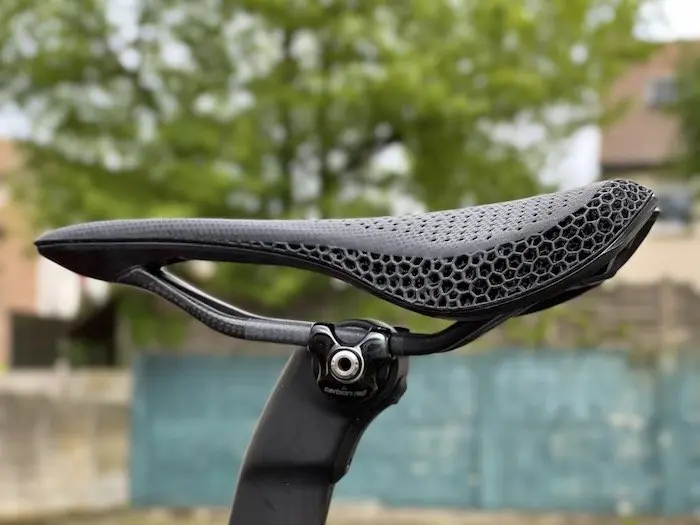
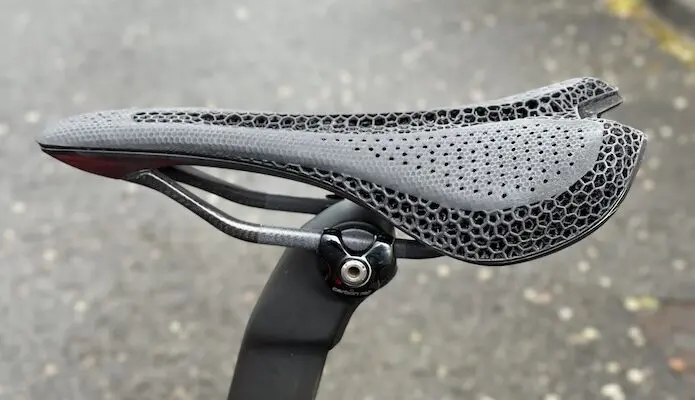
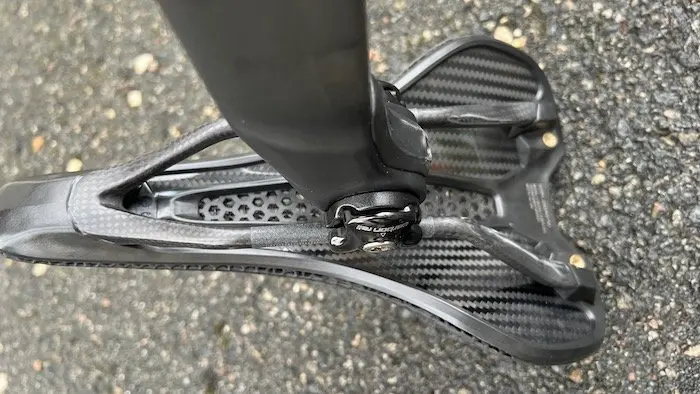
The American brand’s top-of-the-line saddle features Mirror technology, a 3D-printed structure that replaces the traditional foam between the shell and the cover, with density that varies depending on its placement along the length of the saddle. The system is built around a carbon shell and rails to reduce weight and minimize the risk of deformation over time—unlike some nylon shells found in lower-end models, which can sag and alter the seating surface after months of use.
 Focus on Mirror Technology
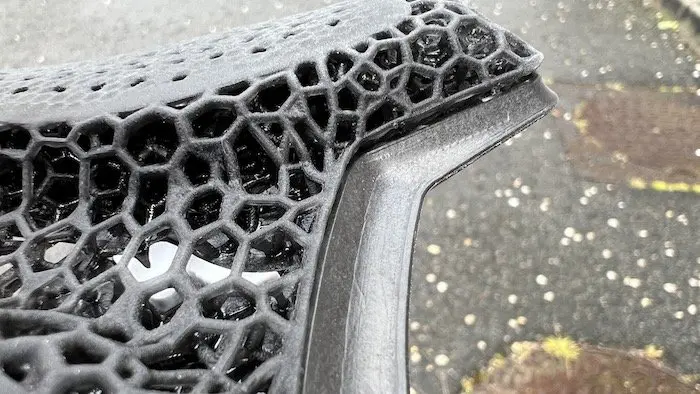
Mirror technology is a 3D-printing process using a liquid polymer, which allows the shell to perfectly conform to the body’s anatomy without the deformation typical of foam and without the risk of long-term padding wear. It features a complex honeycomb structure with a matrix of 22,200 connections and 10,700 intersections, which can deform individually under pressure to provide personalized support and excellent vibration isolation. It’s a bit like an air cushion. 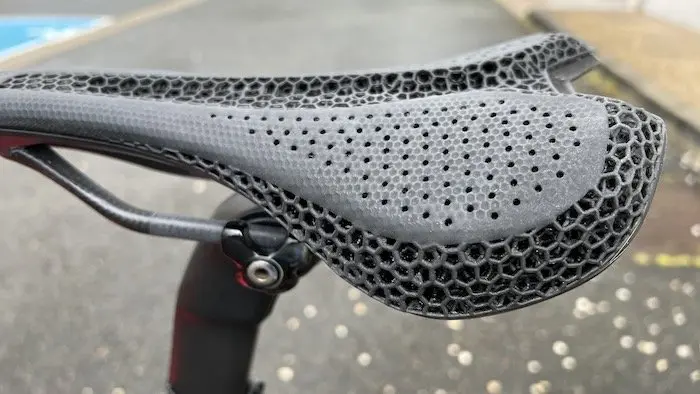
The S-Works Romin Evo Mirror is thus designed in the same way as the Power model we tested in these pages three years ago, but with a different shape and dimensions, as well as—it seems to us—slightly firmer support in terms of the density of the 3D structure.
The S-Works Romin Evo with Mirror thus retains the shape of the traditional Romin—a saddle that is slightly hollowed out in the middle when viewed from the side—measuring 26 cm long (2 cm longer than the Power) and featuring a relatively tapered front section, This leads to a more pronounced flare than on the Power to reach the same maximum width of the crescent—that is, 143 or 155 mm, depending on the option chosen. It also features the now-traditional central cutout designed to promote blood circulation and relieve pressure on the perineum.
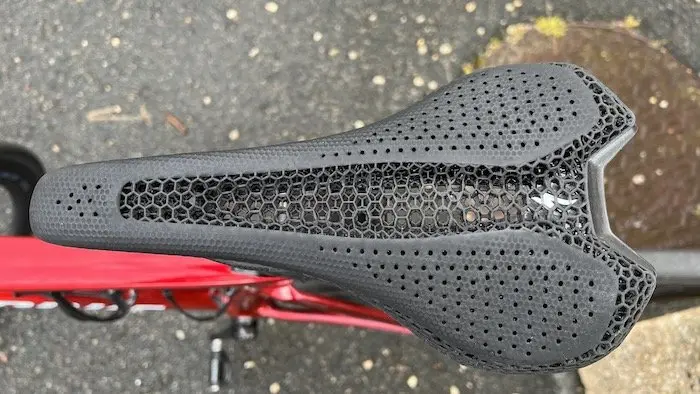
The Romin Evo shape is shown here in the S-Works version, which features oversized 7×9 mm carbon rails that require mounting on a seatpost designed for this purpose. It’s brand new: Specialized is currently launching this saddle in a Pro version, featuring a shell made of nylon and recycled carbon fiber, and round titanium rails compatible with most seatposts, weighing 239 g and priced at €370.
For adjustments, Specialized recommends reducing the saddle setback by 2 cm compared to a Power saddle, which makes sense since the saddle is 2 cm longer and has the same width at the widest point. However, the “midpoint” of the saddle (the point where the saddle is 7 cm wide, a measurement often used in postural studies to calculate saddle setback) is set back by 5 or 6 mm on the Romin Evo, which complicates this simple adjustment slightly. When dialling in height, remember that the 3D structure compresses slightly under your weight, so you may need to raise the Romin Mirror by one to three millimetres compared with a saddle that has firmer padding. Finally, Specialized also recommends adjusting the saddle’s tilt so that the front third is horizontal, allowing the rear section to rise slightly.
Coming from a Power saddle (the model we’ve typically used on two different bikes for the past two and a half years), we followed the brand’s recommendations—only to realize that fine-tuning the settings would take us much longer than expected. This was due to the setback, as explained above, and the tilt. Because the front section is narrower than on the Power, adjusting the front of the saddle horizontally made it feel like we were constantly tipping forward. So we had to experiment and go on several rides with Allen wrenches in our pockets to find a comfortable setting, regardless of the saddle’s qualities. Nothing insurmountable in the end, but it’s enough to call our most recent postural study into question. What this demonstrates, in any case, is that no saddle provides complete satisfaction if it’s adjusted incorrectly. It feels like you’re floating…
The initial sensations on the road are quite surprising, regardless of the issues related to the various position adjustments. The surface of the S-Works Romin Evo Mirror offers quite a bit of grip, and when you combine this feature with the relative flexibility of the 3D structure, you feel as if you’re anchored to the saddle, with your sit bones perfectly secured within the structure and little chance of sliding forward or backward. Of course, the saddle’s 26 cm length offers a bit more freedom to position yourself more or less toward the front depending on the circumstances, but this requires a deliberate movement of the pelvis to find the desired seating position.
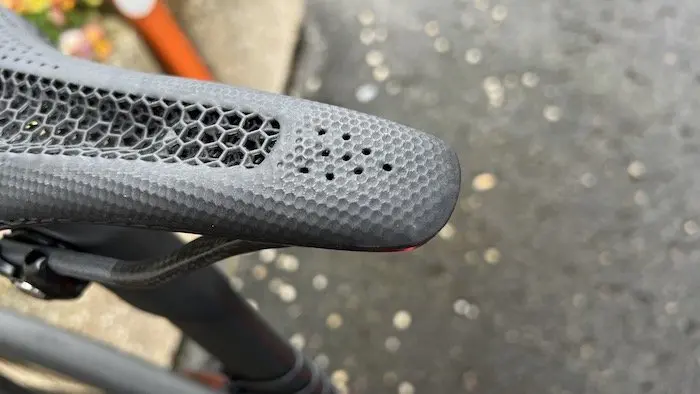
Fortunately, the slightly rough texture of the cover at first touch does not lead to premature wear on cycling shorts. Nor does it seem particularly fragile in use, although, given the saddle’s price, we’d prefer to avoid leaning the bike carelessly against a wall.
Comfort is best judged over the long term. But it only takes a few hundred meters to realize that the usual minor vibrations transmitted by the road are significantly dampened here. Your butt feels as if it’s suspended—like on a cushion of air—with a thin insulating layer between the bike and the seat pad. You might lose a bit of your sense of the road and feel as if you’re riding with a flat rear tire. 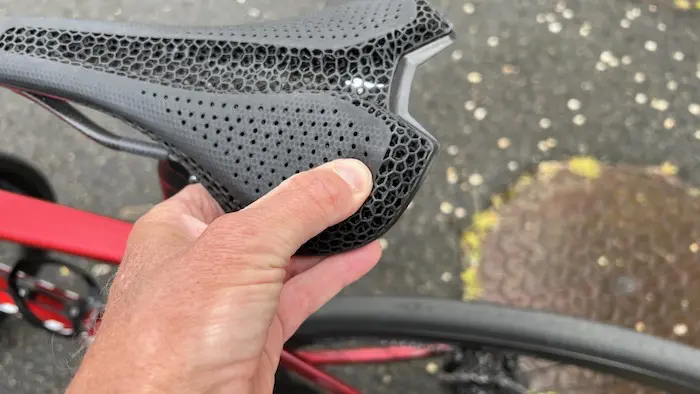
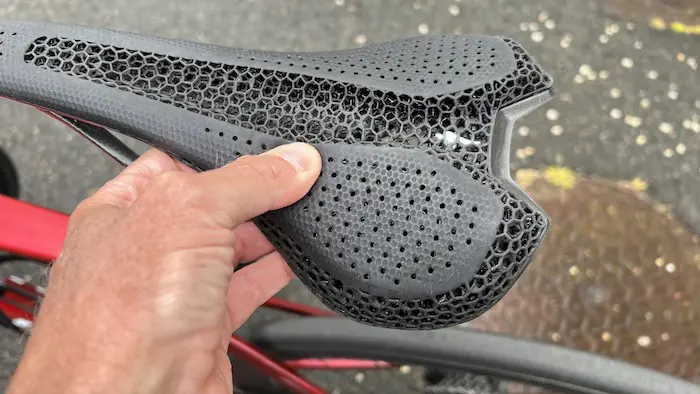
But the big difference compared to a soft entry-level saddle is that you don’t sink into it. You feel perfectly supported along the entire length of the seat, without feeling any hard spots at all. As for the risk of chafing, it isn’t completely eliminated, but it’s significantly reduced. The proof: we’d been experiencing irritation in the right groin area for several weeks, which completely disappeared after two rides with the Romin Mirror.
After three or four rides, the sensation of bouncing a bit on the saddle—especially when riding at a high cadence—disappears. You don’t come back from long rides feeling like you’ve spent five hours on the couch, but overall you experience much less chafing or irritation, and less wear and tear when stringing together training sessions. Even on an indoor trainer, the reduction in chafing is noticeable after 90 minutes of spinning your legs quickly and working up quite a bit of sweat.
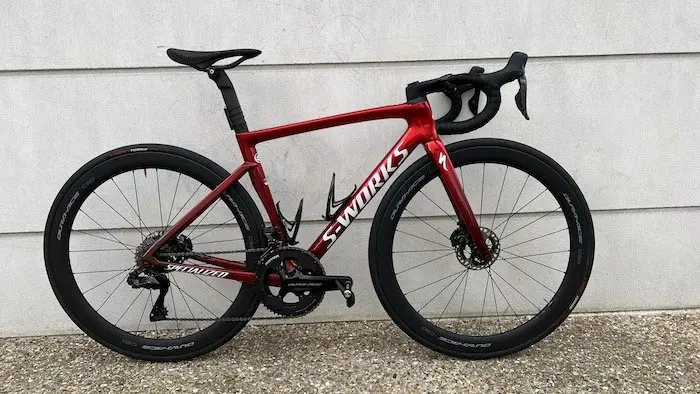
Our take on the S-Works Romin Evo with Mirror saddle Of course, this saddle is expensive—very expensive, even too expensive, some might say. €470 just to sit on—that’s worth a lot of thought. Only the S-Works Power Mirror is currently priced the same, and very few models on the market or among the competition exceed this price (though there are some).
That said, only those who’ve never experienced butt pain while cycling will find the price completely absurd. Others will appreciate the model’s technical sophistication and build quality—and above all, the riding experience it delivers after a few hundred kilometers—which are well worth a few sacrifices. Most importantly, it’s worth making a thoughtful choice between this Romin Evo with Mirror and the Power model of the same name, where the difference in shape could very well tip the scales.
Until now, this Romin Evo with Mirror had only one notable drawback: it wasn’t yet available in a Pro version, as has been the case with the Power for several months. But that’s now been resolved, and the comfort is once again a little less out of reach.
=> SEE ALSO: Review of the S-Works Power saddle with Mirror
The Specialized S-Works Romin Evo with Mirror saddle at a glance… Rating: ***** Pros: technology used, vibration absorption, reduced friction, finish Cons: price Patented Body Geometry design, lab-tested for blood flow – Mirror technology using 3D printing with liquid polymer to create a honeycomb structure – FACT carbon composite shell – Oversized FACT carbon rails (rails compatible only with compatible seatpost clamps) – SWAT-compatible mounts molded into the saddle shell – Weight: 193 g in 143 mm width (also available in 155 mm) – Price: €470 – Contact: specialized.com |
=> SEE ALSO: All our Gear articles
Share the post "Review of the Specialized S-Works Romin Evo Saddle with Mirror"