Share the post "The QSM or the best way to never get injured while exercising"
Once we’ve ruled out injury causes related to falls or poor positioning, the majority of physical ailments in cycling or other sports are systematically the result of an overload placed on the body. In this article, we will therefore see why it is absolutely essential to allow the body to adapt to the various changes inherent in our practice and how to quantify this mechanical stress. With the sole aim of avoiding injuries…
By Jean-François Tatard – Photos: Depositphotos.com / DR
What lies behind the acronym QSM, which sounds like a multiple-choice questionnaire? It is, in fact, the most effective tool in preventing our potential injuries. It is actually the quantification of mechanical stress.
A quick anatomy reminder
The human body is composed of several tissues: bones, muscles, tendons, and cartilage. And during any sports activity, this involves tension, compression, and torsion. These movements represent stress on the tissues. And when this stress accumulates too much, it can lead to a breaking point and thus injuries. The idea is therefore to find the right dosage. But then, how do we measure it? Or how do we quantify it?
Our best ally
The quantification of mechanical stress is therefore our best ally. Nevertheless, the importance of the stress exerted and the tissues solicited differ depending on the sport practiced. Indeed, while the stress exerted on the Achilles tendon in cycling is almost nil, in running, it’s not at all the same thing. To the point that Achilles tendonitis is precisely the most common injury in running. And it is also statistically tenfold in cyclists who are new to running or whose practice is more occasional. Why? Because, as with any sudden change, the body has not had time to adapt, and the stress is perceived by the body as too significant. Added to this is the fact that the cyclist’s benchmarks are skewed, and the volume he is used to in cycling is completely impossible for the same body to tolerate in running.

Prolonged rest zone = danger
The stress exerted also varies greatly depending on the schedule or programming of activities. For example, we often see cyclists who get injured running in winter, and due to their pain, they prefer to take a few days off. And they are right. Except that being in this “rest zone” too regularly is dangerous. Why? Because it is in this inactive state that the body begins to weaken and become increasingly vulnerable to injuries. In truth, I wonder if it wouldn’t be necessary, at a spaced but sufficiently regular frequency during the cycling season, to remind the cyclist’s body what it’s like to run. A 20-minute jog per week, for example?
Pain as an alarm
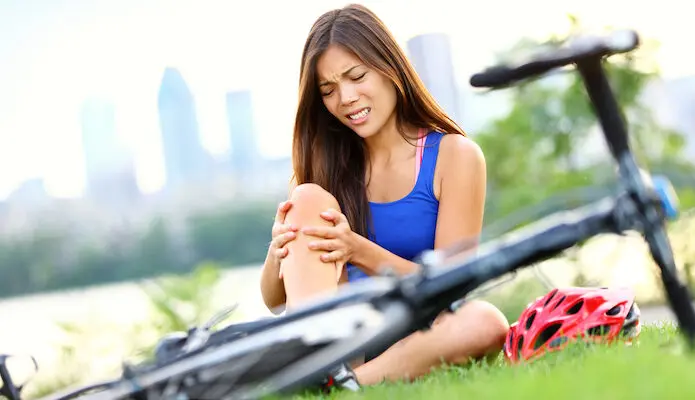
Let’s consider the case where the intensity of the sport practiced is too high. This is where the body’s maximum capacity has been exceeded, and we are in the “risk zone.” If we persist, the risk of inflammation threatens. But the body is well-designed. There are alarms. If we listen carefully to what the body tells us, pain appears during or after sports practice, and this is a first indication that the body is being pushed beyond its limits. Finally, the stiffness the next day or swelling are other indicators that rest is in order.
QSM user guide
The key to avoiding injury is therefore a subjective yet reliable and precise indicator that allows us to quantify stress. How to do it? For each of your sessions, it is essential to note what you do (the date, the details of the session, and especially the associated feeling: during / after / the next day). A smiley can suffice – It is thanks to this data that the QSM curve is built.

In short, the ideal is to stress the body as gradually as possible to create adaptation, without exceeding the maximum adaptation limit or staying for more than two consecutive sessions with the last or second-to-last rating. By repeatedly staying in the zone with the first two ratings, the body adapts to stress and also increases its tolerance. Structures solidify and allow for an increase in the intensity of sports practice without exposing oneself to injuries.
Another variable to consider: the maximum adaptation capacity is not a static line. Indeed, factors that can influence this variable may depend on the affective and emotional state, but also on fatigue or psychological stress. We know that when we are in a good mood and radiating joy, we are less vulnerable and therefore more inclined to tolerate effort.

To conclude
This is what mechanical stress quantification is. And the moral of the story, even if we are not doctors at 3bikes.fr and nothing will ever replace a doctor’s advice, we can still say that the body has formidable capacities for adaptation, and we simply advise you not to go beyond this adaptation capacity. And thus, quantifying the mechanical stress applied to your body with a smiley or a personal rating after each of your training sessions is the best way we have found to avoid injuries and continue to enjoy the pleasures of sport for a long time to come…
=> SEE ALSO: All our Coaching articles

Share the post "The QSM or the best way to never get injured while exercising"