Share the post "Review of the new Sram Force AXS groupset"
At the start of spring, Sram is launching a revamped Force AXS groupset, with improvements in ergonomics and finish, for a price that remains identical to the previous version. We were able to put this new iteration to the test and found that it largely delivers on its promises, as we observed over several hundred kilometers.
By Guillaume Judas – Photos: ©3bikes.fr
Since its launch in 2019, Sram’s second-tier groupset has been a great success thanks to its features and price point. The Sram Force eTap AXS adopted the characteristics of the flagship Red groupset, but for mid-to-high-end bikes. On the menu: disc braking, 12 speeds, wireless electronic shifting, and customization options with the Sram AXS smartphone app. Furthermore, the groupset was progressively offered in numerous versions, in double or single chainring, or with specific gear ratios for Gravel or ultra-cycling. The 2019 Sram Force eTap AXS thus directly competed with Shimano Ultegra Di2, but with a slightly higher weight and a less refined finish, both compared to the 11-speed Ultegra and the 12-speed version unveiled at the end of 2021.
=> SEE ALSO : Full test of the Sram Force eTap AXS groupset (2019)
For this new iteration, Sram has evolved the Force groupset, not in terms of functionality, but rather in the options offered and especially in terms of overall finish and lever ergonomics. Moreover, by adopting the same type of integrated chainrings as the Red groupset, this new groupset, now more simply named Force AXS, saves a little weight at the crankset, without any price increase compared to the previous version. In short, the new Sram Force AXS doesn’t evolve radically, but it has a decidedly more high-end appearance than the previous version.
The weight of the 2023 Sram Force AXS groupset
The groupset saves a little weight at the crankset, but seems to gain a little at the new levers compared to the previous version. And Sram rotors remain relatively heavy. It’s worth noting the many options available for this groupset, with four possible double chainring combinations (46-33, 48-35, now 50-37 like for Red, and the Wide version in 43-30 with the old chainring technology), single chainring versions (standard or Wide) and with a power meter (in the crank spider or in the crank arm), but also numerous cassette options: 10-28, 10-30, 10-33, 10-36, and 10-44 with a specific derailleur. This makes weight comparisons difficult to establish. What to remember is that the Sram Force AXS remains a tad heavier than the Shimano Ultegra Di2 12-speed by about a hundred grams.
| Weight (g) | |
| Complete groupset | 2828 |
| Combined levers + brakes + 140 mm rotors + hoses | 1054 |
| Front derailleur | 182 |
| Rear derailleur | 328 |
| Crankset 48-35 without power meter (with Dub bottom bracket) | 708 + 76 |
| Cassette 10-28 | 238 |
| Chain | 242 |
Sram groupset specificities
The new Force AXS naturally remains faithful to Sram groupset specificities, with wireless electronic shifting between the shift levers and derailleurs, 12 speeds, and now disc braking only. Shifting is done with a paddle located behind the brake lever of each shifter. With the right shifter, you shift down the cassette, with the left shifter you shift up. A simultaneous press on both buttons changes the chainring.
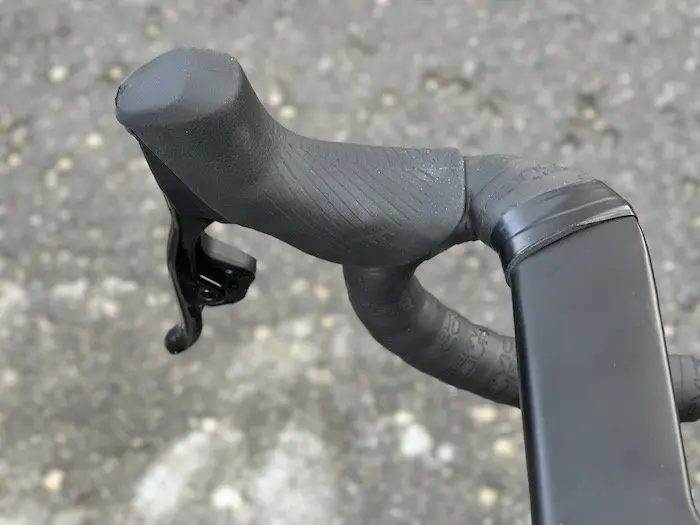
Like the previous Force, the new groupset is of course compatible with the Sram AXS app, which allows you to customize the transmission’s use, for example, by deciding the order given to the derailleur by the right or left lever (you can reverse them) or the number of cogs shifted by holding down the button.
=> TO LEARN MORE : Sram AXS app test
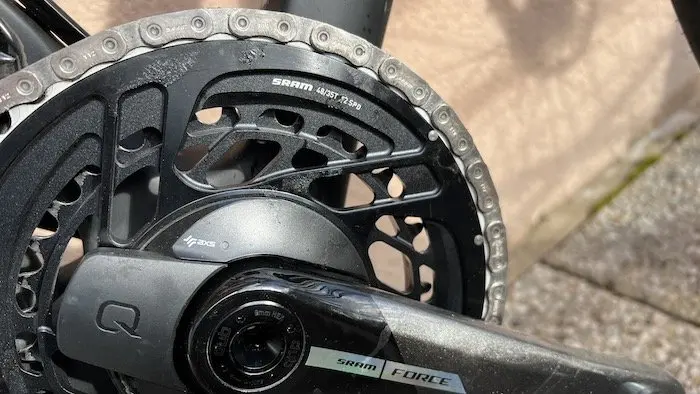
One of the main characteristics of Sram groupsets is precisely the choice of gear combinations, both at the rear and at the front. All proposed cassettes start with a 10-tooth cog, which requires a specific freehub body on the wheel. On the crankset, however, the chainrings are relatively small, with versions in 46-33, 48-35 (as on the test bike), and now 50-37 like the Sram Red, which is added to the Wide version in 43-30, more specifically dedicated to Gravel with a modified chainline and a specific front derailleur. A 50/10 is equivalent to a 55/11, and a 48/10 is almost equal to a 53/11 in terms of gear ratio. Suffice to say there’s no need to worry on that front, even if the main criticism one can make of this type of transmission concerns the large difference in gear ratio between the 11 and 10-tooth cogs, which is greater than on the larger cogs. With four cassettes available for road, from 10-28 to 10-36, Sram groupsets cover a wide range, and whether you’re looking for a wide range of gears or almost “tooth by tooth” progression, there’s plenty to customize your drivetrain. Initially delivered with a black finish cassette in 2019, the Force was given a cassette with a much more qualitative stainless steel finish from 2020. This cassette is retained on the new Force AXS, although of course it is still possible to upgrade the groupset with a lighter Red cassette, as is also offered as an option by Sram with the beautiful rainbow finish.
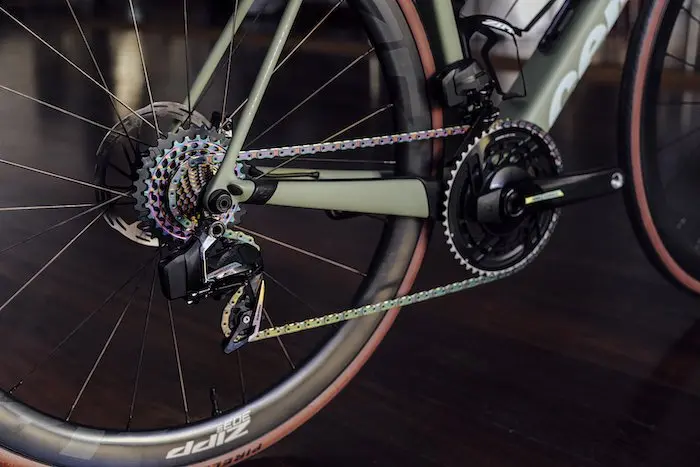
Sram drivetrains require the use of the entire ecosystem, with a specific freehub body and new gear ratio references. However, it should be noted that the derailleurs and chain are compatible with a Shimano 12-speed cassette (starting with an 11-tooth cog), and that it even works perfectly, even if both manufacturers do not recommend it. This is useful to know if you have spare wheels or an indoor trainer without the specific Sram XDR freehub body for a 10-tooth cog.
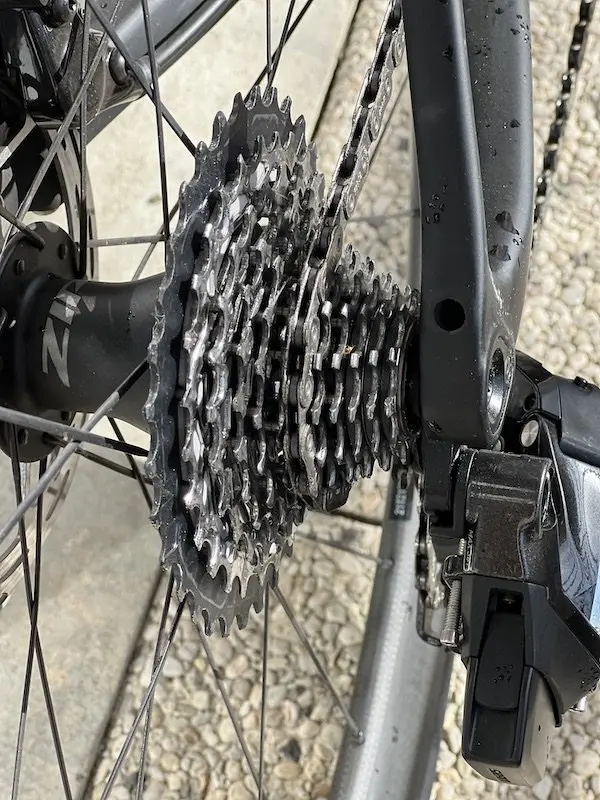
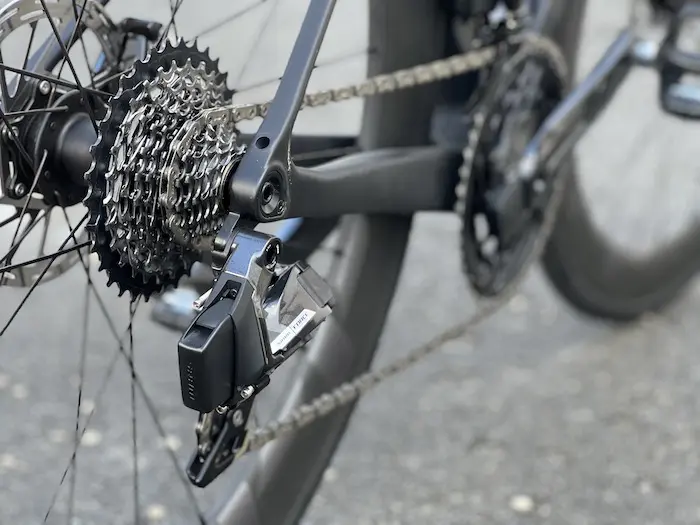
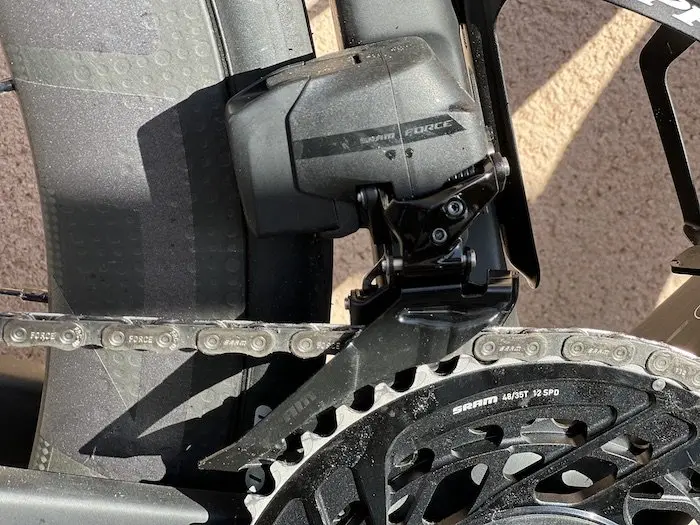
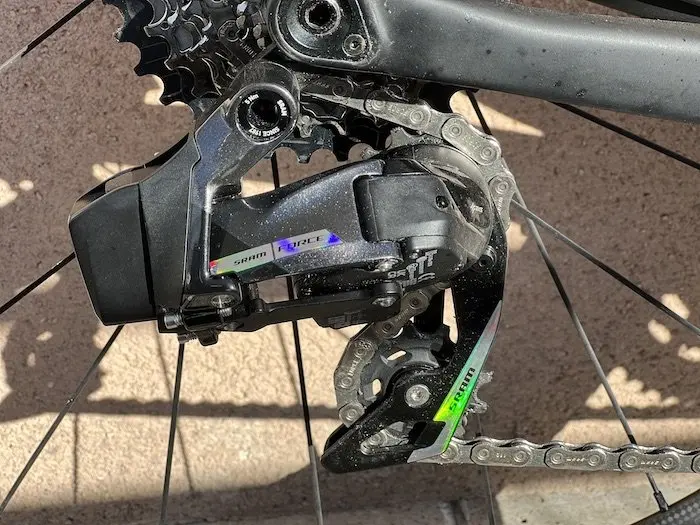
The front and rear derailleurs of the new Force AXS remain identical to the previous version, with an individual battery that can be swapped in case one of the two derailleurs runs out of power. A battery life of just over 1000 km depending on usage conditions. The rear derailleur accepts cassettes with a large cog up to 36 teeth. A push button located on each derailleur allows for shifting on a work stand, for example, or to initiate communication with the Sram AXS app. A green LED lights up on the rear derailleur with each shift, indicating proper system operation.
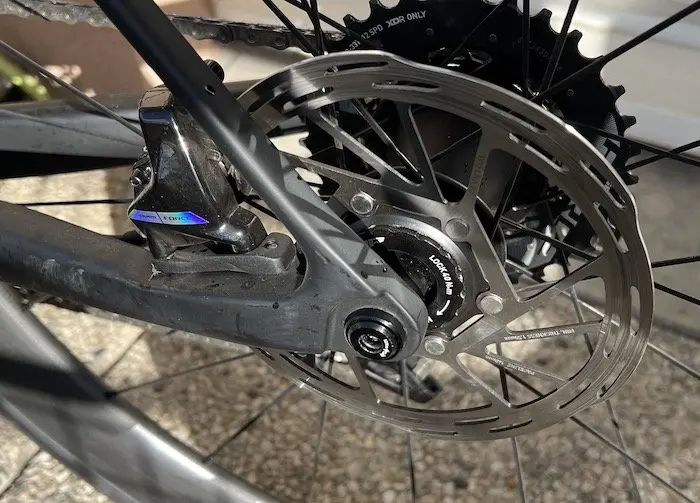
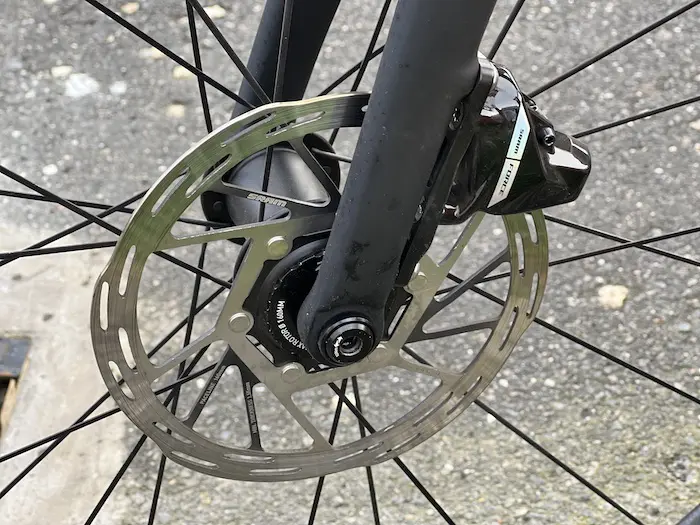
For braking, the Force groupset retains the calipers that were modified in 2020, with a two-piece design to facilitate manufacturing, more precise piston bore drilling, and less friction after prolonged braking. These have not changed for the new groupset. The same goes for the rotors, delivered on the test bike in 160 mm, as usually recommended by Sram for road use with its braking system.
What’s new on the Sram Force AXS groupset
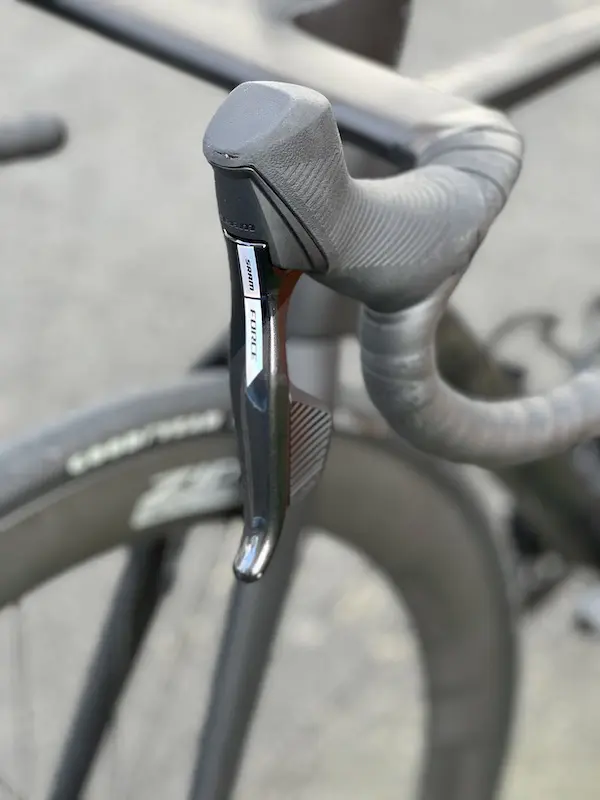
Visually, the new Sram Force AXS groupset stands out with its new levers, which adopt the dimensions and excellent finish of the Sram Rival levers, but here with a main carbon lever. What a change! Where the Force levers had a cheap feel with a blunt and sometimes uncomfortable lower part, the new version instantly makes the mid-to-high-end groupset not just functional, but desirable.
=> SEE ALSO : Sram Rival AXS groupset test
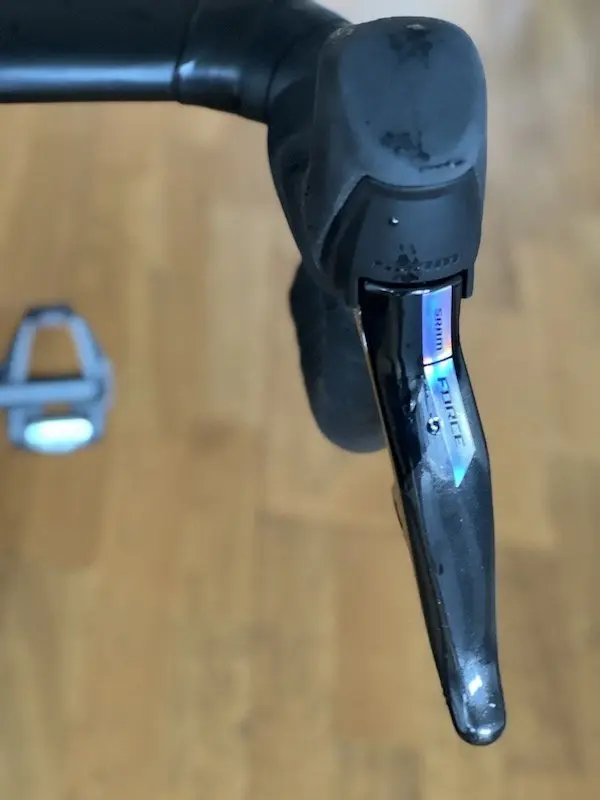
This slight reduction in dimensions, however, comes with the loss of a feature: the ability to adjust the brake contact point, an option rarely used by riders in reality. But the levers retain reach adjustment, with the possibility of bringing them closer to the handlebar, for those with smaller hands. The levers are also compatible with six wireless satellite shifters, which can be placed freely on the handlebar, to shift gears in any position if necessary.
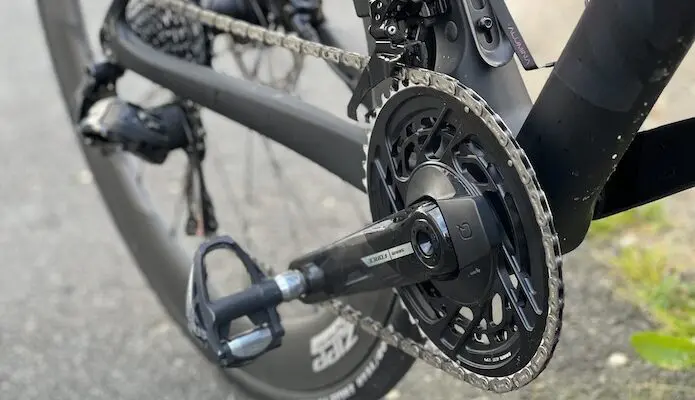
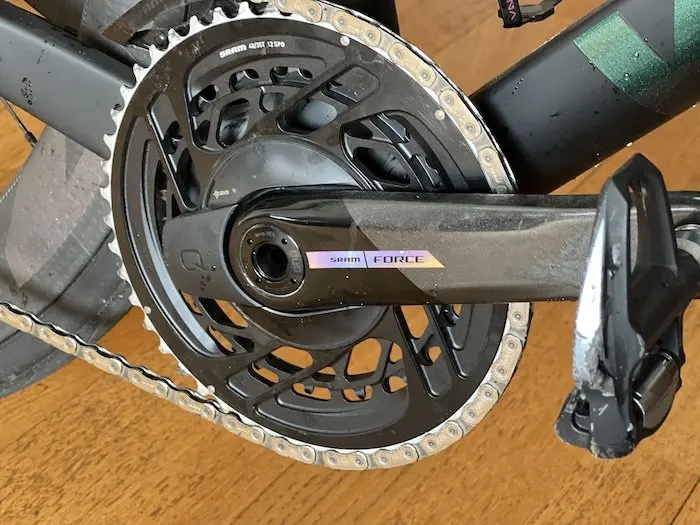
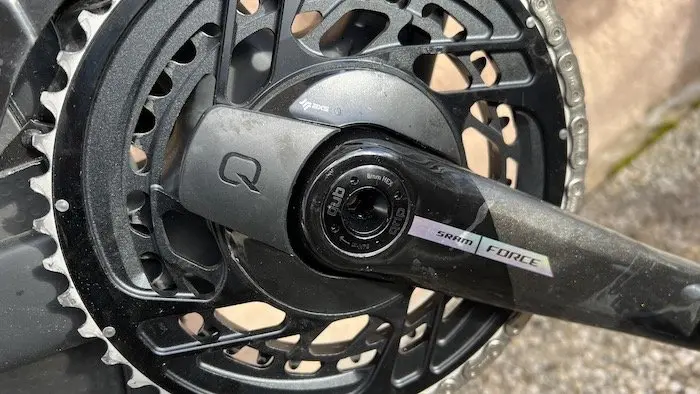
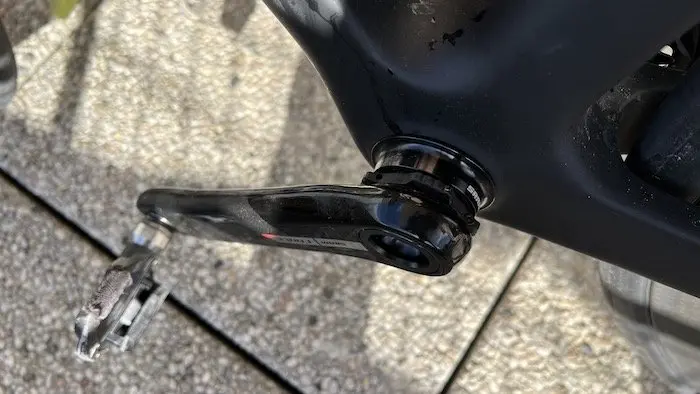
At the crankset, the chainrings adopt the Red crankset system, meaning they are linked together, for a significant gain in weight, but especially in stiffness. Aesthetically, the evolution is also very successful. This crankset is offered in multiple versions, in double or single chainring, in Wide version (43-30 with a different chainline for wider tires at the back), with or without a power meter at the crank spider, or in the spindle to measure power only on the left leg (1x or Wide crankset). The real visual revolution is in the double crankset, in 46-33, 48-35 or now 50-37, with the Quarq power meter identical to the Sram Red groupset, which only adds 40 g to the crankset.
On the road with the new Sram Force AXS groupset
The first contact with the Sram Force AXS groupset is made via the shift/brake levers, and the impression is immediately very positive. Compared to the previous version, there is a noticeable increase in comfort. The upper part of the levers remains a bit bulky, but the body itself is slimmer, and above all, the finish is significantly more premium. Gone is the feeling of a sharp edge on the index finger when gripping the levers tightly. The touch is softer, even on the shift lever, which has a texture that promotes intuitive movements during action.
It takes little time to get used to Sram ergonomics and the principle of shifting with the right and left paddles. The rear derailleur operates silently and with great fluidity. We had been left with the first cassette of the 2019 livery (black), which was a bit noisy, but that is now completely a thing of the past. Even the small 10-tooth cog, which normally does not favor the best chain wrap, seems to offer perfectly fluid operation on the test bike. The use of satellite shifters is also very intuitive with one button to shift down the cassette cogs, and another to shift up. However, unlike the paddles on the main levers, it is only possible to change one cog at a time by holding down the button here.
With the small chainring, the most extreme cross-chaining is prevented by the electronics (35/10) but 35/11 is possible, and also silent. At the other extreme, the maximum cross-chaining 48/33 is possible, but it rubs a little. To avoid this, we quickly opted for sequential shifting, with automatic chainring changes. When riding on the second-to-last cog with the large chainring and wanting to further reduce the gear ratio, the system automatically shifts to the small chainring and the 21-tooth cog to compensate for the difference. Thanks to the new integrated chainrings, the crankset here seems much stiffer than the previous version, and chainring changes are even more efficient, even when continuing to apply strong pressure on the pedals, whether using sequential mode or maintaining control over all actions of both derailleurs.
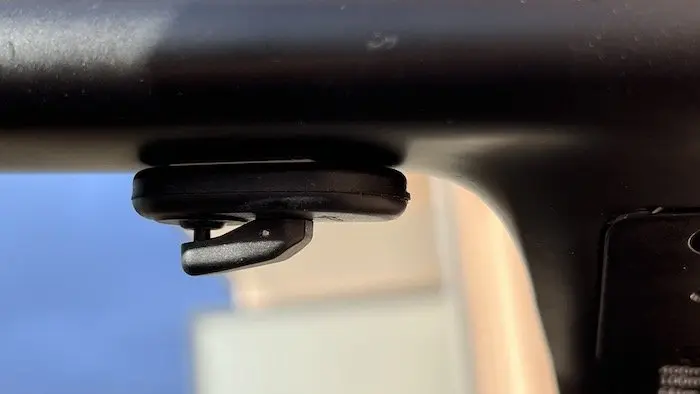
Unlike Shimano, Sram Force levers do not have an additional hidden button to change pages on a Garmin or Wahoo bike computer, for example. This is a shame, as the Sram app offers almost the same functionalities as the Shimano E-Tube app. This feature would, in our opinion, be the icing on the cake for a modern groupset that already makes the most of electronics.
In terms of braking, the Force AXS remains reliable and effective, while retaining the Sram feel, namely a slightly spongy lever feel, but with real effectiveness with 160 mm rotors. It still brakes very hard! In the rain, the system is noisy, and you can still feel some residual rubbing for a few seconds after hard braking, without it being prohibitive, of course.
Our opinion on the new Sram Force AXS groupset
Fundamentally, the new Force doesn’t really evolve, especially since some elements (cassette, brakes) had already been modified in 2020. It retains the same – often much appreciated – functionality and its weight is even almost identical to the previous version.
However, it is in terms of finish that it now clearly approaches the very high-end. And therefore, ultimately, in terms of comfort too. Because not only does this highly refined version seem quieter than the 2019 Force, but also more fluid, smoother to operate, and more precise, especially at the front derailleur. All this for a price that doesn’t skyrocket, which is rare enough these days to be highlighted.
The SRAM FORCE AXS groupset in brief… Rating: * Pros: finish, features, fluidity, numerous options Crankset: available in 46-33, 48-35, 50-37, and 43-30 (Wide), or in single chainring (36, 38, 40, 42, 44, 46 and 48 teeth), Wide. Power meter option in the crank spider (double crankset) or in the spindle (single or Wide). Crank arm lengths available: 165, 167.5, 170, 172.5, 175, and 177.5. Rear derailleur up to 36 teeth or 44 teeth (XPLR model). Groupset weight: approx. 2820 g. Prices: Levers + brakes: €420 Contact: www.sram.com |
=> SEE ALSO : All our Gear articles
Share the post "Review of the new Sram Force AXS groupset"