Share the post "Review of the Stages Cycling SB20 Smart Bike"
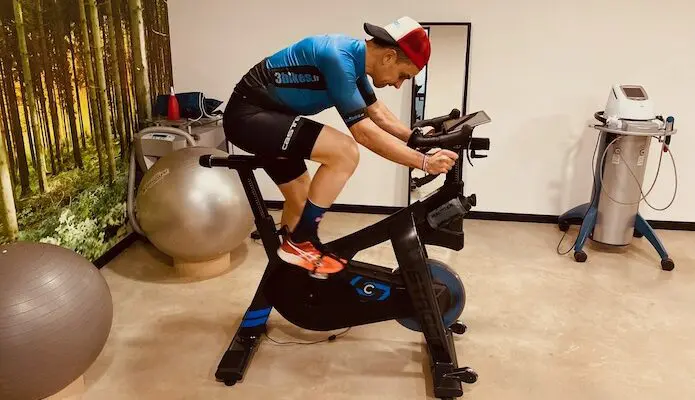
With the rise of connected indoor trainers and smart bikes, the promises made by the brands that design these technological marvels are becoming increasingly ambitious. Nevertheless, even today in 2023, when you decide to ride indoors while staying in the garage, it’s nearly impossible to accurately replicate the sensations of riding outdoors—in other words, those experienced in real-world conditions. So, with great curiosity and in collaboration with the Kinesis physical therapy center, we at 3bikes.fr had the opportunity to test, over a two-month period, a brand-new, high-tech training experience… with the Stages Cycling SB20 smart bike.
By Jean-François Tatard – Photos: DR

But before we take a closer look at Stages Cycling and share the results of our test with you, let’s explore what a smart bike is. First and foremost, a smart bike is designed specifically for cyclists. And even more so for those who strive for performance and are committed to a training regimen. This type of machine aims to realistically replicate the experience of outdoor cycling indoors, without having to leave home. Another common thread in the claims made by brands offering this type of high-tech product is that this indoor cycling option requires a greater investment than the now-more-common home trainers. In return, it offers unparalleled features and unmatched performance. Simply put, the smart bike is a standalone setup that requires no additional equipment, unlike rollers, rear-wheel-mounted trainers, air-resistance trainers, magnetic or fluid-resistance trainers, or direct-drive trainers. Connecting the device to software or an app is another matter entirely, since several categories of indoor trainers can be “connected.”
=> SEE ALSO: Indoor Trainers: What Gear Do You Need for Zwift?
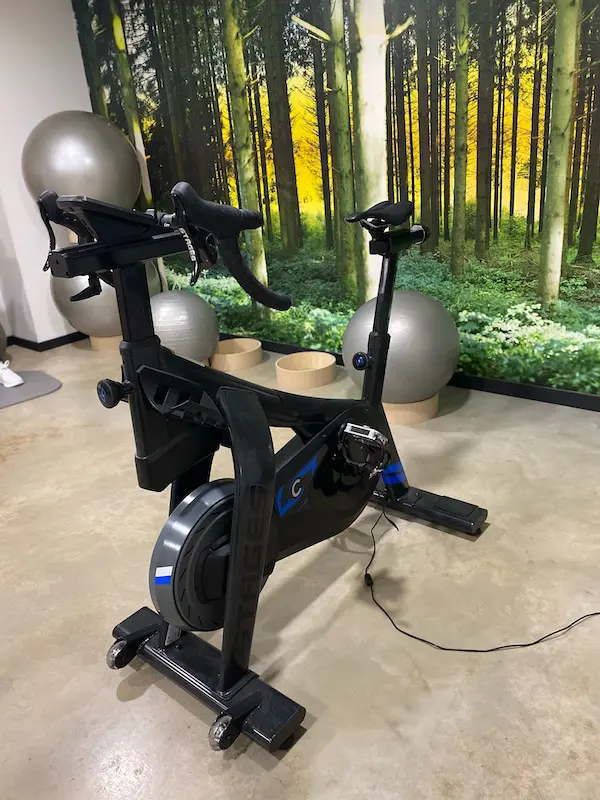
The purpose of this wonderful device is to completely replace the bike as we know it. It’s designed from the ground up to be the perfect indoor training tool. It’s also generally much quieter than a standard drivetrain, and most smart bikes—like the one we tested—feature sturdy frames capable of handling the toughest, most demanding, and most powerful stationary workouts, all while offering exceptional flexibility for an indoor bike.
Who is Stages Cycling?
Stages Cycling has over a decade of experience in cycling technology. Stages Cycling is a major player in this highly specialized field. Stages Cycling is made up of dozens of employees who bring extensive industry expertise to launch and lead the company. Stages Cycling is quite simply one of the world leaders in the commercial production of indoor bikes and power meters. The brand was launched in 2012 with a mission to improve the performance of every rider. The company was founded by Jim Liggett and his brother Scott, who brought together the collective talents of executives, product designers, and indoor and outdoor cycling enthusiasts from across the fitness and cycling industries. The team’s shared goal was driven by a passionate belief that this new company could make a significant and widespread difference by making power measurement accessible to all cyclists, whether riding indoors or outdoors.
The American brand, which was founded in Portland, Oregon, and whose R&D is now based in Boulder, Colorado, offers more than just a simple, comprehensive training solution; capable of providing the precise metrics we’re looking for, thanks in particular to this fabulous indoor training tool called the Stages SB20—which has a 5-star rating and is considered by most, even before we’ve tested it, to be the best smart bike in the world.
Let’s see what this gem has to offer!
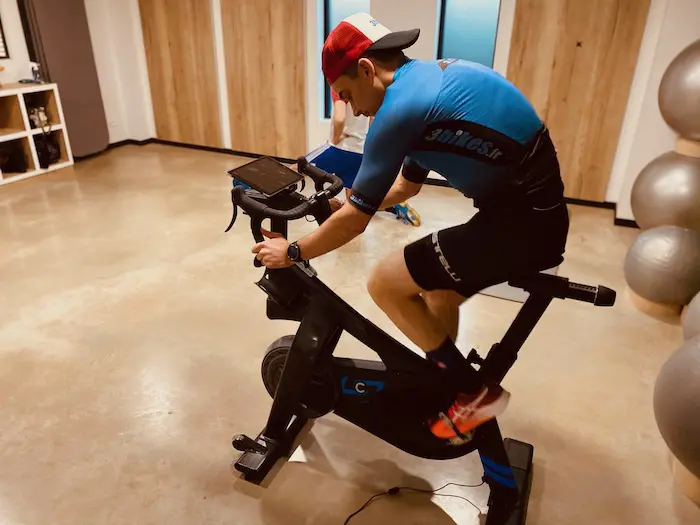
First and foremost, to get the most out of the experience, we felt it was essential to choose a testing environment where everything came together so we could take full advantage of every feature of this equipment, which promised us an unforgettable indoor sports adventure. So, naturally, we knocked on the door of our friends at Kinesis in Méry-sur-Oise in the 95 department. A physical therapy center spanning over 500 square meters, equipped with the very latest machines and the most modern, high-end technologies for rehabilitation and physical conditioning. All of this is supported by a team of twelve sports and health professionals with complementary skills and techniques. As for Mathieu Moretti, the center’s CEO and himself an expert in high-performance sports physical therapy, he was the one who received the equipment and took the lead in coordinating the experiment, with regular updates between him and me.
Once the equipment was set up in a room specifically dedicated to high-end fitness equipment, Mathieu helped me explore everything the SB20 had to offer, including personalized programs designed for the center’s athletes. As you can see, with this SB20 smart bike, we wanted to go beyond a typical test on Zwift or another app, recognizing that this device is ultimately much more than just a connected home trainer.
First impressions…
At first glance, an exercise bike isn’t exactly a dream come true for a cycling enthusiast… But when Mathieu and I opened the box, we realized that, actually, it was already much more appealing. And that, in fact, we could imagine the riding experience would be significantly better than what we’d experienced with more traditional indoor trainers. But while the virtual reality aspect is definitely there, we still had to justify the €2,500 investment for what, for many, is still just a gadget and another bike taking up space in the garage. So what we immediately thought was that if this is for a specific use case, it would only appeal to the most dedicated riders—the same ones who use popular platforms like Zwift several times a week on a strict and regular schedule.
I hope you have enough space at home?
The SB 20 is a piece of equipment that takes up space. It cannot be disassembled and therefore cannot be stored away either. It’s a permanent installation, so you’ll need to think this through before committing. Expect it to take up about the same amount of space as the various pieces of equipment in a gym—roughly 1 m³, distributed as follows: 2 × 0.5 × 1 m.
Mathieu and I received ours from Kinesis on a pallet, weighing a total of nearly 90 kg. Of that, 62.5 kg was just for the bike, which came fully assembled. Thanks to the roller-style wheels under the Smart Bike’s feet! It’s impossible to move the bike without…
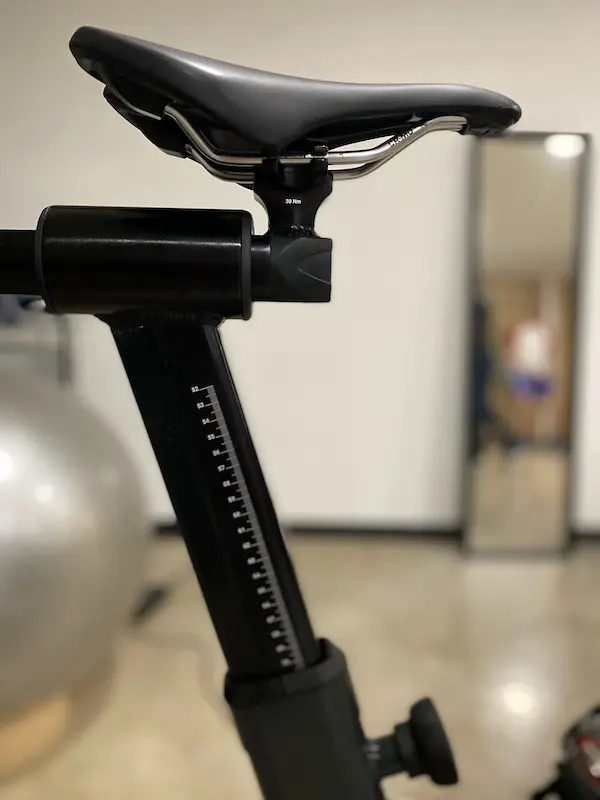
Among the first advantages we noticed are:
- Each adjustable component has a scale.
- Once you’ve found the right position, simply note these values to quickly adjust your bike.
- All contact points can be adjusted without tools.
- The saddle can be adjusted for rearward position relative to its carriage or relative to its “seatpost.”
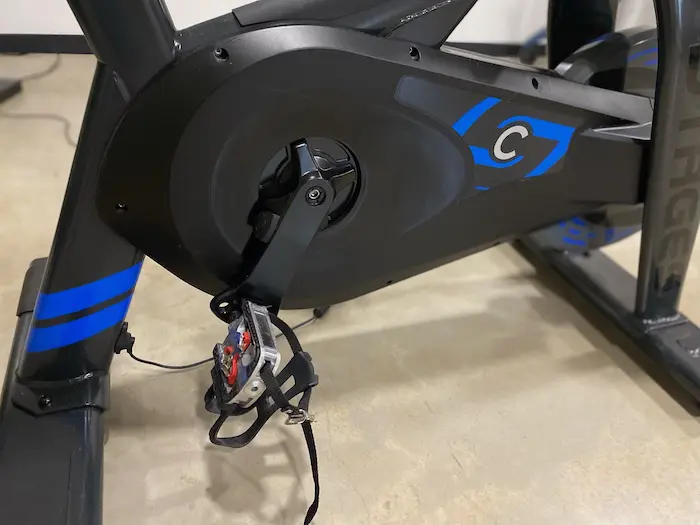
In short, the SB 20 is a custom-fit tool that adapts to everyone because it’s fully adjustable: saddle height, handlebar height, saddle setback, or stem setback—anything is possible. We didn’t do it, but you can also change the handlebars and saddle. And the pedals. All these components are standard. Just measure the adjustment dimensions of your actual bike and transfer them; the adjustments are made using levers, so no tools are needed. The bike comes with pedals that have one flat side and one SPD-compatible side. These are standard parts as well; the only hassle is screwing the pedals in using a 6- or 8-mm Allen wrench. Tightening and loosening them is a bit of a chore. The cranks offer four lengths—165 mm, 170 mm, 172.5 mm, and 175 mm—thanks to offset mounting holes. The SB 20 is therefore set up exactly like the bike used on the road, down to the millimeter!
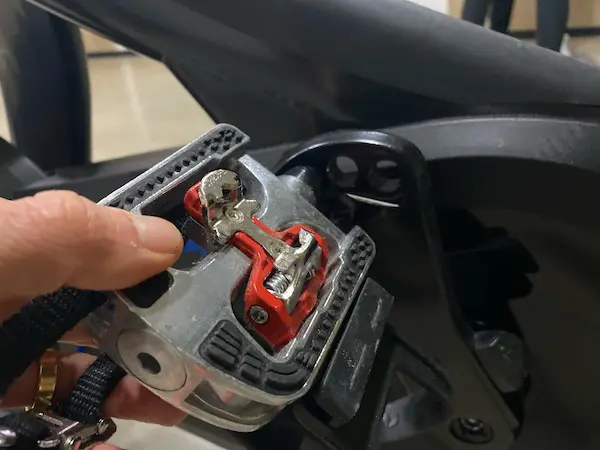
After a few minutes, the bike is set up and ready to ride; all that’s left is to configure it via the app. Power is measured by a sensor on each crank arm. This is a plus because the power is measured close to where it’s applied—rather than extrapolated—so you get greater accuracy. There’s a tablet mount, paired with two USB ports for charging.
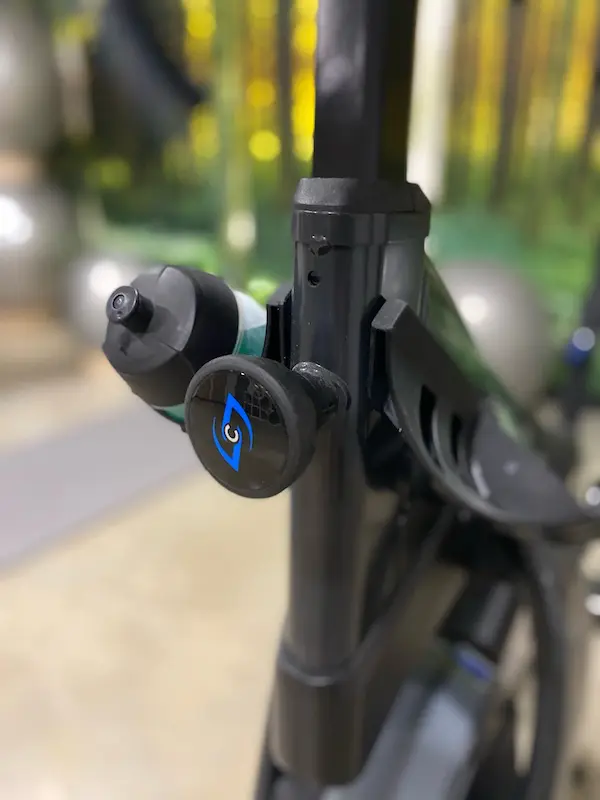
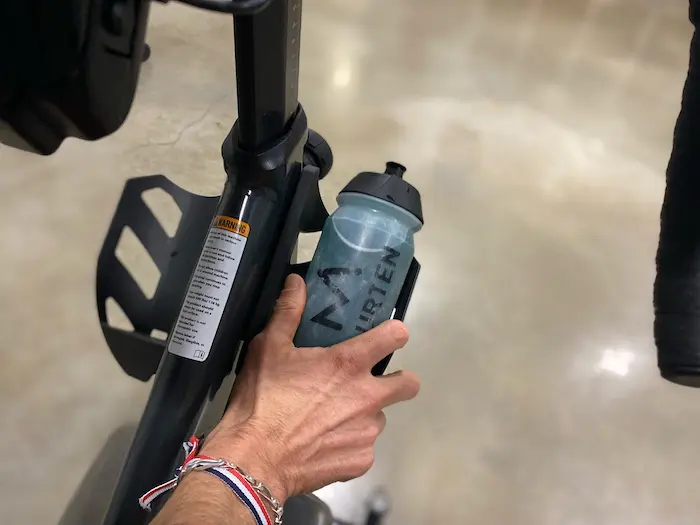
And you know what? We’ll be able to ride for at least two hours. Why? Because there are two water bottle cages located at the front…
And what about the power meter?
Did you know what originally made the American brand so successful? It was the power meter that launched the Oregon-based brand’s success. And in that sense, the SB 20 is equipped with two power meters on its cranks. Each crank has one.
Another thing: the flywheel weighs 23 kg and provides a fairly realistic—and, above all, very quiet—pedaling feel; the maximum power output is 2,200 watts, and the maximum simulated gradient is 25%. To use the SB20, you need to connect it to the app, where you’ll set up the power sensors as well as your gear-shifting preferences.
It also features handlebar controls with an active brake lever to slow down and stop the resistance, as well as customizable buttons for shifting gears. There are also satellite buttons positioned at the bottom of the handlebars, similar to Shimano’s sprinter buttons. In terms of drivetrain options for the SB20, you can choose a single-chainring setup with 25 sprockets or opt for a double-chainring setup with 11- or 12-speed options from Campagnolo, Shimano, or SRAM. You select your own chainrings and cassette.
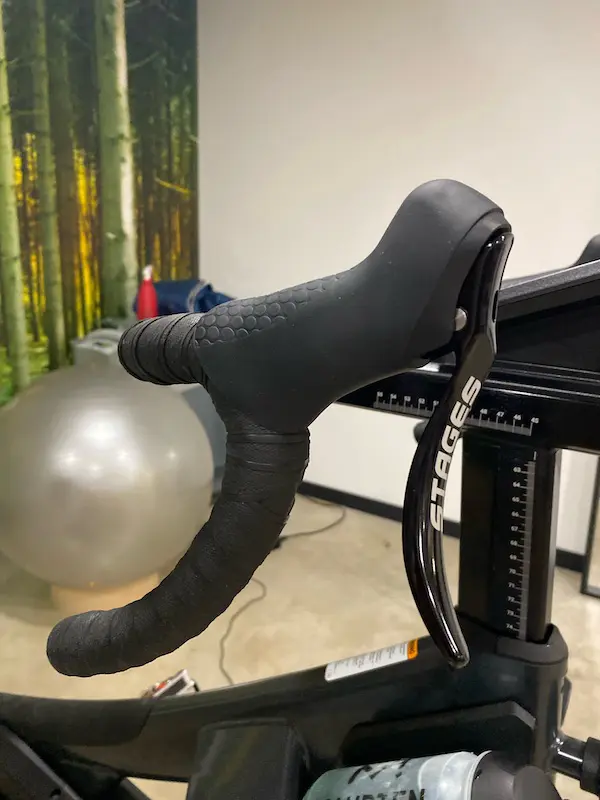
The app’s interface also lets you manage your workout by displaying gear changes, speed, cadence, distance, power output, left/right power distribution, and even the gradient. The app can also guide you through a virtual route and manage a workout in ERG mode. GPS devices can also handle this. Another, more fun option is to connect to a virtual training platform like Zwift.
=> SEE ALSO: How Good Are the New Apps for Home Trainers?
What we thought of it and what Mathieu’s select group of testers thought of it
Once properly adjusted, you quickly find your bearings, whether in terms of ergonomics while pedaling or your overall riding position. Also, compared to a bike mounted on a stationary trainer, the SB20 is much more stable. Energy loss is virtually zero. Whether seated or out of the saddle, you feel completely confident. And best of all, you won’t disturb the neighbors above or below, because it’s significantly quieter than anything we could have imagined. Braking serves no purpose in the simulations, but it allows you to temporarily increase the resistance when working with the app. The simulated gear ranges are realistic and even let you try out combinations for real-life use. Mastering the gear shifts takes a little practice to get it just right. There are buttons on the shifter and on the handlebars, and it can sometimes be confusing to figure them out. You can add an audible click to be “sure” that the gear has shifted, which is quite useful. However, the relatively short travel of the buttons can sometimes be disorienting.
=> SEE ALSO: Buy the Stages Cycling SB20
In a nutshell: “Very realistic”
Without a doubt, when it comes to the riding experience, our sensations are surprisingly well reproduced during different rides, regardless of the rider. In fact, the inertia-based ride simulation provides a very authentic feel to each pedal stroke. It really comes close to what you feel on the road. Changes in gradient are immediate and consistent, and you can even “feel” the slipstream when racing on Zwift. As for stability, it allows you to pedal at full power without fear of falling or breaking the equipment. And we certainly didn’t hold back, sometimes riding flat-out out of the saddle.
The Stages Cycling SB20 in a few numbers…
|
Our Take on the Stages Cycling SB20
It’s a wonderful surprise. The indoor cycling experience, which feels so close to the real thing, will truly be unforgettable. But whether that’s enough to make you forget the hefty price tag—I’m not so sure… Indeed, at €2,500, this is only really for the most dedicated cyclists or, like Kinesis, professionals who have access to a space specifically designed and optimized for this purpose. Nevertheless, this medium-term test led us to conclude that the cost is justified for heavy users of virtual reality sessions or for those who want to split the investment among several people and avoid having to bundle up to brave the cold or rain—let alone traffic lights that stop us in the middle of an interval training session.
If you choose to equip yourself with the SB20, beyond the fact that you’ll have a very quiet, stable, and extremely high-performance device, you’ll be in possession of the ultimate product for cutting-edge training worthy of NASA experiments. And what’s more: you’ll stay warm and dry.
Now, it’s important to keep in mind that, in addition to the purchase price, this is a “permanent” installation that—most importantly—requires two digital sources to be used to its full potential, which means an even larger budget… Something that, in fact, might give the most hesitant buyers pause—or serve as the final push for the most die-hard enthusiasts
The Stages Cycling SB20 at a glance… Rating: ***** Pros: virtually silent, multi-user capability, customizable settings, high-tech power sensors, perfect stability, built-in tablet mounts with USB ports Connectivity: ANT+ and Bluetooth – Power measurement: Stages Power LR (dual-sided power meter) – Accuracy: +/- 1.5% – Wireless firmware updates – Metrics: speed, distance, power, cadence, gradient – Q-Factor: 157 mm – Drivetrain: Gates® Carbon Drive™ carbon fiber belt – Frame material: high-strength steel – Hardware material: stainless steel – Suggested retail price: €2,500 Contact: |
=> SEE ALSO: All our Equipment articles
Share the post "Review of the Stages Cycling SB20 Smart Bike"