Share the post "Dilecta Le Blanc Bike Review"
Born from the rebirth of the Dilecta brand in 2021, the Le Blanc model promises to combine a certain idea of tradition associated with steel frames with a certain modernism to face the inevitable competition from carbon bikes, whose technology makes it possible to meet users’ needs. But this steel, which equipped cyclists throughout the 20th century, has also evolved to confirm its strengths and rectify its weaknesses.
Text: Olivier Dulaurent – Photos: 3bikes.fr, Presse Sport/Papon
Dilecta is not a recent name, as the brand was created in 1913. Over the years, it prospered to the point of producing more than 20,000 bikes per year in its factory in a town in Indre: Le Blanc. But the company had to close its activities at the end of the 60s, after a brief return to the professional peloton for three years. It is on the basis of this glorious past and a father who was a former professional, equipped with Dilecta, that Eric Vanhaverbeke, who worked for several major French brands in the cycling industry, decided two years ago to re-establish a structure that highlights a past brought up to date.

No custom-made, but many options
High-end steel frames often rhyme with custom-made. But here, the choice was made to keep classic sizes with five sizes ranging from XS (51 cm) to XL (61 cm), which is also the size tested for this review. Observing the different geometries according to the sizes, it appears that they are relatively standard, meaning neither oriented towards pure racing nor excessively focused on endurance riding, as is often the case in dedicated ranges. In any case, the components (handlebars, stem, and seatpost) will determine the cyclist’s position.


The Le Blanc frame is manufactured by Cyfac, a true guarantee of experience and quality for this renowned frame builder. The tube set comes from Columbus, with the Spirit quality, whose thickness varies depending on where the stresses occur: a guarantee of rigidity where necessary, but also comfort in less stressed areas, not to mention the weight saving. At 1.7 kg on the scale in a medium size, it is clear that the weight difference is around one kilogram compared to the best carbon frames. But this additional weight is often relative, especially if the user is not necessarily at their ideal weight to the nearest kilo and is riding outside of high mountains.

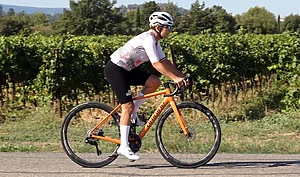
While the frame sizes are not custom, the range of colors is very appealing with 16 possible options, and the choice of rim or disc brakes is available. The test bike featured a stunning orange color, in addition to an absolutely impeccable finish. Under these conditions, the price of the frame kit (€2490) does not seem exaggerated compared to the best carbon frames, which today cost about twice as much, especially considering that we are dealing with French manufacturing and the associated salaries to offer the finished product.


On the road
The first pedal strokes, or more precisely the first energetic accelerations, reveal a rigidity that is difficult to suspect given the diameter of the tubes and the material used – some preconceived notions can be hard to shake. Over the kilometers, this rigidity will never be found wanting. Similarly, the homogeneity of the behavior should be noted: whether at the rear (the chainstays) or at the head tube, there is no “weak link”, the bike seems to be a single block.

These sensations must also be considered in relation to the frame size, and thus, successfully producing this rigidity with large tubes and generously sized triangles suggests similar behavior for more common sizes.
This behavior allows for maintaining a high pace when it is necessary to exert oneself against the wind or on a rather rolling climb. There is also no wobbling during out-of-the-saddle phases, whether with an excessively long gear or, conversely, with a high cadence.

This description of the Dilecta Le Blanc might suggest that we have a carbon bike here. However, this would be forgetting that the bike does not have the same acceleration capabilities as high-end carbon bikes. It is obviously possible to accelerate, but in terms of the explosiveness required when the cyclist needs to close a gap, make a powerful acceleration, or sprint, a discrepancy between the energy deployed and the speed achieved seems to occur. However, while this can be annoying for a competitor over short distances, conversely, a sportive rider or, even better, a cyclist who doesn’t pin on a race number, will be little or not at all bothered by this slight inertia. Beyond the material used, this can also be explained by the choice of chainstay length, here cut to 418 mm.

In any case, explosiveness does not “make” efficiency. If we had to define it, we could say that it is what allows you to go as fast as possible from start to finish, taking into account all parameters, especially fatigue. And it is on this aspect that the Dilecta makes up for it: while it is not as filtering (in terms of vibrations and small shocks) as titanium, in terms of comfort it proves excellent by absorbing all shocks very pleasantly as soon as the ride lengthens. A slightly tired cyclist will not feel like they are “hitting” the frame, as they might fear from a model that also makes the pros happy, who have twice the watts in their legs. This is how we discover over the kilometers that the rigidity of this frame is accompanied by an elasticity that gives different – but very appreciable – sensations than those returned by a carbon frame.

While the choice of long chainstays implies geometry and efficiency in a certain way, the choice of different angles and tube lengths allows for very high stability: it’s quite simple, the bike seems unshakeable as soon as the speed increases on descents. It is never necessary to make micro-corrections as is sometimes the case with certain very high-performance but very lively frames. But above all, this stability is not accompanied by difficulty in turning tight corners, and the whole thing turns smoothly without a “clumsy” effect in sequences or even hairpins.
Thus, and as we might expect, the bike is perfectly suited for long-distance use, even if speed and performance are sought after. The cocktail is perfectly balanced between ample rigidity for any rider, comfort, and a relaxed geometry that doesn’t require particular concentration to steer the bike. This is particularly noticeable in crosswinds: despite the profile of the Fulcrum wheels, and as if it were a predestined name, the Dilecta seems to delight in rides with strong winds.

For the rest, while the frame can be equipped with components of one’s choice, here the choice was to offer 100% European components, starting with a mechanical Campagnolo Record groupset. Accustomed today to electronic transmissions, which by definition excel in their ease of use, it was necessary to re-adapt to the operation of the Italian cable-actuated groupset, whose handling remains quite “manly.” But apart from this characteristic, which helps to bring back memories, the transmission and braking deserve nothing but praise.


As we might expect, the bike is perfectly suited for long-distance use, even if speed and performance are sought after. The cocktail is perfectly balanced between ample rigidity for any rider, comfort, and a relaxed geometry that doesn’t require particular concentration to steer the bike.
In the end, the Dilecta Le Blanc ticks all the boxes in the specifications of any sportive rider or even cyclist who is not looking “to win.” Indeed, whether it’s distance, hills or even passes, descents or wind, nothing frightens it, and the steel used for the frame has been updated to retain its qualities while eliminating the flaws observed in tube sets from a not-so-distant past. Let’s hope that cyclists who appreciate the bike’s qualities will not be deterred by preconceived notions related to this material, which has undergone its own revolution.
The Dilecta Le Blanc bike in brief… Rating: ***** Pros: surprising rigidity, comfort, frame elasticity, stability AND handling, overall ease of use Handcrafted French manufacturing in small, numbered series – Columbus Spirit steel frame fillet brazed and anti-rust treated by cataphoresis – Polished welds – Columbus Futura Disc SLX carbon fork 1-1/8” with 45 mm offset allowing for tire widths up to 30 mm – Columbus Compass headset 1-1/4” – In disc version, 12×100 mm and 12×142 mm thru-axles – Mechanical or electronic transmission (EPS, DI2) – Internal cable routing – Special DILECTA derailleur hanger – BSC68 threaded bottom bracket shell – Brazed and painted seat clamp – 27.2 mm seatpost – Finish with DILECTA logo on the fork and red stripe, brand signature on the top tube – 16 colors to choose from – Specific color customization option on request (+ €300) – Frame weight: 1.7 kg (size M) – Fork weight: 450 g – Tested complete bike weight: 7.9 kg in size 61 – Price: €2590 for the frame kit (rim or disc version) and complete bike starting from €4990 – Contact: Dilecta |
=> SEE ALSO: All our Gear articles
Share the post "Dilecta Le Blanc Bike Review"