Share the post "CyclingCeramic Bottom Bracket Review"
The bottom bracket is often overlooked because it’s a part that’s hardly visible—if at all. Like most bearings on a bike, for that matter. However, a low-friction system offers gains in both performance and durability. This is true of the CyclingCeramic bottom bracket, which also has the advantage of being available in multiple versions to fit all existing frame/crank set combinations.
By Guillaume Judas – Photos: ©3bikes.fr / DR For the past ten years, the French company CyclingCeramic has been offering bottom brackets, wheel bearings, derailleur pulleys with ceramic bearings, and, in recent years, oversized derailleur cages and “prepped” chains—all designed to minimize friction on a bike as much as possible. It’s all about squeezing out those last few watts that make the difference between first and second place.
How many watts? It’s hard to say precisely, even though in 2016 CyclingCeramic had its bearings tested by the renowned Friction Facts laboratory (which has since been acquired by the Danish brand CeramicSpeed). Compared to standard bearings (the kind that come with original equipment), the wheel bearings are said to save about 3 watts, the bottom bracket bearings about 0.5 watts, and the pulleys another 0.5 watts. That doesn’t sound like much, but it’s enough for those chasing ultimate performance—especially when you consider that this type of setup also offers advantages in terms of durability. The French brand claims that its bearings are 4 to 5 times more durable than standard steel bearings.
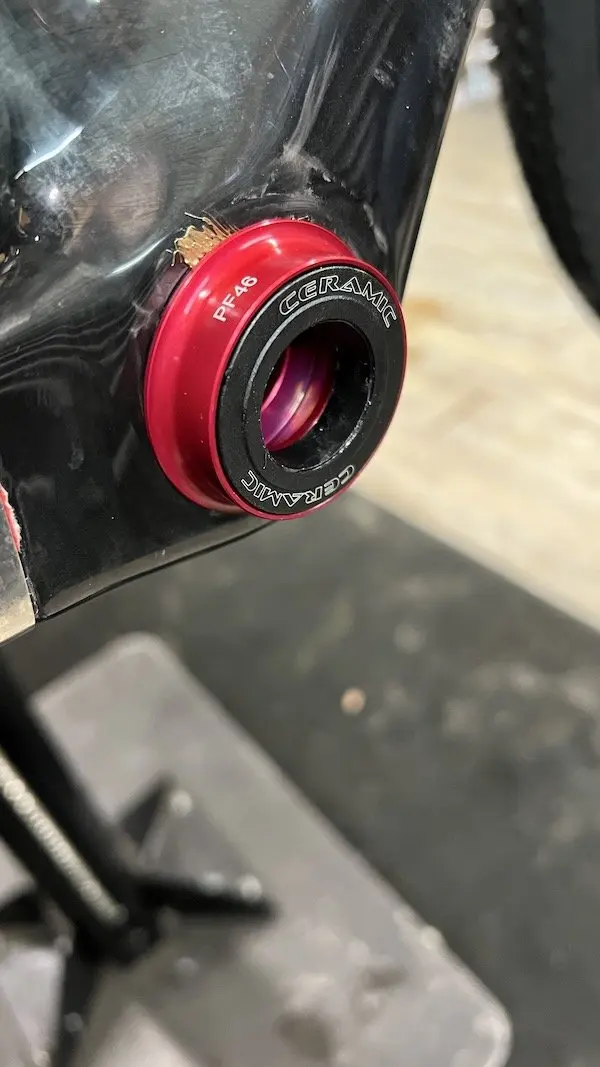
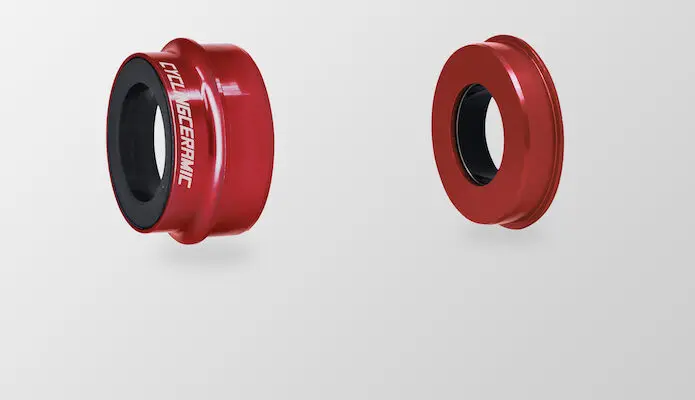
Add to that CyclingCeramic’s extensive range of frame and crankset compatibility options. The brand offers no fewer than 40 models, each available in a black or red anodized finish. No matter what frame you have or which crankset you want to install on it, it’s virtually impossible not to find the right bottom bracket at CyclingCeramic, and they’re all priced at approximately €185.
=> SEE ALSO: Frames and Cranksets—Understanding Bottom Bracket Standards and Compatibility
Marginal gains are becoming increasingly common among pros
Ceramic bearings are now considered a source of potential marginal gains by most professional teams and elite triathletes, but they’re essential for making a difference or staying with the lead pack on race day. As a result, many teams purchase their own bottom brackets, wheel bearings, or oversized derailleur cages (which also improve efficiency through better chain wrap) from three or four manufacturers recognized worldwide for the quality and durability of their products. A few years after officially equipping the Swiss team IAM Cycling, CyclingCeramic remains one of the leading brands in the field.
CyclingCeramic Bearings The advantage of ceramic balls over steel balls lies in their extreme hardness, smoothness, and lightness. There are several levels of finish for ceramic balls, with varying degrees of tolerance regarding their perfection. Grade 3 silicon nitride balls are the smoothest, and these are the ones exclusively used by CyclingCeramic (manufactured in the United States). This type of ball quickly wears down the steel races on which they are mounted, so it is necessary to use either very expensive ceramic races or steel races with a special treatment, such as the ultra-hard coating used by the French brand. CyclingCeramic adds polyamide cages to its bearings to reduce weight, along with specialized seals to ensure waterproofing and durability, as well as a special grease.
CyclingCeramic’s meticulous attention to material selection and manufacturing processes explains some of the price differences compared to other so-called “ceramic” bearings from China that are sold at low prices.
The 7075 aluminum bottom bracket cups are machined in France at the brand’s workshops with a precision of 0.03 microns to accommodate the bearings with precise fit tolerances and prevent bearing compression. This precision meets ISO 2768 standards specific to the European aerospace industry. The bearings are then pressed into the bottom bracket shell in a contamination-free environment.
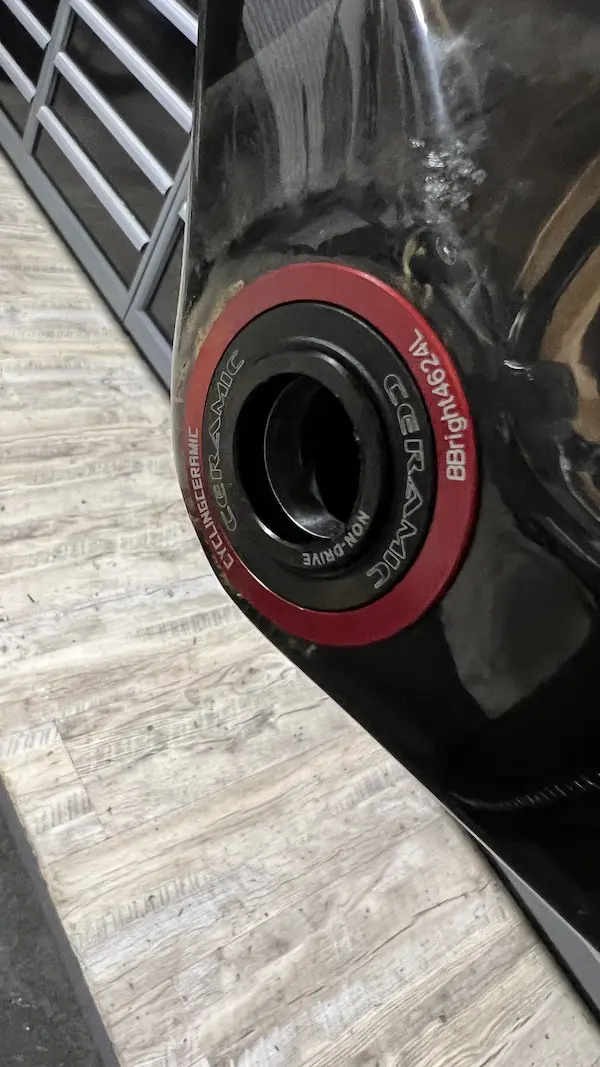
Particular care is taken in the selection of materials and manufacturing processes, which explains certain price differences compared to other so-called “ceramic” bearings from China that are sold at low prices but do not use the same type of ball or design as the French brand.
Unmatched smoothness compared to conventional bearings
Chosen to replace a conventional steel bottom bracket on a Factor frame in the BBRight format (like Cervélo), the CyclingCeramic bottom bracket weighs in at 99 g, compared to 115 g for the original bottom bracket.
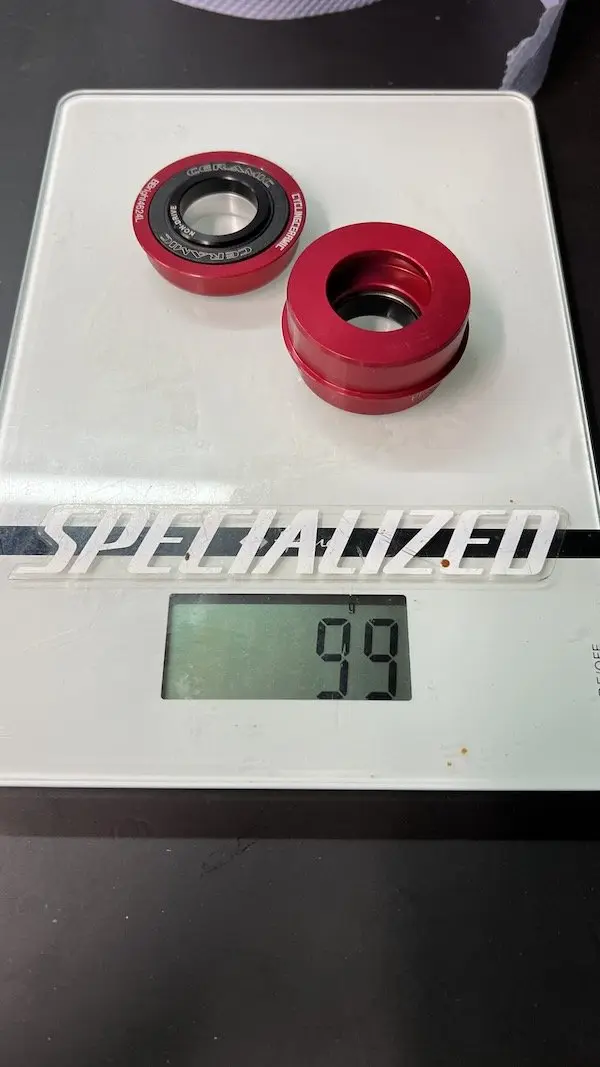
During installation, you quickly notice the unparalleled smoothness of this type of bottom bracket compared to a more traditional system.
Of course, once the bike is fully assembled with the second crankarm, the chain, and standard derailleur pulleys, this smoothness of rotation is less noticeable. However, on the road, you immediately notice a slight improvement—one that’s even more noticeable when pedaling at a high cadence. When riding at a steady speed in the small chainring, there’s less friction than before, even if there’s inevitably a bit of a placebo effect. It’s also worth noting that our other bike has a bottom bracket with ceramic bearings, so we’re quite used to this type of product.
Still, after 2,000 km ridden in winter conditions—and despite a few high-pressure washes—nothing has shifted on the Factor. We don’t notice any play in the bottom bracket. When we remove the chain from the chainrings, we can see that the crankset still spins just as freely. No noise, no creaking—despite an imperfect BBRight system that sometimes causes issues in certain frames. Note that the bottom bracket comes with a syringe pre-filled with special blue grease, and it’s time to apply a little to the bearings to further protect them from moisture.
So a much longer-term test would likely be needed to verify the claimed durability of the CyclingCeramic bearings. And the claimed efficiency gain of half a watt over a conventional bottom bracket—thanks to the lower friction of the ceramic bearings—is likely too small to be a compelling selling point for most potential users. What remains is that very noticeable smoothness and the vast array of options for CyclingCeramic bottom brackets, which are undeniable advantages, especially since the €185 price tag should be compared to the €50 to €60 already charged for a standard steel bottom bracket (depending on the brand and size). If reliability is confirmed over the long term, it could be well worth the investment.
The CYCLINGCERAMIC bottom bracket in brief… Rating: ***** Pros: smoothness, weight, build quality, finish, claimed durability, price compared to other ceramic bottom brackets, made in France |
=> SEE ALSO: All our Equipment articles
Share the post "CyclingCeramic Bottom Bracket Review"