Share the post "Diversify your winter training with alternative disciplines"
November and December are not the best months for road riding in most parts of France. However, autumn and winter have their charms… and their own alternative disciplines. Enough to get through these difficult months while still making progress.
Text: Olivier Dulaurent – Photos: Depositphotos.com
The context
In the minds of most cyclists, the season is simply divided: training resumes in winter, “hard” training in spring, races from spring to mid-summer, then rest in autumn.
However, a break that is too long and/or too pronounced will lead to detraining.
Therefore, other paths are possible:
- continue to train hard, with the risk of not being able to sustain it physically and/or psychologically.
- adapt to the conditions and vary training by trying “winter” disciplines.
In the second case, in other words, it’s about progressing while having fun, discovering new practices and reducing the constraint.
Swimming
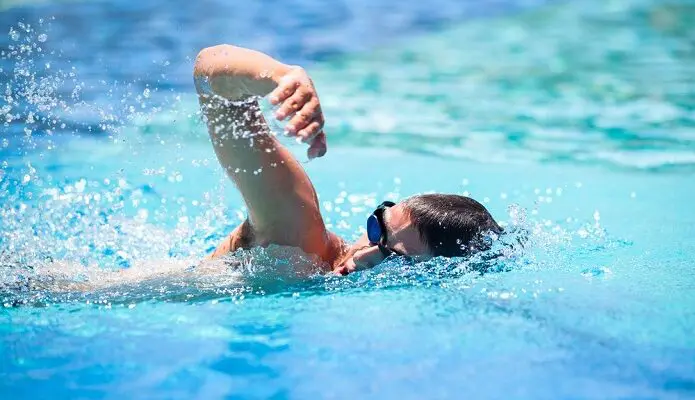
Beyond the notions of planning – it’s not about becoming a real swimmer in a few weeks during the off-season – or even training in the strict sense, it’s important to consider the principle of specificity: transfer phenomena are quite weak between cycling and swimming. However, the objective remains interesting: swimming improves physical condition.
On the other hand, if you really want to improve your swimming, with the eventual goal of discovering the world of triathlon in the future, it’s necessary to keep in mind that the skills acquired in this discipline fade much faster than for others because the technical dimension is much more present. This is why no “substitute” activity can be found.

Cycling in other forms
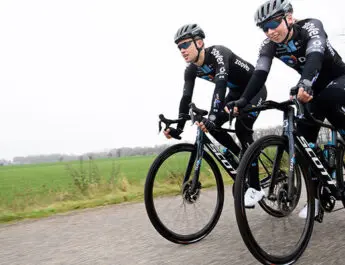
In winter, specific cycling activities stand out: mountain biking on the one hand, cyclocross/gravel on the other, which can potentially be practiced with the same bike.
More fun than road cycling, more enjoyable in cold weather, these activities combine several advantages:
- endurance work, maintenance of aerobic capacity.
- direct impact on performance: strength work, cadence, pedaling technique, changes of pace, etc.
That said, the characteristics of mountain biking, cyclocross, and gravel mean that these activities provide a real benefit to your cycling potential:
- work on agility, balance, trajectories, bike handling, self-confidence, all factors that will be interesting later, especially on hilly and technical courses.
- in both cases, you will be confronted with uneven courses, which will lead to “natural” strength work and changes of pace that will promote the development of your VO2max. This is always better than the traditional slow, unthemed road rides during this period.
These activities, both close to and distant from road cycling, can be used as training sessions, especially to vary the pleasures and avoid saturation, but also as competitions. In this case, they can constitute excellent pace sessions, but they should be consumed in moderation so as not to emerge from the winter period feeling fatigued.
The limits:
Be careful not to overdo it, however. While mountain biking, cyclocross, and gravel offer real progress to those who practice them regularly, particularly in strength and the ability to change pace, it is important to keep in mind that it is difficult to engage in specific, qualitative work by practicing these activities. Indeed, targeted sessions are more easily implemented on the road or on the indoor trainer. It will therefore be necessary to find a balance between, on the one hand, mountain biking and/or cyclocross-gravel, and on the other hand, qualitative and more specific work using one’s road bike.

Running
Mountain biking, cyclocross and gravel for cycling… trail running and cross-country for running.
The “winter” variations of cycling and running are ultimately quite similar: we leave the road for trails and paths, asphalt for mud or stones.
Cross-country, but also and above all trail running, are disciplines that continue to expand and are generally very popular with sportive cyclists, short-distance specialists and federation racers often turning to cross-country, which is very intense, while long-distance specialists are more often tempted by trail running, a discipline where the spirit is quite similar to that found in long-distance events (sportives).
What are the advantages of these practices?
Ultimately, we will find characteristics very similar to running, with two additional “dimensions”, and not the least, both related to elevation:
- they promote highly specific muscle strengthening.
- they offer multiple changes of pace.
It’s no coincidence that cross-country is renowned as a “very good school” for road marathon runners and that winter trails are enjoying growing success.
Preparing for these events means moving away from the road and track to train differently and more in nature with less calibrated sessions. There’s nothing like it to recharge your batteries and avoid saturation.
Like mountain biking and cyclocross, cross-country and trail running can be both training sessions and competitions.
In the latter case, several pitfalls should be avoided:
- avoid multiplying participations, especially for cross-country, so as not to hinder winter preparation and avoid fatigue
- do not fall into escalation and extremes in terms of distances for trail running to avoid setbacks (physical and moral) as well as injuries.
The limits:
Here again, we find a parallel with cyclocross/gravel and mountain biking: these outdoor training sessions leave more room for feeling and therefore less for specific work. However, progress comes from developing basic qualities, especially speed, technique, and VO2max. While cross-country and trail running improve endurance and strength, it will be necessary to find a balance with qualitative, targeted sessions performed on the track or road.

Chained disciplines
How can we not mention vetathlons (or green duathlons) and “run and bike” when talking about winter preparation?
In addition to being a particularly fun activity with a training partner or friend, these events allow you to change your horizons, which is always a plus for motivation. Moreover, the alternations between running (fast) and cycling (recovery) sections ultimately represent a natural interval training session that is largely beneficial for the rest of the preparation.
Conclusion
Cyclocross, mountain biking, cross-country, trail running, vetathlons, run and bike – all very interesting autumn and winter disciplines, both as competitions and as part of your preparation.
Each brings added value compared to road cycling. Be careful, however: it’s about varying the pleasures, maintaining intact motivation by changing disciplines while training, but it’s important to place them in the context of long-term preparation: you must therefore keep in mind that the ultimate goal will be to develop your basic qualities as a cyclist.

=> SEE ALSO : All our Coaching articles

Share the post "Diversify your winter training with alternative disciplines"