Share the post "The Benefits of Low-Intensity Training"
Because it’s always useful to remember – and even more so during the winter season – low-intensity training is the key element for long-term progress in an endurance sport like cycling. Here’s why.
By Guillaume Judas – Photos: depositphotos.com
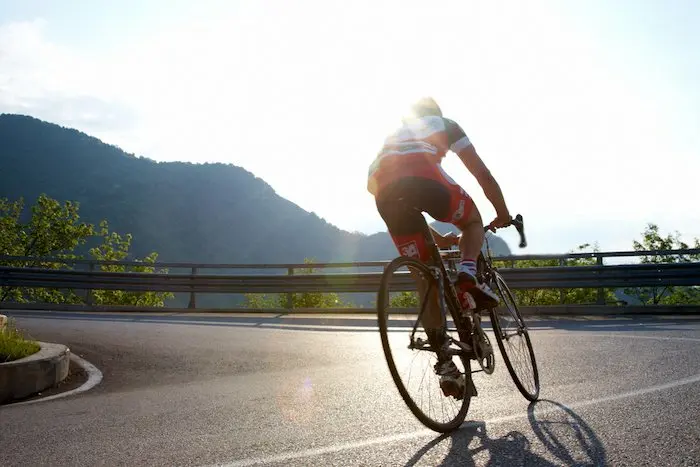
No Pain, No Gain (“you get nothing without effort”). This adage is still relevant when you want to progress in a sport as demanding as cycling. But where this common-sense phrase should imply notions such as diligence, patience, planning, and strategy, others choose to apply a more literal translation (“no progress without pain”) which does not lead to the desired effects. Accumulating training sessions by “hurting yourself,” or in other words at “sustained or high intensity,” can only lead to failure, or at least rapid stagnation.
Some constantly need challenges. Like catching up with the rider in front. Impressing a friend. Hanging onto a too-fast peloton. Exceeding their average speed. Or an indoor trainer session only possible by participating in a virtual race. But it’s often observed that this type of rider rides at almost the same speed all year round. This is the one who makes you suffer in December or January, but who gets dropped on the first climb in a race in June. And this is the one who stays in Pass Cyclisme their whole career while their friends eventually move up to the first category.
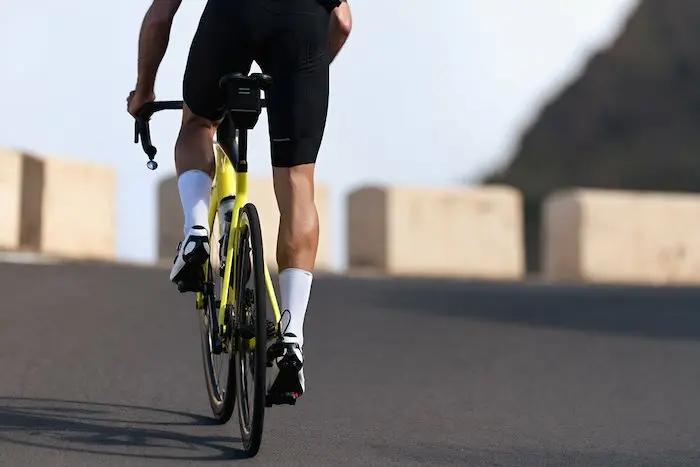
Obviously, this is not about saying that you can give your best without setting goals. But you must do it with rigor and strategy, and that means dedicating most of your preparation time to low-intensity training, to what is called “base endurance.” And this is even more true during the winter period, after a break or a reduction in activity. If professional athletes start high-intensity training very early, it’s because they have years and years of very high training volume behind them, which allows them to maintain a very high base level for a long time, and to get back in shape very quickly after a break. And since they are professionals, they always dedicate a lot of time to a large volume of training in parallel with high-intensity sessions.
What is low-intensity training?
The ESIE scale is a seven-level graduation of what you feel when exerting effort, named from I1 (Intensity 1) to I7 (Intensity 7). These terms are now used by almost all cycling coaches.
- I1 : light intensity, easy, relaxed effort, easy conversation, corresponding to < 50% of MAP (Maximum Aerobic Power), or < 75% of Max HR (Heart Rate). Training objective: long hours of effort, relaxation, regeneration.
- I2 : medium intensity, corresponding to a pure endurance effort, no muscle pain, easy conversation, fatigue occurring after 3/4 h of prolonged effort, 50 to 65% of MAP and 75 to 85% of Max HR. Training objective: increase endurance level, active waste elimination.
- I3 : sustained intensity, appearance of muscle tension, difficult conversation, exhaustion after 2h, 65 to 75% of MAP, 85 to 92% of Max HR. Training objective: effortlessly maintain the average intensity level of an event over time.
- I4 : critical intensity, progressive increase in muscle pain, very difficult conversation, exhaustion starting from 20 minutes, 75 to 80% of MAP, 92 to 96% of Max HR. This is the pace of a 20-minute time trial, or what is called anaerobic threshold intensity. Training objective: withstand high competition intensities, or course difficulties (elevation).
- I5 : super-critical intensity, very rapid and quickly unbearable increase in muscle pain, very complicated conversation, exhaustion between 3 and 7 minutes, around 100% of MAP and between 96 and 100% of Max HR. This is the pace of a climb ridden all out. Or what is called MAP. Training objective: increase pain tolerance threshold (for key phases of an event, to follow or make a difference).
- I6 : sub-max intensity, extreme suffering during effort, close to nausea, exhaustion between 30 seconds and 1 minute, around 150% of MAP, HR not significant. Training objective: lactate tolerance (puncher abilities, uphill sprint).
- I7 : maximal intensity, impression of an effort in apnea, very short, no muscle pain, hyperventilation at the end of exercise, max effort of 7 to 10 seconds, power peak or 250% of MAP, HR not significant. Training objective: develop maximal strength, improve motor skills).
When we talk about low-intensity training, we refer to the first two levels I1 and I2, and even more precisely to I2 in order to best optimize the time spent pedaling. This is in contrast to higher intensities, which are rather to be reserved for the competition approach phase, and of course for the competition itself.
Why low-intensity training?
Endurance work must be the basis of any performance preparation, and it is also what allows for long-term progress. It is, in a way, the foundation of the season.
Accumulating time in this intensity zone offers numerous benefits for physical fitness.
First, physiological adaptations:
- Increase in the number of mitochondria (present in all cells and which allow ATP production)
- Increase in the number of blood capillaries (which transport nutrients in the body)
- Increase in VO2 max (maximal volume of oxygen that can be consumed during effort)
Then, metabolic adaptations that notably allow for easier use of lipids (fat) as an energy source rather than sugar (stored in more limited quantities in the body). Good low-intensity training allows the thresholds for using these different energy substrates to get closer to VO2 max. This is with the aim of gaining endurance by pushing back the threshold at which sugars are used to produce effort, and to lose weight by reducing body fat. This type of training also allows for progress in terms of energy economy to produce the same power, both in terms of movement and metabolically.
Accumulating low-intensity training time therefore allows the body to get used to maintaining a stable state for longer, and thus to gain endurance. This is obviously essential for preparing for long events (such as sportives). It also allows for slow (but sure) progress in all other intensity zones, except for I6 and I7. And above all, a long cycle of low-intensity training allows for better enjoyment of high-intensity sessions later on.
The trap of overly intense training
High-intensity training, poorly conducted or poorly planned, is certainly immediately beneficial in terms of performance, but it leads to rapid stagnation. With an insufficiently prepared body, the athlete quickly reaches their maximum capacities, and they constantly need to increase the intensity and difficulty of sessions to progress, while generating increasingly significant fatigue induced by these training sessions, both physically and psychologically.
By adopting primarily low-intensity training, progress is slower, but more sustainable, and it allows you to go further. Moreover, the gradual increase in training volume each year is relatively easy to physically tolerate.
With a good base of physical fitness thanks to a long cycle of low-intensity training, progress is also quite rapid when it’s time to integrate high-intensity sessions into the training week.
With a good base of physical fitness thanks to a long cycle of low-intensity training, progress is also quite rapid when it’s time to integrate high-intensity sessions into the training week. The introduced exercises can be longer and more difficult while generating less fatigue than when the athlete only trains at high intensity.
How should a low-intensity session be conducted?
It’s often in old pots that the best jams are made. The so-called “old-school” rides are still the most effective for endurance work. Sessions solo or in very small groups, where everyone takes their turn at the front in roughly the same way (riding an entire outing in the wheels is obviously counterproductive), where time flies by chatting but without lingering on the road, and flirting with other energy systems by simply responding to the terrain.
New practitioners will probably prefer more precise instructions. These will consist of staying as regularly as possible within the 75 to 85% of Max HR range (i.e., approximately 125 to 145 beats per minute for someone whose Max HR is 170 beats per minute, or 150 to 170 beats for someone whose Max HR is 200), regardless of the profile and elevation, by playing with the gearing to ride in sequences either with a high pedaling cadence or a bit more in force. A short, explosive sprint of 7 to 10 seconds from time to time is always interesting to integrate into this type of session. This helps maintain maximal strength and preserve a bit of vivacity.
Endurance is built by gradually increasing the duration of sessions. But also by maintaining a regular frequency of rides. Thus, it is more beneficial to do one long ride per week (gradually increasing its duration each week by 15 minutes, for example, until the desired endurance duration is reached), and several short rides in addition, rather than doing two long sessions with nothing in between. It is better, as much as possible, to maintain this habit of one long ride per week (which can last from 3 to 6 hours depending on the athlete’s level) throughout the season, and to take advantage of the rhythm of the additional short sessions to integrate high intensities, as competitions or different objectives approach.

| To learn more about heart rate and energy systems The energy muscles need is supplied by the biological transformation of ingested and stored foods, primarily glucose, which is stored in a particular form in muscles and the liver as glycogen. But the breakdown of fatty acids (lipids) also allows for the synthesis of energy usable by cells. For this energy source to be converted into fuel, it needs oxygen. Everything is immediately converted into ATP (Adenosine Triphosphate). ATP is the main source of energy directly usable by the cell. Depending on the intensity of the effort, the body does not use the same energy substrates and does not produce ATP in the same way. The first energy system (and the main one in endurance sports) is called the aerobic system, and it creates ATP by using oxygen, and by breaking down glycogen and fatty acids. This system produces few waste products in the body, and its limits depend on VO2Max (Maximum Volume of Oxygen Consumption) and glycogen reserves. The other two energy systems are anaerobic lactic and anaerobic alactic. The first produces ATP by breaking down glycogen exclusively, but also by producing lactic acid, which itself is responsible for muscular acidosis, rapidly limiting activity (rarely beyond 2 to 3 minutes at this very critical intensity). The second produces ATP by breaking down phosphocreatine, present in very small quantities in the body, for short, explosive efforts of a few seconds. Fortunately, phosphocreatine reserves are quickly replenished, in a few minutes. Glycogen, on the other hand, does not replenish for several hours, which explains why effort and reserve management is so important. For the anaerobic alactic system, heart rate is absolutely not significant (power in watts, yes!). It is a little more significant for the anaerobic lactic system, but the duration and intensity of the effort depend on glycogen reserves (which decrease rapidly) and the ability to tolerate acidosis. Clearly, you have very few cartridges during a training session or a race. It is mainly within the aerobic system that heart rate is important, because according to Fick’s principle (1870), it is directly related to oxygen consumption. In other words, monitoring heart rate and ensuring it stays within the desired values allows for managing energy potential during long-duration events or training sessions. Glycogen is the primary fuel used during effort, and it is also the most efficient. But reserves are limited, unlike fatty acids, a less efficient fuel but one that allows you to go very far. The improvement in physical condition linked to regular training and the body’s adaptations allows for pushing back the threshold (in intensity, power, heart rate) from which limited glycogen reserves are used in favor of fat reserves. |
=> SEE ALSO : All our Coaching articles

Share the post "The Benefits of Low-Intensity Training"