Share the post "Review of the Lapierre Xelius SL 7.0"
The latest generation of the Lapierre Xelius has evolved gradually and been updated to reaffirm its role as a versatile bike within the Dijon-based brand’s lineup. It has improved in key areas such as weight and integration, featuring a contemporary design and state-of-the-art components, while remaining capable of tackling any terrain. The Xelius SL 7.0 reviewed here is priced competitively (€4,799), but the wheelset isn’t quite up to par, as we observed on the road. By Guillaume Judas – Photos: Vincent Lyky

With the new Xelius, Lapierre sought to modernize a model already widely acclaimed for its versatility and value. This third generation of the Xelius follows in the footsteps of previous versions, while also boasting a more attractive design, with more aerodynamic tubes, integrated brake hoses (and, optionally, derailleur cables) into the head tube, while the 3D Tubular design at the junction of the top tube, seat tube, and seat stays has been retained but revised for a sleeker look.

Designed to reduce vibrations, this separation between the seat tube and the seat stays incorporates a straighter top tube for a more harmonious aesthetic, whereas the previous version curved upward as it approached the seat tube. The new Xelius is thus less polarizing aesthetically than its predecessor, while retaining handling characteristics that allow it to perform well on a wide variety of routes.


The Lapierre Xelius SL Lineup The third-generation Xelius SL is available in six models ranging from €2,999 to €8,999, plus a frame kit for €3,599.
- The Xelius SL 5.0 at €2,999 with Shimano 105 11-speed, Lapierre aluminum wheels, and an aluminum handlebar and stem
- The Xelius SL 6.0 at €3,599 with Shimano Ultegra 11-speed, DT Swiss E1800 Spline wheelset, and an aluminum/carbon handlebar and stem
- The Xelius SL 7.0 at €4,799 (our test bike) with Shimano Ultegra Di2 12-speed, DT Swiss E1800 Spline wheelset, and an aluminum/carbon handlebar and stem
- The Xelius SL 8.0 for €5,899, featuring Shimano Ultegra Di2 12-speed, Lapierre carbon wheels, and an aluminum/carbon handlebar and stem
- The Xelius SL 9.0, priced at €7,799, with Shimano Dura-Ace Di2 12-speed, Lapierre carbon wheels, and an aluminum/carbon handlebar and stem
- The Xelius SL 75th, priced at €8,999, featuring Shimano Dura-Ace Di2 12-speed, Shimano Dura-Ace C36 wheels, and an aluminum/carbon handlebar and stem
- The Xelius SL Superlight frame kit for €3,599 (with aluminum/carbon handlebar and stem)
A lighter frame For this new Xelius SL, Lapierre uses new Torayca carbon fibres that are lighter and stronger (IM T800 / HM M40J, VHM YS60, T1000) as well as a new UD carbon technology called SLI (Super Light Innovation). According to the brand, a new manufacturing process also delivers significant weight savings while maintaining the same handling characteristics regardless of the bike’s size. By modifying the layup during manufacturing, Lapierre is also able to offer three versions of the Xelius SL frame kit: a “standard” model found on complete bikes, a Superlight model rated at 725 g in size M—which would make it nearly 230 g lighter than the previous version—and a Stiff (stiffer) model. The Superlight and Stiff versions are available only as frame kits and in select sizes.

The frame weight of our test bike is listed at 845 g in size M, with a 390 g fork. This is on par with competing all-around models such as the Canyon Ultimate, the Specialized Tarmac SL7, and the Orbea Orca. Equipped with a 12-speed Shimano Ultegra Di2 groupset, a Lapierre aluminum/carbon handlebar and stem, DT Swiss E1800 Spline wheels, and Schwalbe One Racegard tubeless tires, the Xelius SL 7.0 tips the scales at 8.020 kg in size S without pedals—a figure that could be improved upon but still demonstrates the bike’s potential.

Because total weight isn’t everything—and the bike’s overall balance is also important—Lapierre positions the Di2 battery at the bottom of the down tube for better weight distribution. The Powerbox concept, designed to ensure efficient power transfer, remains a core element of the bike’s design. It comprises a beefier bottom bracket shell, a larger down tube, wider chainstays than the previous Xelius, and a head tube with 1.5-inch bearings, all of which contribute to the bike’s lateral stiffness. For versatility, the new Xelius SL is compatible with tyres up to 32 mm in width, which is an advantage for those seeking comfort. Improved Aerodynamics
Although it is joined in Lapierre’s Performance lineup by the Aircode, the third-generation Xelius SL also benefits from specific aerodynamic design work, with optimizations to the NACA and Kammtail tubes (down tube, seat tube, seat stays), the fork and the head tube, plus full integration of cable and brake hose routing. According to the brand, the new Xelius is said to save 7 watts at 40 km/h, 12 watts at 50 km/h, and 22 watts at 60 km/h. These are figures we cannot verify ourselves, and they will surely seem abstract to most riders. Still, there’s no denying that the third-generation Xelius SL is designed to ride faster than its predecessor.
 A Matter of Compromise
As for the components, the Xelius SL 7.0 is equipped with the very latest Shimano Ultegra Di2 12-speed groupset, featuring disc brakes. This high-performance groupset is every bit as good as its big brother, the Dura-Ace, in terms of operation. It also features a Lapierre-designed handlebar setup, with a rigid aluminum stem and a carbon handlebar—relatively classic in design with a round grip on the top— but which features fully internal brake hose routing before they enter the stem and the head tube. The brand also doesn’t skimp on a computer mount that’s perfectly integrated into the stem cover. The Fizik Argo Vento R5 saddle is more of a mid-range model, but it poses no issues with positioning. So far, the components are of very high quality, especially considering the bike’s price, with a groupset that lets you benefit from the latest technological advances.
 On the other hand, for the wheelset, Lapierre opted for DT Swiss E1800 Spline aluminium wheels with 32-mm-high rims and Schwalbe One tubeless tyres in 700×25 (actually measuring 29 mm). The setup is heavy and lacks responsiveness, and this choice was clearly made to keep the price down to €4,799. It’s a shame, because if we focus purely on performance, an upgraded Xelius SL 6.0 with carbon wheels would surely be lighter and more efficient, for a comparable price. This approach may nevertheless appeal to those who already own a high-performance wheelset, or who see interesting potential for future upgrades.
 On the road with the Lapierre Xelius SL 7.0
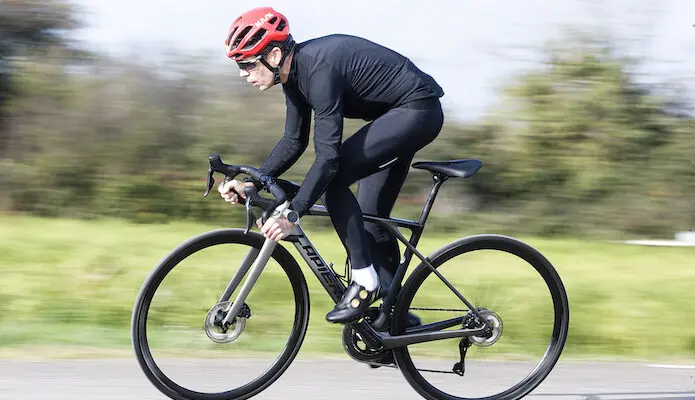
The Xelius SL is designed with a well-balanced geometry that offers a good mix of stability and maneuverability. Directional changes are crisp and precise, and the bike never feels unstable when picking up speed, even on very fast descents. When accelerating sharply after an intersection or a roundabout, the Xelius SL demonstrates excellent stiffness and, above all, great integration between the front and rear sections. Both wheels follow the exact same line without wobbling, even when you aggressively rock the bike from side to side while standing on the pedals to quickly gain speed. The frame feels solid under the pedals and effectively transfers all the power applied, without feeling harsh. It handles both a powerful, torque-driven pedaling style and a more supple approach equally well.

Up front, the stem, bars and head tube feel rock solid when you’re fighting the bike to clear a tough section. Yet this stiffness doesn’t translate into discomfort. The ride feels fairly smooth, and the rough pavement doesn’t transmit any unpleasant vibrations.
While you can feel the bike’s potential over short distances or on routes with little elevation gain, the fact remains that the Xelius SL 7.0 is significantly hampered by a wheel-and-tire package that’s too heavy. First, the tyres—mid-range models that are nothing special in terms of performance—bulge over the rims, measuring 29 mm wide (instead of 25). This means the tyres are wider than the rims. As a result, to prevent the sidewalls from sagging during weight shifts, you have to inflate them quite firmly, thereby losing the tubeless advantage in terms of comfort and grip. Next, the wheels. Weighing about 1,800 g, they clearly lack responsiveness, whether on climbs or during the frequent changes in pace required when riding through a major city’s suburbs. They roll smoothly thanks to their high-quality hubs, and they seem reliable. However, the rims aren’t tall enough to provide the inertia needed to maintain a good cruising speed on flat terrain.

In short, this is truly the bike’s weak point, which—unsurprisingly—is transformed by fitting a pair of high-end wheels and tires (in our case: Dura-Ace C50 wheels with Michelin Power Cup tires). This takes the bike into a whole new dimension—that of versatile, high-end machines that excel equally well in road races, criteriums, and mountain riding. The Xelius SL doesn’t stand out in any one specific area, but it’s perfectly balanced—no questions asked. Ultimately, that’s what makes it so appealing.

Our Take on the Lapierre Xelius SL 7.0 With this updated Xelius, Lapierre has hit the mark by offering a highly balanced, well-finished frame that handles all terrains with ease. The Xelius SL 7.0, equipped with the 12-speed Ultegra Di2 groupset for under €4,800, is a great deal, especially when you factor in the cutting-edge technologies provided by the new Shimano groupsets. But when it comes to pure performance, the wheels clearly don’t measure up to the rest of the bike and hold it back when you want to push it to its full potential. This shortcoming isn’t insurmountable, however, if you have another wheelset, or if you plan to gradually invest in your cycling as you improve.
The LAPIERRE XELIUS SL 7.0 at a glance… Rating: ***** Pros: build quality, integration, versatility, value for money Cons: wheelset too heavy, underperforming tires Frame: New Xelius SL Disc UD Superlight carbon – Fork: New Xelius SL Disc thru-axle UD Superlight carbon – Handlebar: Lapierre UD carbon – Stem: Lapierre – Brakes: Shimano Ultegra 160/140 mm – Front derailleur: Shimano Ultegra Di2 12-speed – Rear derailleur: Shimano Ultegra Di2 12-speed – Shift levers: Shimano Ultegra Di2 hydraulic – Cassette: Shimano Ultegra 11-30 – Chain: Shimano M7100 12-speed – Crankset: Shimano Ultegra 52-36 – Wheelset: DT Swiss E1800 Spline 32 – Tires: Schwalbe One Raceguard Tubeless Easy 700×25 – Saddle: Fizik Argo Vento R5 – Seatpost: Lapierre Carbon Light – Weight: 8.020 kg in size S without pedals – Sizes available: 5 – Price: €4,799
|

=> SEE ALSO: All our Equipment articles
Share the post "Review of the Lapierre Xelius SL 7.0"