Share the post "Long-Term Test of Michelin Power Cup 25 mm Tubeless Tires"
Today’s tyre market is becoming increasingly specialised. We’ve never had such a wide range of options, and every manufacturer is bringing its highest-performance model to the market, boasting the best efficiency, and so on. While Continental’s GP5000 SR now sets the standard for tubeless tires, French manufacturer Michelin has developed a model that rivals the very best the market has to offer.
By David Polveroni – Photos: DR This model, called the Power Cup—a worthy successor to the Power Road—is presented here in its tubeless version. The 25 mm test model will be followed by a personal purchase of the 28 mm version for another wheelset. The range includes several models, detailed in the table below. 
This Power Cup tire is available in tube, tubular, and tubeless versions. => SEE ALSO: Long-term test of Michelin Power Cup tires The first thing we can measure is its weight, which we verified here at 254 g. This is within the standard range for this category of tires. Once the tire is unfolded, it’s time to mount it. This can sometimes be complicated, especially with tubeless tires, depending on the tire/rim combination you’re using.

On the RAR, Topwheels, and Black Inc. wheels I was able to mount them on, I had absolutely no problems. Both beading went on easily; I had to use a tire lever to finish mounting them on Venn rims. That’s a plus. Next comes positioning them and snapping them onto the beads. Don’t bother trying with just a pump. The RAR/Conti combination is the only one I’ve successfully mounted using just a pump. You need to remove the valve core and blow a large volume of air into the tire; a compressor is ideal, but an air tank or even an air canister will do the trick. => SEE ALSO: Topwheels Light Bicycle Wheel Review
Once the tire is in place, you’ll inevitably need to seal it. As a reminder, this is a Tubeless Ready tire. To do this, inject at least 50 ml of sealant. Distribute the product evenly by spinning the wheel and/or shaking it vigorously. Inflate the tire to 5 bar for an initial test; make sure the sealant takes effect and seals the tire properly. Leaving it overnight should do the trick, provided you’ve used the correct amount of sealant. Sometimes you’ll need to go back and add more if you initially used too little…

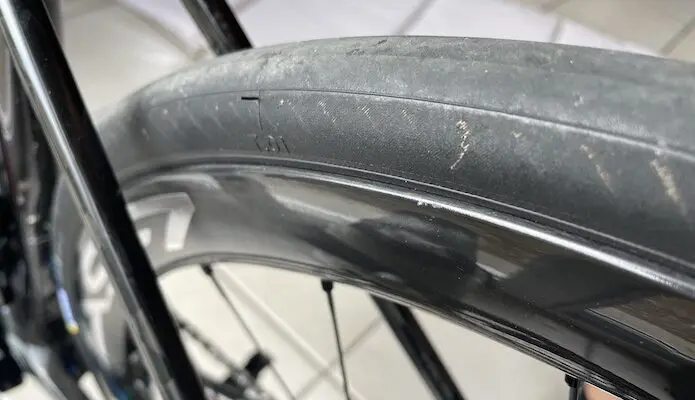
On our Rar Exalt rims—which we’ll be using most of the time to test these tires—the first thing that stands out is the bulge created by this tire. Rims with a 21 mm internal width give us an external bulge of 27 mm for these tires (700×25, as a reminder). The tire profile is therefore really not suited to these rims—it’s too wide and a disadvantage aerodynamically compared to a GP5000, for example. We’re being picky, but at this point, we consider it a mistake.
=> SEE ALSO: Long-term test of the RAR Exalt Disc wheelset We therefore contacted Michelin to clarify this point: the conclusion is that this tire is designed for all rims (and thus users) on the market, such as 17 mm, for example. A rim width that’s almost a thing of the past. That said, this is just our impression without having actually ridden on them. Top-Notch Performance The first few laps are quite impressive. You immediately feel like you’re riding a tire that’s gliding over the road. The language is undoubtedly exaggerated, but descents and fast sections are pure joy—the tire whistles like a tubular. A real treat! Riding out of the saddle, the tire offers that bit of responsiveness that Continental tires lack, to stick with the comparison.

While the tread may seem too thin at first glance, you don’t notice it at all on the trail. You can clearly see this dual-compound construction, optimized for efficiency in the center and grip on the sides. This tire performs very well in independent tests available online. That’s not the focus of this article—we trust those reviews and can definitely feel that “efficiency” effect. As for grip, we appreciate how well the tire handles corners on descents, with the bike feeling firmly planted on the ground—a truly positive and, above all, reassuring feature. In this regard, too, we’re at the top level. I opted for a tire pressure of 4.7/5 bar, which is what Michelin recommended for my 56 kg. And I must say that I really appreciated this balance between performance, grip, and comfort. That last quality is further enhanced on 28-mm-wide Topwheels rims, while the tire still feels efficient.  After nearly 5,000 km—4,700 to be exact—I’m nearing the end of the rear tire, almost down to the cord. The tires have been through all kinds of conditions, and we know that in the mountains, it’s mainly the rear tire that wears out. From the summer heatwave to the snow on the Gavia Pass, these are very versatile tires that have given me complete satisfaction despite a few minor flaws. The snow and cold, sometimes damp, ground on the Alpine passes this fall provided less grip than on warmer surfaces. But the right tire from the Clermont-Ferrand-based manufacturer would likely be an all-season tire at this time of year. On the other hand, it’s worth noting that the wider tire profile makes the sidewalls more susceptible to cuts, as numerous small nicks have appeared. Only once did I have to repair a puncture—on the sidewall—during those many kilometers.
The Michelin Power Cup Tubeless tires are therefore high-performance, durable, and resilient—all at a price of €60 each. This is pretty close to perfection “made in France,” so we’re not going to pass it up.
Michelin Power Cup Tubeless tires at a glance… Rating: ***** Pros: performance, grip, responsiveness, durability, weight, price; Cons: sidewalls more prone to cuts / excessive bulge on modern rims Type: tubeless tire – Protective layer: Aramid Shield – Compound: Gum-X – TPI: 3×120 – Bead wires: flexible – Colours: Black, Classic Beige Sidewalls – Available sizes: 700×25/28/30 – Weight: 254 g (verified for 700×25) – Price: approximately €60 (per tire) Contact: michelin.fr/bicycle |
Share the post "Long-Term Test of Michelin Power Cup 25 mm Tubeless Tires"