Share the post "Doping/MPCC: Credibility Figures in 2022"
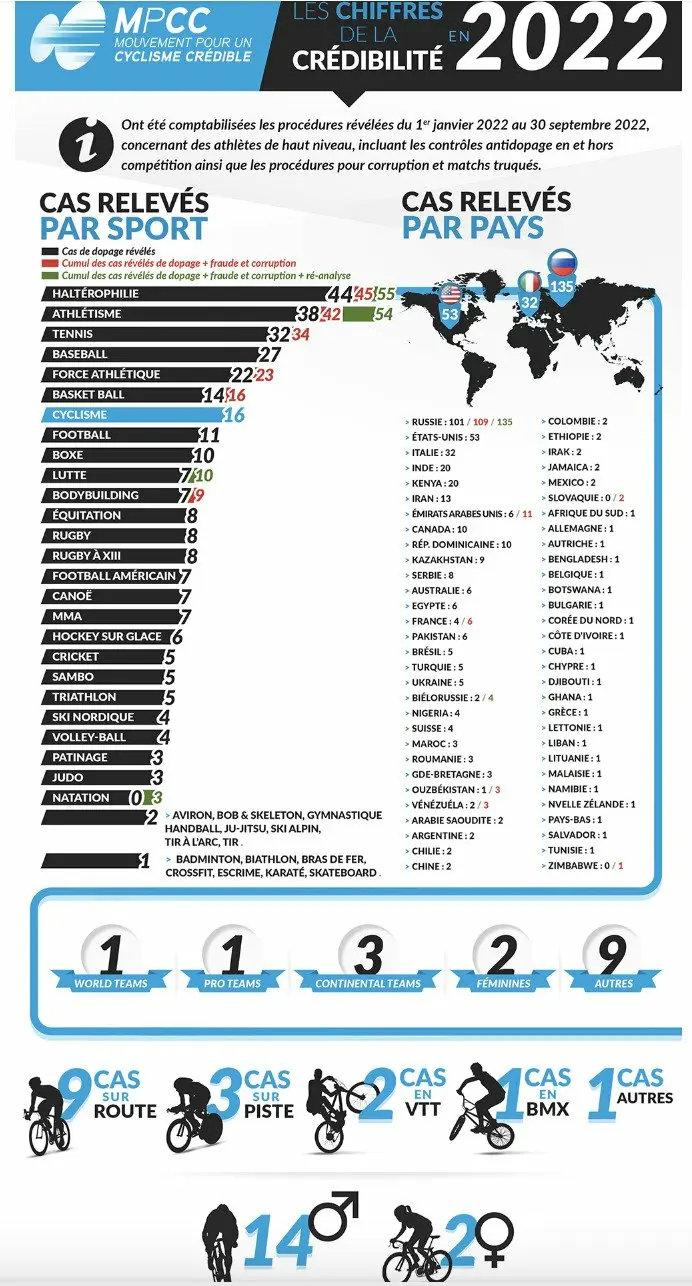
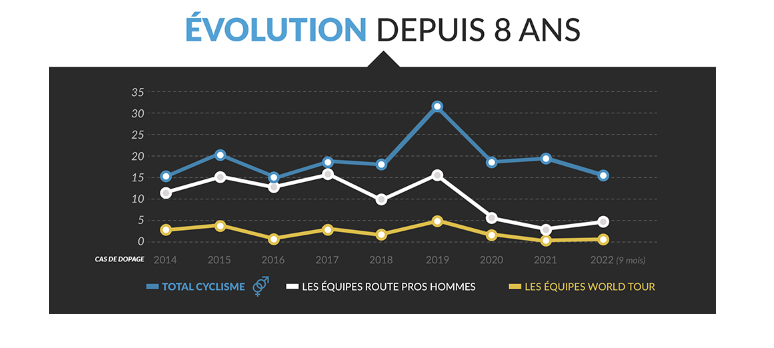
An increase in cycling-related procedures this summer. A dozen procedures concerning various cycling disciplines were revealed this summer, compared to only four cases during the first 5 months of the year. Explanations.
Source: Press Release
The figure may be surprising. In reality, only one case has attracted significant media interest, that of Nairo Quintana. Even if, in the strict sense of the term, the facts do not constitute a doping case, the Colombian rider was found guilty by the UCI for the use of a prohibited substance.
An use that the main interested party contested on Wednesday, October 12, in Lausanne, before the Court of Arbitration for Sport, which has reserved its decision. If the CAS confirms this positive test of the Colombian rider, it will be the very first sanction applied by the UCI for the use of Tramadol (Quintana was disqualified from his 6th place in the last Tour de France). This substance, whose use has been prohibited since 2019 by the UCI, has been prohibited for even longer by the MPCC (of which the Arkéa-Samsic team has been a member since its creation).
As early as 2012, the movement had prohibited Tramadol within its member teams. It is now admitted by all authorities that this level 2 analgesic causes dizziness affecting vigilance in race and rider safety. According to team doctors, this powerful drug also distorts the perception of pain, thus improving performance and ultimately impacting the athlete’s health. Ten years after the MPCC’s request to put Tramadol on the list of prohibited substances, WADA decided to ban it from January 1… 2024!
Like the overall country ranking, Russia is also the most affected for cycling (three track riders and one road rider), ahead of the United States (one road rider and one BMX rider) and Italy (two road riders).
Italy, facing its demons
The anti-doping fight in Italy remains very intense, with striking results. Limiting ourselves to high-level or professional athletes, there are already 32 procedures this year (all sports combined), compared to 34 for the rest of Europe (excluding Russia).
Regarding Italian cyclists, it should also be noted that the Italian anti-doping agency (NADO) has also suspended a dozen amateur cyclists, most of them for the use of heavy doping products (EPO in particular). Paradoxically, this is not the case for the two Italian professional cyclists shown in the graph. Vincenzo Russo (Qhubeka) allegedly evaded an anti-doping control. His compatriot Michele Gazzoli (Astana Qazaqstan) was also suspended, admitting to having used a medication called Rhinofluimucil (a nasal spray for the treatment of rhinitis). Even if the UCI specified that it was an unintentional violation of the anti-doping rules, the rider was dismissed by the Kazakh team.
It had been two years since a rider had been suspended within a World Tour team.
=> SEE ALSO: All our News articles
Share the post "Doping/MPCC: Credibility Figures in 2022"