Share the post "Gravel World Championships: Different Technical Choices"
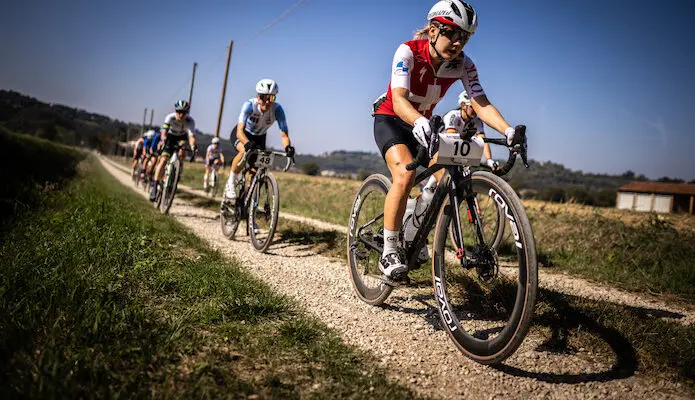
The UCI Gravel World Championships took place on October 8 and 9 in Veneto (Italy), with victories for Pauline Ferrand-Prévot (France) in the women’s elite category and Gianni Vermeersch (Belgium) in the men’s elite category. This first edition showed that the competitive discipline is still finding its way, on a course that, while featuring many dirt roads, had little elevation gain and consistently fast surfaces. This format was quite far from original Gravel, with the men’s race completed at an average speed of 37.6 km/h over 194 km, and the women’s race at 33.5 km/h over 139 km for the two winners. For this reason, participants opted for very different equipment choices.
By Guillaume Judas – Photos: specialized/DR
Many professional riders who participated in this first Gravel World Championship used a road bike – choosing a model specific to harsh courses – with the only adaptation being 32 mm tire width. This is very far from commercially available Gravel bikes, those used by bikepacking enthusiasts, or even those used in “historic” competitions (even if the discipline is still very young) like the Unbound in the United States with its long sandy sections. Some Gravel courses are closer to mountain biking, such as the Roc Gravel at the Roc d’Azur, where an average of 26 km/h is already exceptional. For this latter event, 42 or 45 mm tire widths are strongly recommended, as is a minimum gear ratio of 1:1.

One of the main reasons professional riders chose to use road bikes at the Gravel World Championships was precisely the gearing. Mathieu van der Poel predicted an average speed of 38 km/h for the winner (we’re not far off) and he wanted, for example, to be able to keep a 53 and 39 tooth chainring combination, which is not possible on many Gravel bikes offered by different manufacturers.

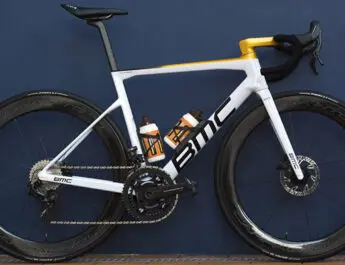
In the women’s race, Sina Frei (Switzerland) and Chiara Teocci (Italy) finished second and third respectively behind Pauline Ferrand-Prévot. They are both equipped by Specialized, and made radically different choices regarding their equipment. The French rider, who also claimed her fourth world title in less than a month and a half (after the MTB Short Track, XCO, and Marathon titles), was equipped with the latest BMC Kaius, a Gravel bike specifically developed for competition.

Frei and Teocci chose the Specialized Pathfinder Pro tire, which has already proven itself at the famous Unbound, but with the new 32 mm width, knowing that the course would be very fast. The Italian, who finished third, opted for the Diverge model, a true Gravel bike, while the Swiss rider, who finished second, chose the Roubaix, in a configuration very similar to what she might have chosen for Paris-Roubaix, with a more traditional road geometry and the aerodynamic performance of a pure aero race bike. Teocci stuck to a more usual Gravel setup, using the Swat system, as well as a saddle bag and a sealant/inflator to prepare for any incident.

The two competitors also made different choices regarding wheels. Teocci opted for the Roval Terra CLX, while Frei went further in her pursuit of aerodynamic performance, using the Roval Rapide CLX II. She also chose the S-Works Evade III helmet, while the Italian preferred the Prevail III.

As for common choices, they both opted for an S-Works Power Mirror saddle and S-Works Recon shoes (for MTB and Gravel), but it should be noted that some competitors chose road shoes and pedals, such as the men’s race winner, Gianni Vermeersch. Another common point for Frei and Teocci is the use of the Future Shock 2.0 suspension system in the steerer tube, found on both the Roubaix and the Diverge. A plus for shock absorption and handling according to both champions.
It remains to be seen whether this type of competition will find its ideal format in the future, allowing it to attract road riders, mountain bikers, and adventure enthusiasts alike, while avoiding blurring the message that manufacturers wish to convey, with bikes supposed to enter a new category in addition to road, cyclocross, and mountain biking.
=> SEE ALSO: All our MAG articles
Share the post "Gravel World Championships: Different Technical Choices"