Share the post "Cervélo R5 Review"
Alongside the Soloist—which was recently reviewed on 3bikes.fr—and the S5, the other high-end model designed for speed, Cervélo continues to give pride of place to its R5 model, which is tailored for rough terrain. This is one of the two bikes used by Jonas Vingegaard during his victorious 2022 Tour de France. But while this bike is an asset for winning the world’s greatest cycling race, is it suitable for the average cyclist? I set out to answer this question by putting the bike through its paces over more than 1,000 km in the Pyrenees—the very terrain where the Danish rider achieved his feats.
Text: Olivier Dulaurent – Photos: www.3bikes.fr, Cervélo

In Cervélo’s road bike lineup, the R5 sits at the very top of the hierarchy alongside the S5 model, which is better suited for flat to rolling terrain and helped Wout van Aert shine in the most recent Tour de France. It therefore sits above the Soloist, a model that has just been officially released and has already been tested on www.3bikes.fr. This R5 isn’t strictly speaking a new model; it was actually unveiled in September 2021. The feedback that led to this new version of the frame was gathered primarily from professional riders on the Jumbo-Visma team, with the goal of reducing fatigue over the course of a stage through a less demanding frame. It’s worth noting that even for cyclists capable of sustaining very high power output for hours on end, it is not by constantly pushing the stiffness threshold higher that efficiency—the factor that truly allows a rider to go as fast as possible from the starting line to the finish line—is optimized.


As a result, Cervélo focused on fundamental parameters:
- weight, with a reported reduction of 130 g on the frame, 20 g on the seatpost, and 44 g on the handlebar-stem assembly;
- aerodynamics, with a 25 g reduction in aerodynamic drag—a gain of 2.5 watts. However, they did not specify at what speed this result was achieved;
- stiffness. In this regard, research focused on reducing stiffness (without providing specific figures) to create a bike that is more responsive and less tiring for the rider.


Furthermore, while the geometry of the previous version has been retained, subtle modifications have been made to the tire clearance to allow for 34-mm tires, as well as a more pronounced sloping design so that the seatpost plays a greater role in its flex, resulting in increased comfort.

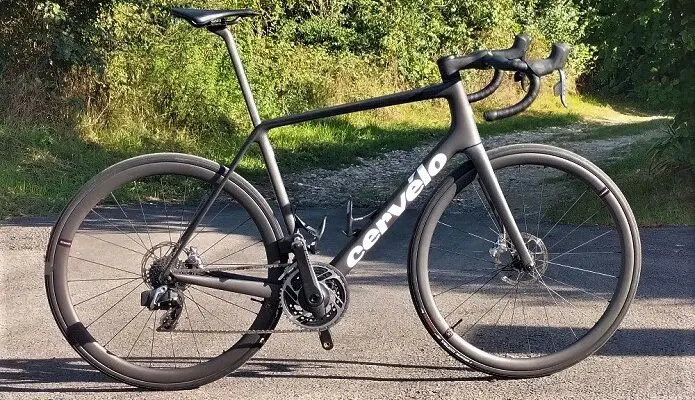
In terms of components, we tested one of the two most high-end versions, priced at €11,999 according to the catalog. While a version equipped with a Shimano Dura-Ace Di2 groupset is also available, I rode the model featuring a complete 12-speed SRAM Red AXS groupset. For the wheelset, “in-house” wheels developed internally by Cervélo under the Reserve brand (37 mm rim width in the rear and 34 mm in the front) fitted with 25 mm Vittoria Corsa Graphene tubeless tires complemented the frame. This setup stays true to the bike’s overall design philosophy of minimizing weight and making descents easier, as this low-to-medium profile is easier to maneuver through tight turns.


A bike in its element in the mountains
From the very first few revolutions of the wheels—or more precisely, the first time the rider stands up on the pedals on this Cervélo R5—the significant stiffness of the bike’s front end is immediately apparent, particularly at the head tube. This stiffness requires the rider to adjust their technique when rocking the bike from side to side in order to achieve the right coordination between this rocking motion of the upper body and the pedaling cadence. However, while this characteristic remains particularly pronounced despite the redesign of the frame released by Cervélo in 2021, it is one of the bike’s many strengths and contributes to its overall performance.

More specifically, excessive stiffness throughout the frame could have been a disadvantage on long climbs such as the Tourmalet, the Plateau de Beille, or Hautacam. After all, any cyclist riding on this kind of terrain knows that their bike shouldn’t be an enemy they have to fight against. In this case, the stiffness of the central section (bottom bracket) and rear section (chainstays and seatstays) is significantly less pronounced, and in practice, the bike remains responsive even when the speedometer shows a single-digit speed. In the mountains, overall efficiency is aided by the reduced weight (7.130 kg in size 58, without pedals), and on long climbs at a steady pace, the bike remains just as “light on its feet” as the best rim-brake bikes, which isn’t always the case with lower-end disc-brake bikes.


Furthermore, the difference in stiffness between the front and rear could have made the bike feel inconsistent or even unbalanced. But that’s not the case at all, and the R5 comes across as a bike with two sides: sufficiently forgiving at low speeds while seated in a low gear, it seems to “tighten up” as soon as the rider stands up and pushes hard.
The R5 comes across as a bike with two sides: sufficiently forgiving at low speeds while seated in a low gear, it seems to “tighten up” as soon as the rider stands up and pushes hard.
Under these conditions, only the rear wheel could have benefited from being stiffer. To limit this effect, one option is to use a rim with a profile wider than 37 mm (as on the test bike). However, this last point applies mainly to riders of a certain build. For others, this shouldn’t be an issue unless you’re sprinting… which isn’t the bike’s primary purpose.
On flat terrain, the bike leaves a very good impression. In terms of ride feel, while it’s impossible to detect any loss of performance compared to the S5 from the same brand, the R5 doesn’t feel like it’s struggling against the wind when riding at high speeds. It’s under these conditions that the comfort really shines. Thanks to the combined characteristics of the tire choice (Vittoria Corsa Graphene in 25 mm tubeless), with an optimal inflation pressure of around 5.5 to 6 bars for a 72 kg rider, the carbon fiber used, the out-of-saddle riding position enabled by the frame’s steep rake, and the flexibility of the rear triangle, the combined effect is particularly pleasant.

It even becomes a notable advantage in terms of handling when descending on sections with poor road surfaces. In fact, whereas on a conventional bike you’d need to slow down to avoid being jostled or simply to read the road, the feeling here is that nothing can happen to you, which boosts the rider-bike connection’s confidence as the kilometers go by. And we know very well how important that confidence is for riding downhill with peace of mind. This goes hand in hand with the bike’s impressive stability at high speeds: the R5 is largely unaffected by external factors such as gusts of wind or the subtle adjustments needed to maintain a straight line. Nevertheless, handling in tight turns poses no problems, and the bike turns energetically and safely, following its “rider’s” commands—aided once again by the quality of the tires, whose excellent baseline grip is enhanced by the low tire pressures used.

Under these conditions and given the speeds reached, the braking system must be up to the task. This is where the bike’s limitations became apparent, due to the SRAM Red eTap groupset, despite the 160-mm rotors front and rear. It wasn’t so much a lack of braking power that was observed, but rather a difficulty in applying that power exactly when needed. In fact, the feel at the brake levers is spongy—even with the proper adjustment—and the first few millimeters or even centimeters of travel do not slow the bike down significantly. As a result, you have to apply more and more pressure to achieve the desired deceleration. However, it’s obvious that during this time, the bike continues to move forward, sometimes quickly. It’s only at the end of the lever’s travel that the braking performance lives up to what you’d expect from a disc brake system. One solution might have been to squeeze the lever all the way down immediately. Except that, even after 1,000 km, it’s difficult to find the right balance between “too little” and “too much” within the lever’s travel—with the risk of lockup that this entails. A quick comparison with a bike equipped with Shimano (Ultegra) disc brakes clearly shows the difference: while the braking is noticeably more “on/off,” it ultimately proves easier to modulate because the rider isn’t caught off guard. Brake pads with more bite might be the solution. But after riding 1,000 km—less than 100 of which were in the rain—the original pads need to be replaced.


That caveat aside, the SRAM groupset is a pleasure to use. Stylish, intuitive, fast, and ergonomic, it deserves plenty of praise. However, the gear ratios offered can be confusing. With combinations like 48-35 and 10×28, the feel of shifting through the gears is different from a more traditional range, especially when compared to 53-39 chainring sets. It’s worth noting that the bike comes standard with a power meter, which is a small consolation given the price tag for the complete bike (€11,999). The version equipped with SRAM Force is priced at €8,799.


Our Take on the Cervélo R5
The Cervélo R5 combines the qualities needed to excel in its natural habitat: the mountains. By bringing together qualities that are sometimes hard to reconcile—such as high stiffness, responsiveness, forgiveness, and comfort—it’s not just for the world’s top riders. Its approachable handling makes it an excellent partner, regardless of the rider’s skill level. Furthermore, its performance on the flats makes it particularly versatile. Unfortunately, the price tag is quite high.
The CERVÉLO R5 Sram Red eTap AXS at a glance… Rating: ***** Pros: Perfect balance of stiffness and comfort, stability on descents, efficiency in the mountains, versatility on flat terrain Frame: Cervélo R5 Disc – Fork: Cervélo All-Carbon Tapered R5 – Handlebar: Cervélo HB13 carbon – Stem: Cervélo ST31 carbon – Brakes: SRAM Red 160/160 mm – Front Derailleur: SRAM Red AXS 12-speed – Rear Derailleur: SRAM Red AXS 12-speed – Shifters: SRAM Red AXS hydraulic – Cassette: SRAM Red 10-28 – Chain: SRAM Red AXS 12-speed – Crankset: SRAM Red AXS 48/35 (with Quarq power meter) – Wheels: Reserve 34/37 mm – Tires: Vittoria Corsa Graphene TLR 700×25 – Saddle: Prologo Scratch M5 Nack – Seatpost: Cervélo SP24 Carbon – Weight: 7.13 kg (verified for size 58 without pedals) – Sizes available: 6 (48 to 61) – Price: €11,999 Contact: www.cervelo.com |
=> SEE ALSO: All our Equipment articles
Share the post "Cervélo R5 Review"