Share the post "Doping – The Credibility Figures: Should Cycling Be Pleased with Its Record?"
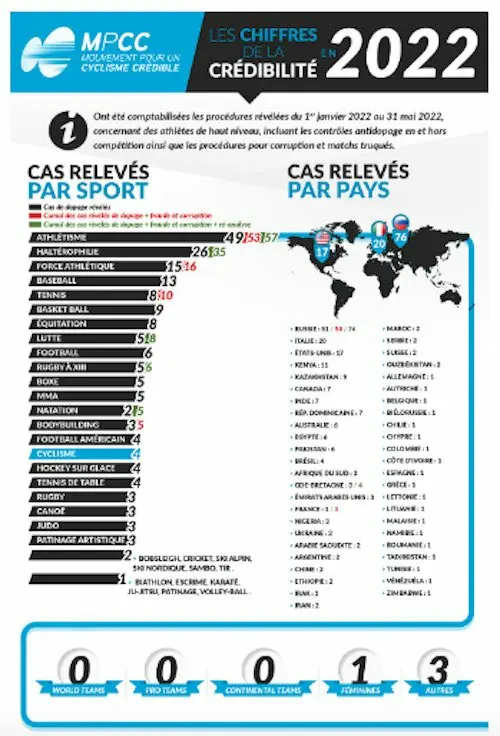
While the number of doping procedures revealed has increased this year (in all sports in general), cycling has so far been spared this rise. Within professional road teams, doping cases are even non-existent in this first half of the year. This is unprecedented in the 9 years that figures have been scrutinized by the MPCC (Movement for Credible Cycling).
Source: Press Release
The anti-doping fight seems to have started at full speed this year! On average since the beginning of the year, nearly 50 revelations per month have been made public, whereas in recent years, we were rather around 35 revelations per month.
However, there is nothing new concerning the most affected sports during the first 5 months of the year: athletics, ahead of weightlifting and baseball (despite a delayed start to the season and a resumption of controls only in early April). Russia remains (by far!) the country most often singled out, ahead of the United States and Italy.
How to explain this increase in cases?
With the decrease in the intensity of the pandemic, and the Olympic deadlines (Tokyo then Beijing Olympics), the pace of controls significantly increased in 2021 and 2022. There is always a time lag between the collection of samples and the revelation of doping cases.
But it is from Russia that the resurgence of suspensions has been the most spectacular. A sporting nation largely discredited since 2016 by the revelations of Grigory Rodchenkov, former director of the Moscow laboratory, which led the IOC to suspend Russia from the Olympic Games in 2018, 2020 and 2022. Today, to regain lost trust, the Russian anti-doping agency Rusada is showing a certain zeal. In the last 5 months, it has suspended four doctors for fraud in athletics, but also coaches in the world of bodybuilding and powerlifting.
At the same time, under the guidance of WADA, re-analyses of suspicious samples dating from 2008-2015 and concerning Russian athletes are continuing. Eighteen new procedures have resulted in sanctions in weightlifting (9 cases), athletics (4), wrestling (3) and swimming (3).
The situation in cycling
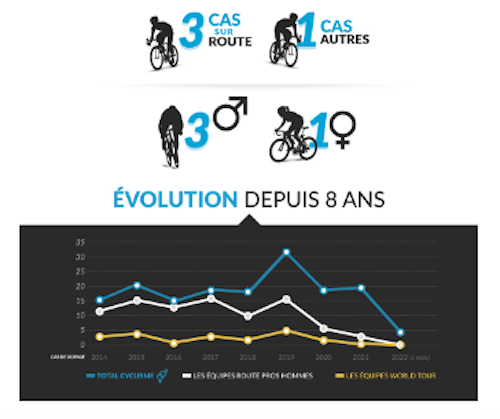
Limiting ourselves to high-level athletes, this beginning of the year has revealed, among cyclists, only three new procedures and only one sanction pronounced:
- Aigul Gareeva (RUS). The former Junior European champion, aged 21, has been provisionally suspended for a third whereabouts failure on the ADAMS platform.
Source: TASS news agency, 01/18/22. - Toon Aerts (BEL). The two-time Cyclo-cross World Cup winner tested positive for lezotrole in an out-of-competition control. Lezotrole is a substance generally used to treat breast cancer (!), present on WADA’s list of prohibited products due to its masking effects. The Belgian from the Baloise-Trek-Lions Cyclo-cross team has been provisionally suspended.
Source: himself, 02/15/2022. - Danilo Hondo (GER). Retired from competition since the end of 2014, the former German sprinter was sanctioned with a 5-year suspension pronounced by the Munich Criminal Chamber, after his confessions as part of the Aderlass judicial investigation involving athletes from several disciplines (cycling, Nordic skiing, triathlon and American football).
Source: Swiss Olympic, 05/13/2022. - Samandar Sultanov (UZB). Aged 17, he was provisionally suspended after a positive control carried out at the end of March, during the Asian Jr. Road Championship, which he had just won in Tajikistan. This control revealed the presence of methasterone in his urine, an anabolic steroid that has never been marketed for medical purposes.
Source: UCI, 05/30/2022.
No cyclist concerned belongs to a professional road team (an unprecedented situation since the Festina affair!).
The MPCC had the opportunity to specify in its 2021 report that, for the first time since the creation of the World Tour in 2005, no doping procedure had involved a team from this world division. As for the last proven case on the Tour de France, it is worth remembering that it dates back to 2015.
This continuous decrease in the number of doping procedures began in 2020. But the trend is much more noticeable among professional road cyclists. In recent years, only presumed cases among women have increased. There have been six per year since 2019 (compared to one or two annual cases previously). The increase in the number of teams and competitions that accompanies the professionalization of the women’s peloton is probably not unrelated to this rise.
Cycling authorities such as the UCI and the ITA (International Testing Agency), the independent anti-doping agency mandated by the UCI since January 2021, remain cautious. “If we don’t find anti-doping rule violations, it doesn’t mean that doping has disappeared, it just means that no one has tested positive,” notes Nicholas Raudenski, ITA’s Head of Intelligence and Investigations.
Based on the same observation, the MPCC reiterates its unreserved support for the ITA’s recommendations, detailed this month, to strengthen the means of an effective fight against cheaters.
=> SEE ALSO: All our News articles
Share the post "Doping – The Credibility Figures: Should Cycling Be Pleased with Its Record?"