Share the post "Training: How to Organize Your Week"
Between the weather and the multiple professional or family demands you face, organizing your training week often proves complicated. However, to progress, a coherent plan is essential. It’s a matter of choice.
By Guillaume Judas – Photos: depositphotos.com
Between various professional and family demands, your schedule is packed. So, how much time should you dedicate to your sport? Obviously, this depends first and foremost on your ambitions. Do you want to progress, to aim higher? To simply maintain your current level? Or more prosaically, to just enjoy yourself?

How can you project yourself into the future, in the short or medium term, without even reviewing the past few months? Honestly, you first need to ask yourself if the goals you set were achieved. These can be at several levels. For a racer, they might correspond to certain victories, a category upgrade, or reaching a physical level that allows them to keep up with the best. For a sportive rider, the goals might be focused on completing a brevet, a certain distance, or a long or difficult course. In both cases, it is dangerous for both morale and physical health to aim too high. But underestimating yourself also eventually leads to motivation problems. The right compromise involves choosing your goals and getting your entourage to accept the sacrifices necessary to achieve them. Planning should begin at the end of the current season. Some riders roll through September and October, others use this time to work on their weaknesses or focus on another discipline that could, fundamentally, help them progress. But no matter the time of year, it’s never too late to make good resolutions.

An Annual Plan
Since rest and decompression phases are an integral part of training, you should start planning the “off-season” period in September. Its length depends on the season that has just ended, and your physical and psychological fatigue thresholds. You choose it by considering the time needed to get back in shape afterward, a kind of countdown to the dates set for the next season. For pros, spring classics contenders ease off very early to resume base training in mid-autumn. For a sportive rider, everything can be shifted to still enjoy the late season and only resume long rides after the following winter. In all cases, you should never choose your periods randomly. Similarly, when resuming training, you should know, more or less, how many kilometers, hours, days, or weeks you will dedicate to each type of effort. You shouldn’t adopt a passive attitude towards events. Even if there are still unforeseen circumstances, they are more easily circumvented within a plan.
Numbers That Mean Nothing
“How many km have you done since you started back?” This fuels many discussions within the pelotons. Is the number of accumulated kilometers directly linked to current form? No, because there are multiple ways to ride or train… Form is precarious and can fluctuate, but it relies on a good basic physical condition that can be maintained all year round. In other words, the volume and intensity of training must be considered as a whole and not over a given period. Weight gain, poor lifestyle, or too long a break are elements that hinder recovery and access to form, as is too long a period without stimulating the energy systems related to performance. Conversely, alternative sports, a consistent weekly volume throughout the year, maintaining sports activity as an essential habit or need, limit the time and amount of work required to get back in shape and align with specific goals. Planning a year, a month, or a week of training must take all these factors into account. Basically, apart from the relative rest period, which is beneficial for body and mind and whose length will vary according to level and ambitions, you shouldn’t put off what you can do now. This avoids accumulating delays and the need to catch up on lost time as the goal approaches.

The Seven-Day Week
The free time dedicated to training or maintaining physical condition is determined by the social and professional arrangements organized around the seven-day week. For most people, a week consists of five working days followed by two days of rest (Saturday and Sunday). However, the supercompensation mechanisms that follow physical exertion, which are key to progress, do not necessarily adhere to these criteria. Thus, ideally, it would be more judicious to have two non-consecutive days for good base rides, rather than Saturday and Sunday. The most effective approach, to respect the body’s rhythms, would be to disregard the calendar when scheduling rides. This is what professional racers do, following a training plan based not on a seven-day cycle, but on a cycle that respects work and rest phases, depending on the physical or technical qualities to be developed. For an amateur, the data are, of course, more complex, especially when the season begins, simply because competitions mainly take place on Sunday, and the rest of the week must be structured around these events. This is also why one solution could be to skip certain less important competitions, in order to train specifically (to work on a weakness). A racer who lacks distance at the beginning of the season would benefit more from doing long training rides than from racing and not finishing the event, for example.
Some rides should, of course, be dedicated to pleasure and active recovery, but if they are too numerous compared to rides aimed at developing a specific quality, there will be stagnation, or even regression of the base level.
The Quality of Rides
Riding just for the sake of riding, without a goal, limits progression or even the maintenance of hard-earned qualities. Some rides should, of course, be dedicated to pleasure and active recovery, but if they are too numerous compared to rides aimed at developing a specific quality, there will be stagnation, or even regression of the base level. Training doesn’t need to be long to be beneficial. Each specific quality worked on doesn’t require the same recovery time to be optimized. Finally, depending on the period of the season, the emphasis should be placed on a particular type of work, to respect the evolution of form based on what has been acquired. For example, during the “resumption” phase, the ideal is to regularly string together base rides, gradually increasing distances, at a rate of one ride every two or three days. But, in peak season, one long ride every nine or ten days is enough to maintain base fitness, which should be coupled with short but intense rides, designed to work on PMA, sprint, threshold, etc. Each of these short rides doesn’t necessarily combine with the others, but in all cases, volume is of very secondary importance, which nevertheless increases the possibilities for fitting them into the schedule. When setting progression goals, the frequency, importance, and content of these rides become paramount and take precedence over their volume. Training is therefore no longer a matter of kilometers or weekly hourly volume. It is about regularity, progressiveness, and correctly distributed workload.
ASSUMED CHOICES On a family level, the sporting ambitions of a forty-something craving sensations are often difficult to understand. However, for many purely amateur cyclists, regular practice is a source of balance that, ultimately, benefits health, professional achievement, and relationships with those around them. Get your family to accept this necessity and discuss the distribution of your schedule by making some compromises. From then on, the time dedicated to sports practice is devoid of any guilt. This is essential for organizing yourself correctly and thus optimizing the time spent on and off the bike. |
The Weather
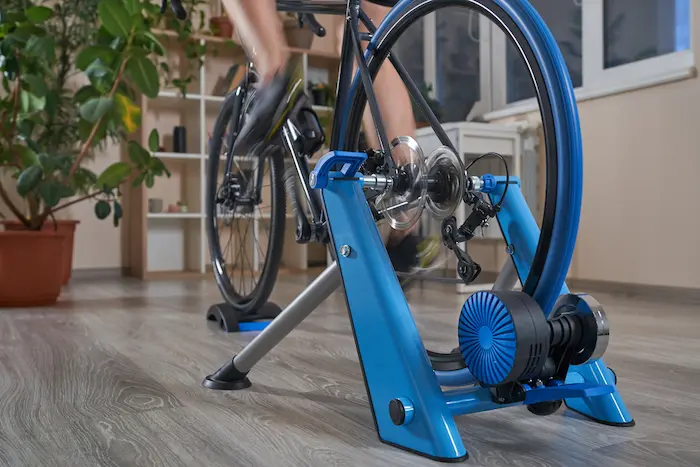
Riding in the cold or rain is never easy or very motivating. But giving in to the temptation to rest at the first drop or gust of wind when your schedule is tight risks compromising everything. Recovery rides can be skipped without guilt, but those intended for training cannot. You can always reduce the volume, but not the intensity, to stay on track. Most intensity efforts can be replicated on an indoor trainer. This should reconcile you with rollers, provided you can adjust the resistance. Not to mention that intensities can be replaced by other disciplines. Good planning therefore implies pushing yourself when necessary, to be able to enjoy free moments when they arise.
The Week in Practice
Since you have to adapt to the elements and obligations around you, let’s see how to define a priority order when establishing the week’s program. In the case of a competition every Sunday, the first few days after must allow for recovery to approach the next one well. The same applies to the days preceding it. From there, only the middle of the week remains to fit in a base ride, if it is part of the program. Long interval rides (e.g., “threshold”) are also demanding in terms of recovery and are more beneficial at the beginning of a cycle, while short interval rides are more judiciously placed on Friday for a Sunday competition, for example. In all cases, depending on the period, the dominant work, and the qualities you seek to develop, you structure the sessions not day by day, but by arranging them in order of importance. What is the most important ride of the moment? What are the essential types of effort for which we need to be in perfect physical and psychological condition? We will not venture to propose a typical training plan here, as it is far too specific and varies greatly depending on each individual’s level.

It remains to be remembered that there is never any chance in an athlete’s success, and that willpower, determination, management of effort and potential, inscribed in short- and long-term planning, are the key to success, even for objectives considered modest by others.
FIVE BONUS TIPS FOR ORGANIZING YOUR TRAINING WEEK – Free up time for training, early morning, midday, or evening, and stick to it. |
=> SEE ALSO : All our Coaching articles

Share the post "Training: How to Organize Your Week"