Share the post "Frames and cranksets: understanding bottom bracket standards and compatibilities"
It is sometimes difficult to find your way among the different bottom bracket formats and their associated compatibilities. To the point that even bike shops sometimes get lost. Here, we clarify things to help you know which bottom bracket model to install on your bike.
By Guillaume Judas – Photos: depositphotos.com / DR
If your crankset is not turning smoothly or if you feel creaking with each pedal stroke, it may be time to change your bottom bracket, the assembly that houses the bearings. Depending on the bike brand, manufacturing type, manufacturer’s choices, or model year, you can find different bottom bracket standards, and not all of them are obviously compatible with each other.
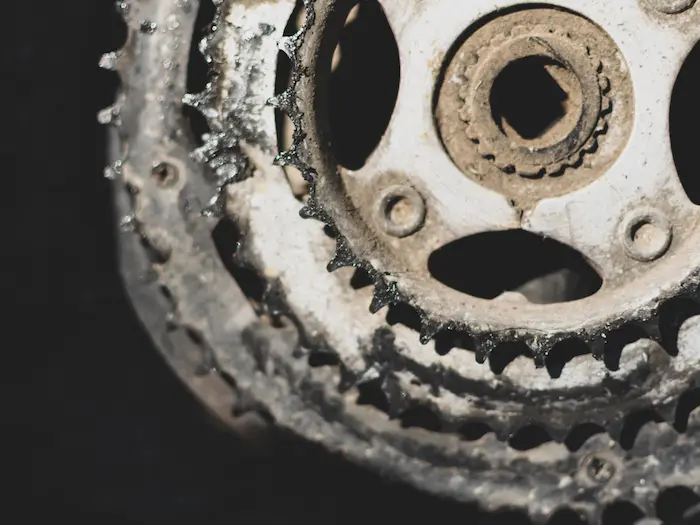
In the days of steel frames, there was only one type of bottom bracket shell, with a threaded system on all frames. Two types of threading coexisted: the BSC standard (also called BSA) with a shell width on the frame of 68 mm and a thread pitch of 34.8 x 1.06, and the Italian standard with a width of 70 mm and a thread pitch of 36 x 1.06. For mountain bikes, 73 mm wide shells were more common. Into this bottom bracket shell, threaded at both ends, ball bearings were slipped, and cups were screwed in to hold everything in place.

We already find three different standards among these bottom brackets. First, the square taper bottom bracket, still present today on entry-level bikes, but still widespread until the late 90s. It is the most reliable system, but not the stiffest. Then came the Isis standard, with splined crank fixings to improve stiffness. Then Shimano also had its own standard, Octalink, also in the late 90s, with eight splines for even more stiffness. These are types of bottom brackets that you can still find on old bikes, and which are still available as replacement parts.
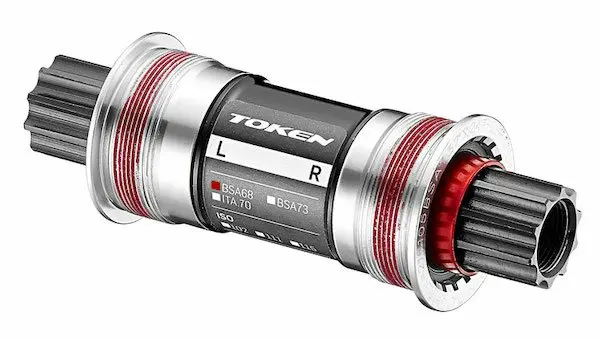
After these threaded axle standards, other types of bottom brackets appeared, oversized and pressed-in (BB30). Since then, standards have multiplied, which has become a real headache for compatibilities, even if for some model years many manufacturers are returning to the traditional threaded bottom bracket (but with external bearings) for reasons of reliability and ease. This explains why some bikes are sold with a crankset different from the rest of the drivetrain group. Fortunately, component manufacturers offer adapter kits or variations of their crankset models depending on the frame’s bottom bracket type. A few cases of total incompatibility remain, but in all cases, you need the right system with the right bottom bracket shell.
In terms of weight, the BB30 system has a clear advantage over the external bearing system. The aluminum axle is shorter and oversized, and the bearings are lighter (without a threaded support). As a result, there is a difference of 40 to 100 g between the two systems. Whatever solution is considered, if an adapter is used, it adds approximately 20 to 40 g to the weight of the frame or crankset.
How to know which type of bottom bracket to choose?
The choice of bottom bracket depends first on the frame you intend to mount it on, and the standard chosen by the manufacturer. You then need to check that the crankset you intend to install matches the bottom bracket type, with an adapter if necessary. First, observe the bike’s bottom bracket shell, near where the cranks attach to the bottom bracket axle. If you see the cups protruding on each side with the indentations for the tightening/loosening tool, it is an external bearing bottom bracket. The type of threading (BSC or Ita) and the width of the shell are then indicated on the cups. If you see a thin aluminum piece slightly protruding from the frame’s bottom bracket shell, as well as a large bolt on each crank, it is a pressed-in axle bottom bracket, such as square taper, Isis, or Octalink. The type of threading is also indicated on the visible aluminum part. Finally, if the frame is smooth inside and the cup with the bearing is simply press-fitted, it is a BB30, BB386, Press Fit, or other type of bottom bracket. Measuring the width of the shell can help you find your way, but the best way to avoid choosing the wrong format is to consult the bike’s technical specifications.
External Bearings
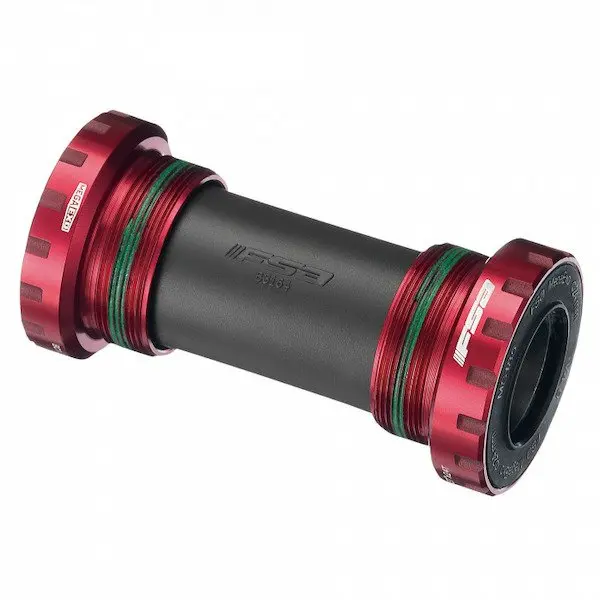
This standard appeared in 2003 with Shimano and remains the preference of the Japanese brand and Campagnolo, while Sram offers it alongside the BB30 standard. It consists of cups integrating the bearings that screw into the frame’s bottom bracket shell. The bearings do not slide inside the frame but are located just before the thread, against the cranks, once the bottom bracket axle, integral with the cranks, is inserted inside the bottom bracket. The axle diameter is 24 mm and the cranks are spaced 90 mm apart. With very specific BSA30 bottom brackets, you can mount a “long axle” BB30 type Rotor, for example. With Sram, the axle is 24 mm at the chainrings, and 22 mm at the crank arm, to avoid crushing the bearings. Installation must be on a frame with a threaded bottom bracket shell, with BSC or Italian threading. This system is known for its reliability, but it is not the lightest.
BB30
The name BB refers to a system where the bearings are press-fitted into the frame and therefore do not have threads. BB30 is the first of the integrated standards. The bottom bracket axle diameter here increases to 30 mm instead of 24 mm. The cranks are only 68 mm apart. Their central part therefore applies directly very close to the bottom bracket shell, which itself is larger to accommodate the 30 mm axle and suitable bearings. The bearings are slid inside the frame, onto a bearing seat that must be perfectly aligned and surfaced. With a system of shims, the bearing play is adjusted by compressing them when tightening the cranks. This system is light, stiff, but the bearings are relatively exposed.
BB386 EVO
This is a format found on more and more bikes, as it relies on an 86 mm wide bottom bracket shell, but for cranksets with a 30 mm diameter axle. Any crankset with a 24 mm axle can also be installed with an adapter. A BB386 crankset can also be mounted on a frame designed for BB30 with an adapter, or a BB386 crankset can be mounted on a frame with a threaded bottom bracket shell, also with an adapter. Compatibilities with this standard are numerous.
BB86 (and BB90)
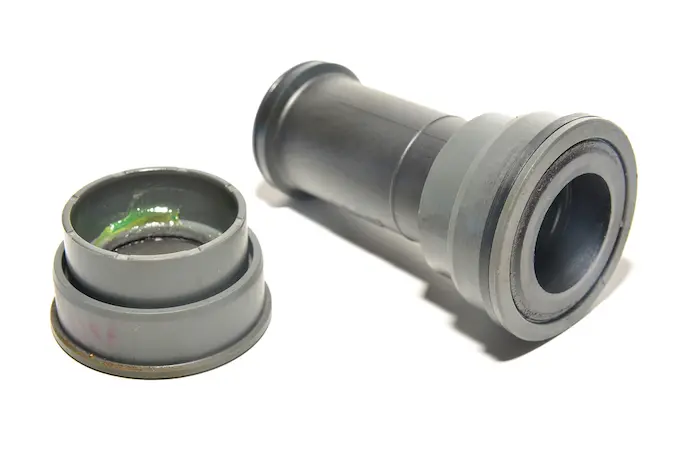
To gain stiffness and potentially aesthetics, BB86 refers to an 86 mm wide bottom bracket shell (instead of 68 mm). It accommodates cranksets with a 24 mm axle. But unlike external bearing bottom brackets, cups containing the bearings are inserted into the frame’s shell. This ultimately amounts to the same as an external bearing bottom bracket, except that here the bearings are hidden. Press Fit type bearings are used, available from most major manufacturers. The internal plastic cups can be fragile during removal. There is also the BB90 specific to the Trek brand, which uses the same principle, but the bearing seats are integrated into the shell.
Press Fit 30
The Press Fit 30 bottom bracket is housed within an oversized bottom bracket shell designed to receive a BB30 axle crankset, but 24 mm axle cranksets can be mounted with an adapter. It is an alternative to BB30 bearings, because here the bearings are not directly inserted into the frame, but integrated into nylon or aluminum cups. The bearings are thus better protected.
BB30a
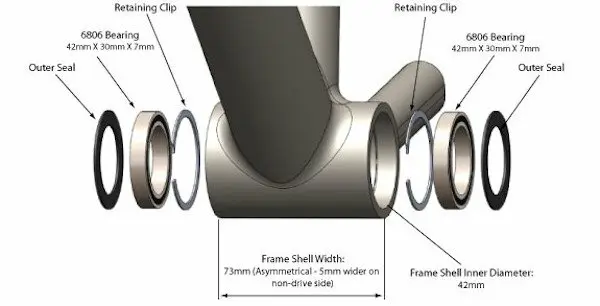
A standard specific to Cannondale, with a real diameter of 42 mm and a length of 73 mm, which explains why the brand’s bikes were delivered, at least for a time, with an in-house crankset. Nevertheless, it is still possible to use a BB30 crankset with an extended axle (increasingly common) and an adjustable spacer on this bottom bracket shell, or even 386 EVO. The system is particularly stiff.
BB65
The concept specific to Look for its 695 and 795 allows the mounting of a one-piece carbon in-house crankset. To slide the left crank arm and axle into the frame, a very large bottom bracket opening and adapted bearings are required. Look also offers an insert that allows adapting a Press Fit 30, so all types of cranksets (BB30, BB386, Sram GXP, Shimano…) can be mounted. The system is very stiff and light, provided the in-house crankset is used.
BB Right
The concept is a bit more complex, as the bottom bracket shell is offset and widened by 11 mm on the left side to optimize forces on the frame. A crankset with a 30 mm axle is mounted, but since the shell is 79 mm wide, not all cranksets fit. With Rotor or FSA, compatibility is total, but it is always possible to adapt a classic crankset with a 24 mm axle, losing some of the supposed advantages of the system.
BB OS Fit
For older generation Specialized bikes, a concept identical to BB86 was chosen, but with BB30 (30 mm axle). The bearings are therefore inserted into cartridges rather than directly into the frame. All cranksets with a 24 mm axle are compatible, but require specific adapters for each brand. Note that all the latest Specialized bikes are now delivered with bottom bracket shells for external bearings.
The best standard?
Frame manufacturers choose a system to gain weight, stiffness, efficiency, or reliability according to their own criteria. It’s difficult to say that one standard is better than another. However, it’s better to use the recommended crankset rather than resorting to adapters, to fully benefit from the system.
=> SEE ALSO: All our Gear articles
Share the post "Frames and cranksets: understanding bottom bracket standards and compatibilities"