Share the post "Progressing with Strava"
What cyclist today doesn’t know Strava? More than 100 million individuals currently use this application, which continues to add new subscribers every day, at the same time you’re accumulating kilometers. Founded by two college friends who rowed at Harvard, the app has also established itself as an individual coach and a social network for athletes who want to measure the evolution of their performance to progress. So let’s see how it’s possible to optimize its use.
By Jean-François Tatard – Photos: ©3bikes.fr / DR
Behind its name, which in Swedish means “to strive tirelessly for something,” Strava is a real company with its headquarters in San Francisco, California. The startup has significantly increased its revenue in recent years by transitioning to a freemium model. And after a recent fundraising round of over $100 million, the Californian team is still looking to accelerate its growth by becoming a partner to the biggest players in sports events worldwide. But for us individuals, amateur or professional athletes: how can we better take advantage of all these features? How can we use this application to help us progress?

Record your bike rides
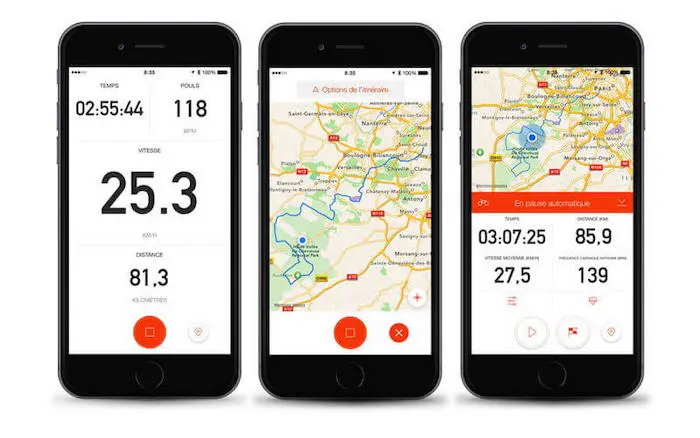
Thanks to the sharing of GPS tracks recorded on your bike computer and uploaded to the application, your route is presented as a map, and those who follow you on Strava can be inspired by it and check your activity, which you won’t fail to illustrate with a photo. But what will perhaps help you most to progress and motivate you are the encouragement and congratulations from your friends who can comment on your ride.
The uploaded tracks remain in memory on the site and are also transferable to your bike computer. This is extremely interesting for inspiring friends who are just starting out or others who are discovering the region where you left your mark. In two clicks, you’ll be able to find a route that matches the mileage or elevation gain you’re interested in for your next ride.
Motivation through KOMs
The interest of Strava also lies in the fact that the concept is very community-oriented. KOMs or QOMs (King of Mountain or Queen of Mountain) don’t just exist for the climbs of the Tour de France. Whether you’re in Timbuktu or Vladivostok, everywhere in the world, you’ll find segments created by users themselves. These timed road sections lead to rankings that you can try to improve. It’s a good way to meet people. Who is this rider I don’t know who beat my KOM (my record)? Send them a message! It might be a new friend. In any case, it’s motivating. And it helps you progress. It’s like the challenges offered by the application: it’s always an extra motivation worth taking.
Segments or KOMs, as they are called on Strava, are a source of motivation for cyclists. When you’re training, you can try to beat your friends’ best time or, more simply, your own. Indeed, you can regularly test yourself against your own reference. Your bike computer/GPS records your split times. All your data is archived, so you can find your personal history on the app and thus measure your progress. You can analyze your efforts. Check the evolution of your power. The evolution of time. The evolution of speed. The evolution of heart rate. And if you want to compare yourself to others, you can also compare yourself to people in your age group. Or even your height or weight.
An analytical log
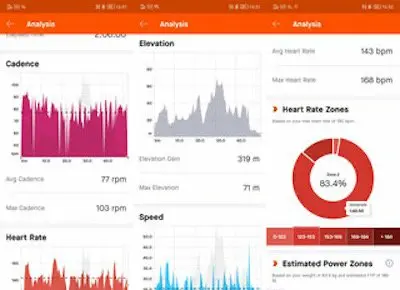
Strava is also a real analytical log. Indeed, you have all your activity history in the application. And you can thus dissect a whole host of statistics. The analysis can be broken down according to the nature of the data to be analyzed. But also explore the relationship between the data. Cross-reference curves. Power and heart rate, for example. You can even create a personal model to synthesize the relationships between these same data. Finally, you can use the analysis as a predictive tool to unfold scenarios that will guide future actions. It also gives you trends. If you are precise in your observations, it will allow you to identify typical patterns that work. Or conversely, to better represent what doesn’t work at all and should be avoided.
Identify areas for improvement and consolidate strengths
The primary contribution of this data is therefore to be considered at the level of sports performance itself. It allows for optimizing efforts for better results. And if done well, precise analysis of this data allows for correcting small details that ultimately make a difference. Thanks to Strava’s data collection during competitions or training, we can now highlight strengths or weaknesses (physical, mental, fatigue, etc.), and thus adapt our individual strategies. Everything here involves maximum personalization to optimize performance: at what training frequency will we be most effective in competition; which attribute to work on first to improve in a particular area…
Anticipate injuries and potential
Data also helps prevent and thus avoid injuries. Many of us now train with a multitude of sensors that can measure over a hundred data points in real time. All this data gathered on Strava allows us to anticipate from what load or intensity of sport we will have more or less risk of eventually getting injured, and thus adapt the workload to avoid this injury. And to go even further, today future talents are observed and studied from a very young age. The ultimate goal is to discover these future stars first. Based on the evolution of successful athletes, as well as on competitions in recent years, mathematical models are created to predict the evolution of these young people, and thus not to make mistakes when it comes to betting on a particular young person.

A tool accessible to everyone
Beyond the benefit of being able to archive and log all our activities or create a new community network, Strava is a fabulous tool for progress. Indeed, this modern and free tool is a true ally for performance. While many will be interested in playing with the famous record segments to gauge themselves, or in looking, through precise data analysis, where they stand in terms of fitness, it also allows them to discover routes and finally compare themselves to the elites and see how far they still have to go…
And now, who among our readers are still not registered on Strava, who, before the end of spring, will (finally!) join this friendly community and thus experience the joys of Kudos and KOMs?
=> SEE ALSO: All our Coaching articles
Share the post "Progressing with Strava"