Share the post "How to get over a wall (or a steep climb)"
It’s steep, it’s hard, and it can be long… Yet, it’s not all pleasure, far from it! When a wall rises under your wheels, in other words, a very steep hill, you never know how to approach it. Here are some tips to best tackle these topographical anomalies that are never much fun on a bike.
By Guillaume Judas – Photos: depositphotos.com
When a cyclist has to gain altitude, they never consider the shortest path to be a straight line. The steeper the climb, the more intense the effort, even if you just want to ride “within yourself.” With a minimum of practice and experience, managing your gears allows you to conquer a long, moderately steep climb without much difficulty, but for a steep climb, regardless of its distance, you have to “dig deep.” So, of course, some riders are more “airy” than others when tackling this type of obstacle. Should we consider them better climbers for that? Do they suffer less than us, poor anchors stuck on the slope, lungs burning, biceps tensed, veins on the verge of bursting, and a bike that feels like a ton?

“Walls” are everywhere
The advantage of walls is that they are everywhere. At least, we can find them in all regions. No need to look for the biggest elevation gains or the most mountainous massifs to face hills with (very) high percentages. The North, known for its flatness, has its share of “monts,” sort of warts rising over 500 meters, sometimes less, and often paved with bad intentions. In the West, Charente, Vendée, and Poitou also have their “cutthroats.” The Center is not to be outdone, especially along the Loire, but also whenever a small country road abruptly leaves the banks of a river or a smaller waterway to climb onto a plateau or a hill barely 50 meters higher.
Walls are also found near urban areas. This is normal, with demographic expansion, cities and neighborhoods expand, investing the surrounding hills. These steep climbs must be tackled to get home or to avoid major roads. Some organizers even have the idea of including them in local races. And when it’s on a circuit, it’s almost more fun!
Another advantage of walls is that you can go around them. Yes, but what’s the point of always avoiding difficulty? Some walls are made famous by major professional races that often use them as a test of strength. We immediately think of the Mur de Huy, the scene of the finish of the Flèche Wallonne, the Mur de Grammont, long a mandatory passage of the Tour of Flanders, as well as the famous Kopenberg (both cobbled). Of course, there are others, countless and always as tricky. And on sportives? Difficult climbs are part of the game, and when events take place in non-mountainous regions, organizers always unearth a “raidard” here or there to make the selection and test the riders. It is therefore useful to know how to approach them, for pleasure or out of obligation, knowing that specific training can be useful for general physical condition.
What qualities are needed to climb a wall?
The intensity of the effort required depends on the length of the difficulty. The shorter a wall, the further the qualities required are from those of a pure climber. Why? Someone described as a climber primarily has a very advantageous power-to-weight ratio at the anaerobic threshold. The threshold is that intensity of balance between the highest possible power output and the elimination of waste by the body. Beyond that, it’s guaranteed collapse in the short or long term. Respiratory control is often a relatively reliable indicator of this effort zone, although it is not the only one. It is at this intensity that you climb a pass. The pace is sustained, perspiration is abundant, the legs are constantly engaged, the breathing rate is very high but regular. With training and a diet rich in sugars during the effort, you can continue for several tens of minutes at this pace. The climber is therefore someone who maintains intensity for a long time, and since they are relatively light for the power they develop, they are more effective at overcoming gravity. This is for a sportive level, of course, because an international-level climber has other assets in their game, notably the ability to change pace during a long ascent, to go into the red for a few hundred meters, and then return to their cruising speed.
However, when climbing a wall, you don’t have time to settle into that pace. The sudden change of rhythm from the bottom of the climb is very taxing on the muscles and breath. Even if you are already well warmed up at the foot of the wall, the difference in power required to overcome the obstacle – which is higher the steeper the gradient – is equivalent to a long sprint in terms of muscle effort. Your heart rate rises quickly, but out of sync with what you feel in your legs, lungs, and arms. Obviously, if you know you’re at the foot of a five-kilometer climb, you don’t panic; you shift to your smallest gear and settle into your “threshold” cadence. These are the qualities of a climber that come into play. But if the climb is only one kilometer (sometimes less), you have to dig deep to avoid losing the wheels of your riding companions. In any case, over one kilometer, even by setting your pace, the body doesn’t have time to find its equilibrium zone between power output and waste elimination.
Climbing five one-kilometer walls in a row is therefore much more strenuous than climbing a single five-kilometer hill with the same percentage and thus the same cumulative elevation gain. Climbing a wall – short and steep – calls upon maximal aerobic power (MAP), one of the essential qualities for cycling performance. However, this is not the intensity zone that most sport cyclists and touring cyclists work on. This is normal, as it is also the most unpleasant. But having this power reserve can be very useful for overcoming difficulties and staying with the best groups in a sportive.
Gaining punch
To be more comfortable when tackling a short, steep climb, you often need to train both technically and physically. Since MAP is primarily solicited in this specific case, there’s nothing better than optimizing it, but not necessarily by immediately tackling walls in real conditions. To properly frame your progress, you can train your MAP with effort series designed to spend as much time as possible at the desired intensity. The most important thing for progress is the percentage of time during a ride where you truly engage the desired energy system. For example, if you want to ride as long as possible at the fastest possible speed, you will collapse after X minutes (depending on your level), and in any case, before you crack, the intensity will inexorably decrease. On the other hand, if you string together short effort series at the targeted intensity, interspersed with recovery periods, you will ultimately accumulate more time at the heart of that intensity.

Well, in practice, here’s how to do it: after a progressive warm-up phase, and on a short ride, do a long 30-second sprint and then recover for one minute; then repeat this pattern until you have nothing left in your legs. The number of long sprints depends on your baseline level or your fitness, it can range from four to ten sprints, which can be multiplied by two sets within the same training session. When we talk about sprinting, obviously, over 30 seconds, you have to pace it. Don’t give it your all on the first seven or eight pedal strokes, otherwise you’re not working the same energy system. Someone who does two sets of eight sprints accumulates a total of 2 x (8×30”) of MAP effort during their session, which is eight minutes in the target intensity. So much more than they could achieve continuously.
To progress over the weeks, the game is to gradually decrease the recovery time between sprints. From one minute, you go to 50 seconds, then 40 seconds. At 30 seconds of recovery, after 30 seconds of sprinting, you are at a very good level. But be careful, this type of session is very costly in terms of energy. It should be done at a distance from other long and/or difficult sessions and, of course, from a competition. And above all, these exercises must be based on a previously solid physical condition. Because MAP training, by the principle of communicating vessels, diminishes endurance qualities by promoting explosiveness, and tends to “crush” the value of the anaerobic threshold, i.e., the power at which lactates are properly metabolized during effort.
The whole art of training and the know-how of the coach therefore consist in distributing these sessions as fairly as possible according to the objectives and the state of form. But for the sportive or leisure cyclist, all there is to know is to occasionally distribute this kind of exercise to break habits, which are detrimental to long-term progress.
Another way to work on MAP
Less explosive but just as difficult, there is another method to improve your MAP, highlighted by Frédéric Grappe, based on the work of Gimenez (1992). This type of session can be applied on the road, or better, on an indoor trainer, in order to smooth out the power output. It consists of settling into intensity I3 for four minutes, then pushing to I5 for one minute, before returning to I3 and so on. In the end, the complete exercise lasts 45 minutes, i.e., nine five-minute sessions (four minutes plus one minute) and therefore nine minutes in total at MAP. You must already be in very good condition to be able to sustain such an exercise, but what the cyclist needs to remember is the basic principle. It doesn’t matter if you can only do five or six sets, since the targeted intensity of the exercises is the priority.
THE SUBJECTIVE EXERCISE INTENSITY ESTIMATION SCALE In order to use a common, easily understandable and reproducible language in training programs, the French Cycling Federation’s coaches decided to use a tool developed by Frédéric Grappe, the ESIE scale. This tool is based on field observations and empowers the athlete based on their perception of effort intensity. It can be related to an intensity measured with a power meter or a heart rate monitor, knowing that in the latter case the index is not always reliable. Athlete’s perception I1 : No muscle pain, easy pedaling, very easy conversation, fatigue over several hours. I2 : No muscle pain, easy maintenance of intensity, easy conversation, fatigue over three or four hours. I3 : Muscle tension, sustained intensity, stable ventilation, difficult conversation, exhaustion after two hours. I4 : Progressive increase in muscle pain, progressive increase in ventilation but controllable, difficult conversation, exhaustion after twenty minutes. I5 : Rapid increase in muscle pain, rapid and difficult to control ventilation, very difficult conversation, complete exhaustion between five and ten minutes. I6 : Extreme suffering during exercise, maximal muscle pain, impossible conversation, very significant nervous fatigue, maximal hyperventilation at the end of exercise. I7 : No muscle pain, impression of an exercise in apnea, very significant nervous fatigue, hyperventilation and muscle tingling at the end of exercise. Source: Cyclisme et optimisation de la performance, by Frédéric Grappe, éditions de Boeck. |
What does this have to do with climbing a wall?
Obviously, these exercises are designed to help you progress globally in MAP, since this is the intensity at which you climb steep hills when they are short. They can be done on the flat, on an indoor trainer, or why not on long climbs with a reasonable gradient. The important thing here is to be physically ready to handle this particular effort, which is far removed from the regular rhythm of a usual endurance ride.
On the ground
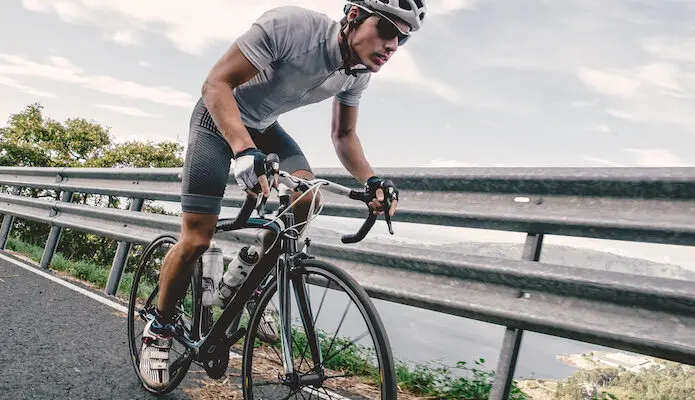
The fact remains that it’s difficult to train for climbing walls without… climbing walls! The physical disruptions caused by this type of effort are not the only elements to consider. Technically, there are still things to know to get through as best as possible. Facing the slope, especially if it’s steep, we are much more effective out of the saddle. The anterior thigh muscles are primarily richer in fast-twitch fibers, therefore more explosive. Standing on the pedals, these are the ones we call upon first. The glutes, also very powerful, and the calves are also more engaged. Problem: out of the saddle, it’s complicated to eliminate the top and bottom dead spots of the pedaling cycle. But by rocking the bike from right to left, thanks to a good grip on the handlebars, you use your body weight by pushing alternately on each pedal. This requires arm strength, but also good core stability (abs, lower back…) to limit energy loss.
The steeper the slope, the more we tend to hunch over our bike, bend our arms, and curl up. Whereas, on the contrary, we should remain as upright as possible, elbows bent at a maximum of 45°, to make good use of the lower back and glutes. The out-of-the-saddle position is not always easy for many cyclists, especially beginners. Practice this technical movement in perfect coordination over a few sessions. Avoid overly steep slopes at first and find the right cadence between rocking from right to left. It is commonly said that climbing out of the saddle increases heart rate, but this is actually due to lack of habit and relaxation. On a wall, in any case, you don’t have much choice if you want to get through as efficiently as possible.
Next, you need to determine the right gear. Be careful not to aim too low, precisely because of the coordination you need to find. It’s a kind of estimation based on the steepness of the slope, its length, and the intensity of the effort. If you use too large a gear, you risk getting stuck halfway up. If you use too small a gear, you’ll suffocate and lose your rhythm in terms of coordination. Thanks to brake levers with integrated shifters, don’t hesitate to change gears during the effort. Take advantage of momentum, if there is any, to start climbing with a medium gear, even if it means shifting up one or two teeth later. Do some trial and error in training to get to know yourself better in these conditions and facing the gradient. Test your equipment to see how it reacts, especially when it comes to shifting gears during the effort. Indeed, under chain tension, gears may struggle to shift. It grinds, it skips, and you can quickly find yourself off your bike. It’s then impossible to restart. You have to anticipate everything, understand everything, so as never to be caught off guard.

In a peloton
Climbing walls in training helps you not to make a mountain out of a molehill at the foot of the climb once the race or event comes. It’s psychological. Within a peloton, there are still other factors to consider. You’re ready, you’ve worked on your MAP, improved your out-of-the-saddle technique, adjusted your derailleurs well, 20% gradients no longer scare you. But in a race, a sportive, or during a ride, you must take your riding companions into account before tackling that famous wall. A priori, few gaps form when climbing a wall, because the distance is short and the speed of each participant is relatively low. But if you are poorly positioned at the foot of the wall within the peloton, you risk being hindered by other cyclists. You can take all your precautions, but that’s not necessarily the case for everyone. In every peloton in the world, there are careless riders who derail, get stuck, or ride in zigzags… Managing your effort is all the easier if you ride in the best positions, i.e., at the front. But above all, find out about the topography of the top of the climb, and the condition of the terrain.
If you lose 50 meters during the ascent on the leaders and the summit is directly followed by a descent, you have every chance of easily catching up. But if, at the top of the hill, the road is flat and clear, the 50 meters will turn into 200 meters, and you will no longer be sheltered. Regarding gear changes, be sure to shift to the small chainring before you reach the steepest part of the climb, ideally about fifty meters before you really get into the hill. Don’t shift too low at the bottom; shift up one tooth at a time. At the summit, reverse the operation: gain enough speed before shifting back to the large chainring, as the operation can be tricky with too low a pedaling cadence. You are now ready to tackle all the steep climbs; it’s your turn to play!
DOWN WITH PERCENTAGES It’s difficult to list all the walls in the territory, a fortiori in Europe. The most famous ones are made famous by professional races, or even sportives that use the routes of these races. But there are also a multitude of them, nestled in your regions, around a country road, a housing estate, at the foot of a hill, or to access a cul-de-sac. The wildest fantasies circulate about the percentages of the slopes that appear under your wheels. In reality, few walls have slopes of more than 15% and especially over the entire ascent. Remember that the average gradient is calculated as follows: elevation gain (in meters, difference between the altitude of the starting point and that of the arrival point) divided by the length of the climb (in kilometers). An average gradient of 15% is 150 meters of positive elevation gain over one kilometer, or 75 meters over 0.5 km. However, the average gradient is only indicative. On a one-kilometer climb, there can be much steeper sections, over 50 or 100 meters. These are often the sections that perpetuate the legend of the wildest percentages. |
=> SEE ALSO : All our Coaching articles

Share the post "How to get over a wall (or a steep climb)"