Share the post "Long-Term Test of the New Orbea Orca Aero M10ILTD"
With the new Orca Aero, Orbea offers a high-performance bike that’s more versatile than it looks. Well-finished and fully equipped, it also offers excellent value for the price. So whether you’re a road racer, a triathlete, or simply a rider who loves a thrill, the Orca Aero might just win you over.
By Guillaume Judas – Photos: Vincent Liky

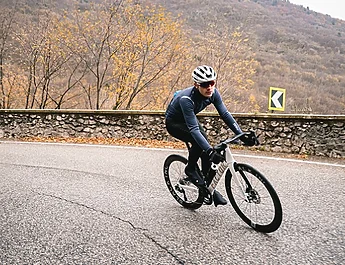
The first glance at the new Orca Aero M10ILTD is quite captivating. The shape and cross-section of the tubes demonstrate meticulous attention to detail designed to slice through the air and gain speed. The cockpit and the integration of the brake hoses are inspired by time-trial bikes. The massive, tapered seatpost exudes sturdiness. The latest Shimano Dura-Ace Di2 12-speed groupset adds a touch of class and cutting-edge technology, immediately establishing the bike’s high-end status. The understated paint job (in a custom MyO version), combined with the discreet look of the Dura-Ace C50 wheels, gives it a stealthy appearance, barely disrupted by the dual protrusions of the aerodynamic water bottle and the tool box mounted under the down tube just behind the front wheel. The weight, however, dampens this enthusiasm somewhat: at 7.92 kg without pedals in size 49, it’s slightly heavier than advertised at the bike’s launch. With the pedals, the computer, the contents of the tool box (320 g including a spare inner tube, a CO2 cartridge, and a 6 mm Allen wrench), the full water bottle, and the Garmin Varia radar, the riding weight is approximately 9 kg. A bit heavy for a bike costing nearly €10,000, but fortunately, its performance isn’t just a matter of weight.


With the new Orca Aero, Orbea set out to design the most specialized road bike in its history, based on the Ordu time trial frame. The Basque brand did not seek a half-hearted compromise between weight and aerodynamics, and continues to offer, in addition to this new bike, a traditional Orca in two versions: the first with OMX carbon fiber, and the second, more affordable, with OMR carbon fiber. The Orca Aero thus replaces a model that was already in the lineup, but it goes even further in terms of power savings thanks to its new design. Orbea claims a gain of 15 watts at 40 km/h and 28 watts at 50 km/h compared to the latest version of its aero model. This is an advantage we were unable to verify precisely in the field, but one that seems evident from the very first pedal strokes.

The Orbea Orca Aero’s shape was computer-designed
The shape and cross-section of the tubes were first analyzed by computer to optimize airflow around the frame and thereby minimize the bike’s drag. Given that air resistance is the primary force to be overcome on a bike traveling at speeds above approximately 20 km/h, this work is obviously crucial for a bike designed to go fast. Based on this data, various models were built for wind tunnel testing, before the final prototypes were finalized following tests at a velodrome, where the power required to ride at a certain speed was compared. Because beyond aerodynamic constraints, the new Orca Aero also had to meet stiffness requirements in order to deliver the best possible performance on the road. Special attention was also paid to the geometry to provide stability at high speeds, as well as the maneuverability that is sometimes lacking in this type of bike. To achieve this, the bottom bracket was lowered slightly to lower the center of gravity, but the bike’s wheelbase remains relatively short. Aerodynamically optimized for tires with a 25–28 mm width (the 25 mm tires on the test bike actually measure 27 mm on wide rims), the Orca Aero accommodates tires up to 30 mm wide, which allows for a bit more comfort if needed.

And speaking of comfort, the brand hasn’t overlooked the rider’s position—which is, in fact, far more important than simply dampening vibrations. The Orca Aero is available in seven sizes, from 47 to 60. For the handlebar and stem setup, a separate handlebar and stem combination was chosen rather than a one-piece set, which offers the advantage of being able to choose from seven stem lengths (70 to 130 mm) and four handlebar widths (360 to 420 mm), as well as adjusting the handlebar angle by 15°. And of course, it’s always possible to install a different model if necessary. The only drawback regarding the handlebar setup is that it’s currently impossible to mount bar extensions on the OC RA10 Road Aero Carbon handlebar, given the shape of its upper section. However, this handlebar remains a model of aerodynamics, particularly with its flat top section and 5° flare at the bottom, which allows for a narrow shoulder and forearm position with hands on the brake levers, while maintaining good maneuverability with your hands on the lower part of the handlebars. Finally, the seatpost offers a 25 mm offset, which is sufficient for a wide range of rearward adjustment, and a 10° angle of tilt adjustment.


A Top-Notch Build for the Orbea Orca Aero
In this top-of-the-line version priced at €9,999, the Orca Aero M10ILTD is equipped with the new Shimano Dura-Ace Di2 12-speed groupset, which operates flawlessly and offers numerous options for customizing the shifters thanks to its electronic controls. The new Dura-Ace C50 wheels are also highly efficient in a headwind while remaining versatile, with a profile that keeps them agile and responsive, whether in gusty conditions or on climbs. The Vittoria Corsa Competition G2.0 tires offer excellent road feel, efficiency, traction, and comfort. This TLR (Tubeless Ready) version can be ridden tubeless with sealant, but that’s not the choice Orbea made for a production bike. That’s a shame, since the tubeless setup adds a bit of weight to the bike. The Prologo Dimension T4.0 saddle provides stability and support, even in an aggressive, forward-leaning position.


Finally, a word about the two most striking accessories—the water bottle and the tool box—which contribute to the bike’s unique look, but also undoubtedly to its aerodynamic efficiency. The specialized water bottle (and its holder) isn’t all that easy to grab or put back in its holder, especially when wearing winter gloves. It’s also worth noting that it holds only 500 ml (compared to 600 for most water bottles on the market). The mouthpiece works well, but unfortunately it tends to leak a little when the bike is jostled. With a spotless bike, if the bottle is filled with syrup or an energy drink, you’ll quickly end up with unsightly streaks on the down tube. This is just a minor detail, though, since you can always mount one or two standard bottle cages—even if it means losing a bit of charm. As for the tool box, it simply replaces the saddle bag and can hold items that you’d otherwise put in your jersey or jacket pocket.
According to Orbea, this tool box offers a 3% aerodynamic advantage for the entire bike. That’s not insignificant.
According to Orbea, this tool box provides a 3% aerodynamic advantage for the entire bike. That’s no small thing. It’s also removable, if only to comply with UCI regulations, which prohibit additional aerodynamic attachments on a frame during competition. This is not an issue for triathletes. This tool box contributes significantly to the bike’s character, both aesthetically and in terms of aerodynamic efficiency, so frankly, we don’t see why anyone would want to do without it if the option is available.


Other versions of the Orca Aero are, of course, available, all offering excellent value for the price. The M11ELTD version is equipped with a SRAM Red eTap AXS groupset and Vision SC 55 wheels, for €8,699. Then there’s the M21ELTD version with SRAM Force eTap AXS and Vision SC 40 wheels, and the M20ILTD version with a 12-speed Shimano Ultegra Di2 groupset and the same wheels, priced at €5,999. An M31ELTD PWR model with the SRAM Rival eTap AXS groupset, a power meter, and Fulcrum Racing 400 wheels is available for €4,999. Finally, the M20 LTD with Shimano Ultegra 11-speed for €4,199 is a very attractive entry-level model.
The Orbea Orca Aero offers great efficiency
On the road, the Orca Aero feels lighter than it does on the scale, thanks to a geometry that promotes a certain responsiveness during accelerations—with short chainstays—and well-controlled lateral stiffness that delivers excellent power transfer. The suppleness of the Vittoria tires and the Dura-Ace wheels—which aren’t too stiff longitudinally or laterally—give the bike just the right amount of liveliness so that this firmness doesn’t feel too heavy. The bike feels very compact under pedaling, yet the road feel remains relatively smooth. Both wheels seem to always follow the same line, without the bike bouncing or feeling too stiff, even when pushed hard during frequent accelerations in the city and on the hilly stretches at the start of our training rides. Even before settling into a steady cruising pace—its theoretical purpose—the new Orca Aero reveals a more playful and efficient character than it first appears.

The handlebars, which are very narrow at the grips (38 cm), surprisingly offer unexpected stability in a speed-seeking position, and they’re stiff enough and well-integrated with the rest of the bike so as not to disrupt the out-of-the-saddle pedaling motion during hard sprints. The reach—the distance between the top of the handlebars and the grips—is quite long, which provides excellent support for the forearms with the elbows at a 45° angle and the hands on the shifters. On the other hand, with your hands on the lower part of the handlebars, your forearms can easily bump into the upper section during certain accelerations. You might even bump your knees against it while riding out of the saddle, due to the width of its upper section, which is also uncomfortable for your hands. But this handlebar setup allows for ultra-precise and confident steering, letting you position the bike with millimeter precision without feeling it wobble, even when taking very tight lines.

On climbs, it once again demonstrates rather surprising handling. It never seems to buckle under the strain, yet it isn’t excessively stiff either. It accommodates a few gear-shifting errors and adapts to different pedaling styles, whether with high gear ratios or a more relaxed cadence. And if the rider runs out of breath, shifting to the 36-tooth chainring restores just the right amount of responsiveness to push through to the summit.

But it’s on the flats and downhills, of course, that it really shines. The faster you need to ride, the more it outperforms most bikes in the peloton. Sustained stretches at a steady pace are a real treat. With a tailwind, the Orca Aero lets you maintain high speeds with less effort than most other bikes. With a headwind, you feel less resistance from gusts, which ultimately leads to higher average speeds per kilometer. And what’s most surprising is that in crosswinds—despite its wide tubes and the extra surface area provided by the water bottle and tool box—the bike remains controllable without having to fight it.
With the maximum gear ratio of 52/11, you don’t feel any part of the bike giving way under stress.
When it comes to finishing with a sprint, this bike once again seems to be the ideal machine. While it may not be the most explosive out of a standing start, on long, rolling sprints it offers a clear advantage once you pass 50 km/h and allows you to finish with a burst of speed. With the maximum gear ratio of 52/11, you don’t feel any part of the bike giving way under stress, and the riding experience it delivers is phenomenal.

Are we looking at the perfect bike? Almost. One could criticize it for being a bit on the heavy side, which inevitably limits its performance in high-altitude mountain terrain. But we don’t see this as a major obstacle for a triathlete looking to maintain a steady pace. The Orbea Orca Aero’s well-engineered stiffness, effective vibration damping with this build, and a geometry that promotes responsiveness more than make up for the compromises that had to be made to achieve clear aerodynamic gains at high speeds. Despite a few minor teething issues, such as the water bottle’s improvable spout or the handlebar’s unusual shape, we’ve truly fallen in love with this machine.
| The Orbea Orca Aero M10ILTD at a glance… Rating: ***** Pros: efficiency, stiffness, handling, build quality, customization options (colors, components) FRAME: Orbea Orca Aero Carbon OMX disc – FORK: Orbea Orca Aero OMX ICR, full carbon – WHEELS: Shimano R9250 C50 Disc Carbon TL CL – TIRES: Vittoria Corsa Competition G2.0 TLR 700x25c – CRANKSET: Shimano Dura-Ace R9200 52-36 – CASSETTE: Shimano Dura-Ace R9200 11-30 12-speed – DERailleurs: Shimano Dura-Ace R9250 Di2 – BRAKES: Shimano R9270 Hydraulic Disc – SHIFTERS: Shimano R9270 – STEM: Orbea OC RP10 Road Performance ICR – HANDLEBAR: Orbea OC RA10 Road Aero Carbon – SEAT POST: Orbea Orca Aero OMX – SADDLE: Prologo Dimension T4.0 – NUMBER OF SIZES: 7 – WEIGHT: 7.92 kg (size 49 without pedals) – PRICE: €9,999 Contact: www.orbea.com |
=> SEE ALSO: All our Gear articles
Share the post "Long-Term Test of the New Orbea Orca Aero M10ILTD"