Share the post "Peak form"
If competitors – whether cyclists, triathletes, or runners – made it their priority quest, the “peak form” would probably be their most beautiful treasure to discover. Do you remember an article on 3bikes.fr that already discussed supercompensation? So, fellow theorists, or you lovers of coaching and training methods, is this moment when your potential is maximized truly plannable?
By Jean-François Tatard – Photos: Billy Ceusters
Peak form is the culmination of preparation. The moment your body is at its peak to perform. The moment you extract the quintessence of what your parents bequeathed to you in your little body as an aspiring champion. But how do you achieve it? Is it possible to regularly renew this disposition? How many peaks can you create in a year?
Generating Peak Form
In its grand theory, to generate the peak, you will need to build a plan. A plan that is anticipated many months in advance. Perhaps even a year in advance. It is organized in stages…
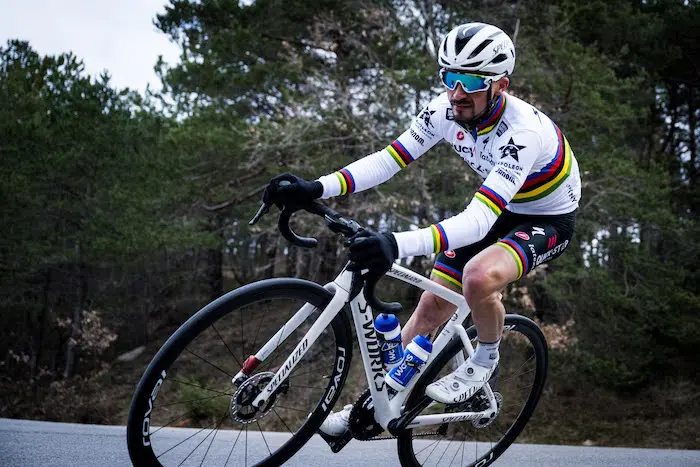
The Major Phases to Reach Peak Form
Can you count to 4?
- Stage 1: the development phase where you build your base endurance
- Stage 2: you specify the work by targeting the pace and intensity that you will need to reach at the key moment on D-Day. During this period, you accumulate training loads, also accumulating fatigue. You don’t necessarily feel like you’re progressing from one day to the next, and sensations are sometimes poor. The idea behind all this is to work on the different energy systems, according to a more or less complex training plan.
- Stage 3: you release the pressure. Physically & mentally. You recharge your energy through nutrition and rest, thus maximizing the body’s capabilities.
- Stage 4: the D Day! The day of the competition, the day you are supposed to have reached your peak form…
How Long Do These Magical Effects Last?
Peak form necessarily depends on individuals and their ability to recover, but generally, we can imagine that the peak lasts a few weeks. A maximum of one month. It would therefore be better to speak of a period of form rather than a peak of form.
And After?
Well, after: you recover! This is the time to take stock. A review of what worked. Of what can be improved. You capitalize on the positive points and set up a future action plan to transform areas for improvement into future strengths. By respecting this period of relaxation, you can consider two or three other peaks of form in the season.
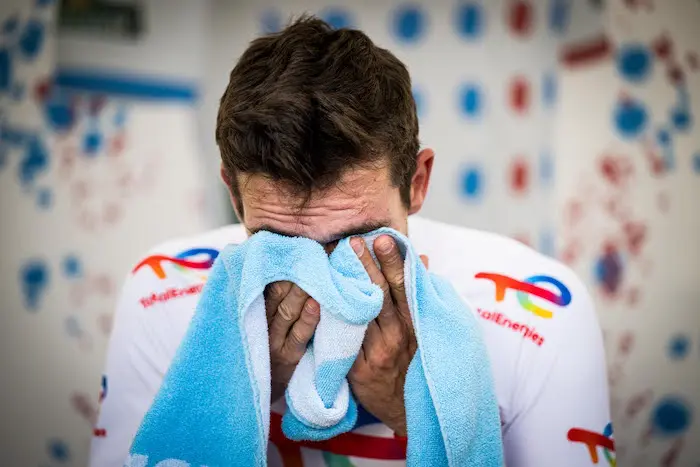
The Eraser & the “Trial and Error” Principle
Coaches ensure that the athlete’s major competition of the season falls within this period of form. The moment when training generally focuses mainly on the qualitative aspect. But if it were that simple… No, training plans must be adapted according to unforeseen events, injuries, context, or setbacks. Moreover, even if there is a training base, each athlete is different, depending on their background, their past, their capacity for progression, their trainability. What works for one (the sequence of certain sessions) does not necessarily work for another. That’s why you know the coach’s best tool, don’t you? The coach’s best tool is the eraser and the “trial and error” protocol!
In Conclusion
Rest assured, theorists, yes, you can schedule a peak form. Yes, you can schedule a state of form. It is necessary to prioritize training cycles: resumption / development / pre-competition / competition, knowing how to play on recovery times to allow energy resources to gradually increase until the period of form. Thus, you will have understood: the biggest threat lies in the planning of recovery times, which is contextualized and individualized according to all the factors that make up your existence and your daily life. And now that you have the keys, all that remains is to define the date on which you truly want to shine the most…
=> SEE ALSO: All our Coaching articles
Share the post "Peak form"