Share the post "Review of the Elite Suito-T Exercise Bike"
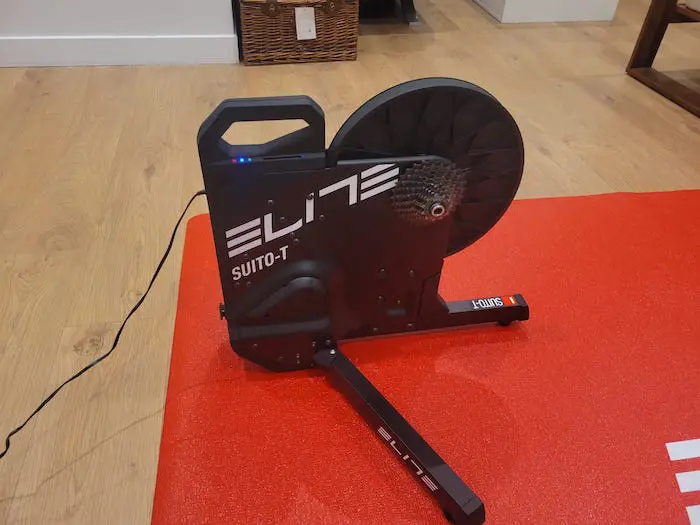
The Elite Suito-T indoor trainer is a competitively priced, interactive direct-drive trainer designed to make indoor training easier. Compact and easy to store, it also offers excellent stability during workouts on various apps such as My E-Training, Zwift, TrainerRoad, Kinomap, Rouvy, or Bkool, with which it is compatible.
By Guillaume Judas – Photos: Kevin Le Cunff
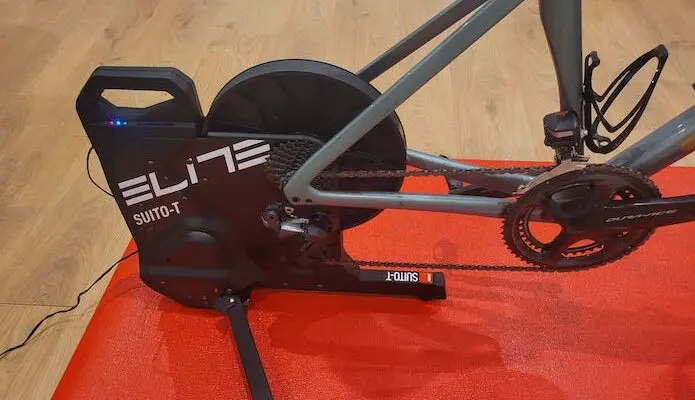
The Suito-T is the cassette-free version of the Suito, a model that ranks as the second tier in the Italian brand Elite’s line of interactive indoor trainers. Priced at €629.99, it offers all the features needed for virtual rides on apps like Zwift, with responsive and realistic simulated gradient changes, a simulated gradient range of 0 to 15%, and a maximum resistance of 1,900 watts. It also supports ERG mode, which means the trainer’s resistance can be controlled by the selected app based on the training plan being followed.
=> SEE ALSO: Buy the Elite Suito-T indoor trainer for €549.99
This version comes without a cassette and with a Shimano HG body for 9/10/11/12-speed cassettes. However, Campagnolo, SRAM XRD, and Shimano Microspline cassette bodies are also available for €49.99. The Suito-T is compatible with road bikes, gravel bikes, and mountain bikes, featuring 130–135×5 mm hubs with quick-release skewers and 142×12 mm hubs with thru-axles. Optional adapters are available for compatibility with 135×10–12 mm, Boost 148×12 mm, and Super Boost 157×12 mm hubs. However, there’s no need to install an additional sensor on the bike or on the indoor trainer, as the Suito-T measures cadence, power, and speed. The box also includes a front wheel mount, a cable and power adapter, documentation and a user manual, a card with a 12-month free subscription to My E-Training, and another with a one-month free subscription to Zwift.
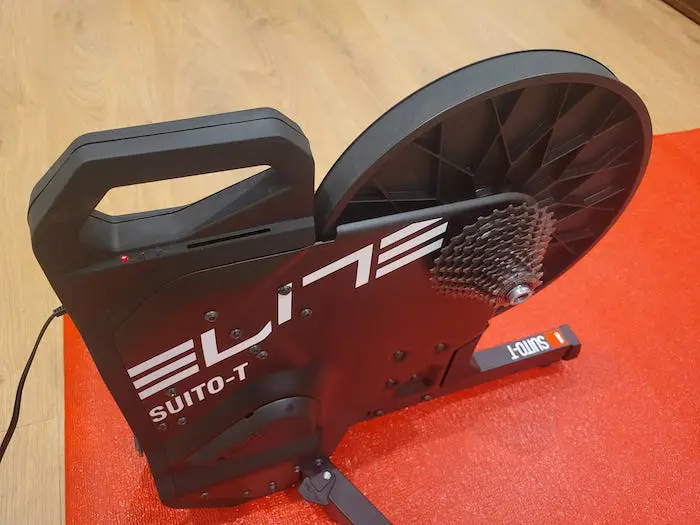
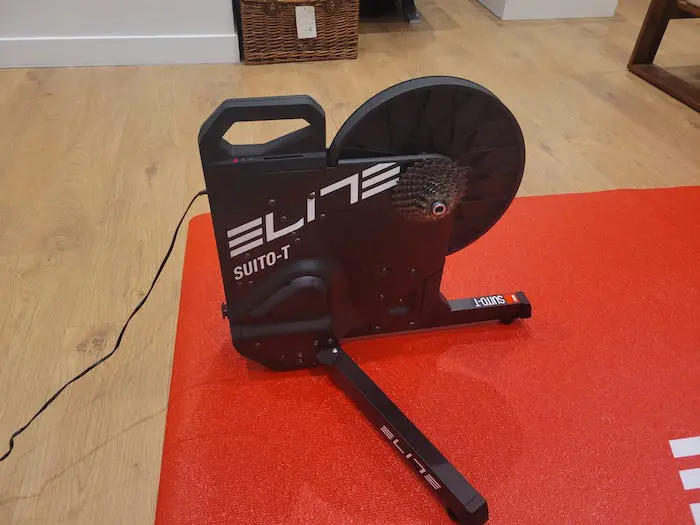
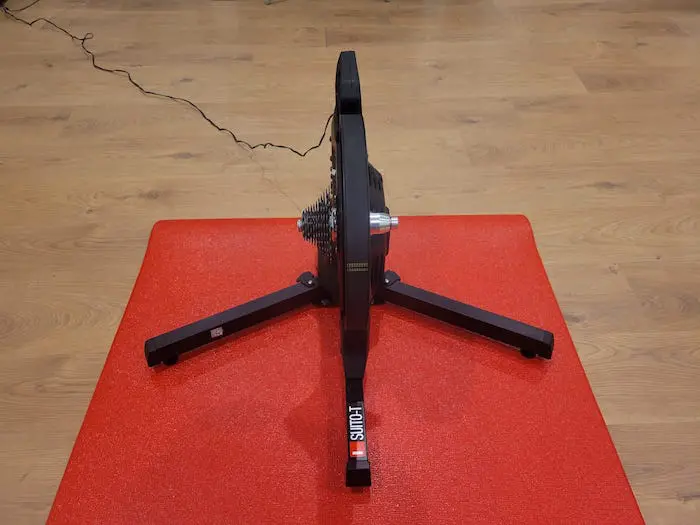
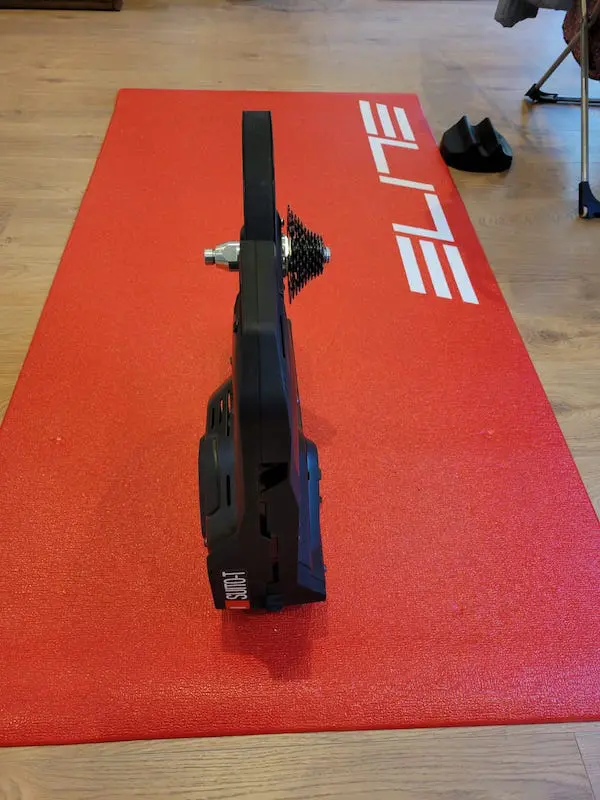
Setup is very easy once you take the device out of the box. Simply unfold the legs, install a cassette, plug in the power cable, and the device is ready to mount a bike. Once in position, the Suito-T measures 57 cm long, 76 cm wide, and 49 cm high. When the device isn’t in use, you can fold up the legs, making it easy to store with a width reduced to 20 cm. Handy for small apartments! On the top of the Suito-T, a large, well-placed handle makes it easy to move from one place to another.
The indoor trainer connects via ANT+, FE-C, and Bluetooth and is compatible with smartphones, tablets, and laptops, whether they run on iOS, Android, Mac OS, or Windows. Connecting with these various devices is generally hassle-free, although it may be helpful to disconnect all other devices connected via Bluetooth to a smartphone or tablet to ensure seamless recognition and data transmission. On Zwift when connected to a computer, the setup is very simple, allowing you to use the Suito-T as a source of power and cadence, as well as a control source (controllable within Zwift) to manage changes in gradient.
The Suito-T provides power measurement with a claimed accuracy of +/- 2.5%. To achieve this, it features a temperature compensation algorithm that allows the indoor trainer to account for variations caused by the brake heating up. It also features the Spindown function, a calibration procedure designed to account for all friction—which varies over time and during use—that affects the brake’s accuracy, and to compensate for its effects on the resistance generated by the indoor trainer. Finally, it features the Power Meter Link function, which allows you to use the power meter already installed on your bike as a power source. This is an option already offered by Zwift, since it’s possible to use your own power meter instead of the indoor trainer—for those seeking greater accuracy or who have more confidence in their usual power meter.
Excellent stability
Weighing 14.4 kg—less than most of its competitors—the Suito-T benefits from its wide base when unfolded, ensuring it remains perfectly stable during exercise. The adjustable feet allow you to level it out regardless of the evenness of the floor on which it’s set up. It offers a great riding feel and responds well to changes in gradient, even though its 3.5 kg flywheel isn’t as large as those on other models. In terms of noise, it isn’t quite as quiet as a Wahoo Kickr Core or an XPlova Nova S, especially at speeds of 40 km/h or higher. However, with a dedicated mat, vibrations are greatly reduced, and it’s still possible to use it in the evening without disturbing the entire neighborhood—or even other family members in an adjacent room.
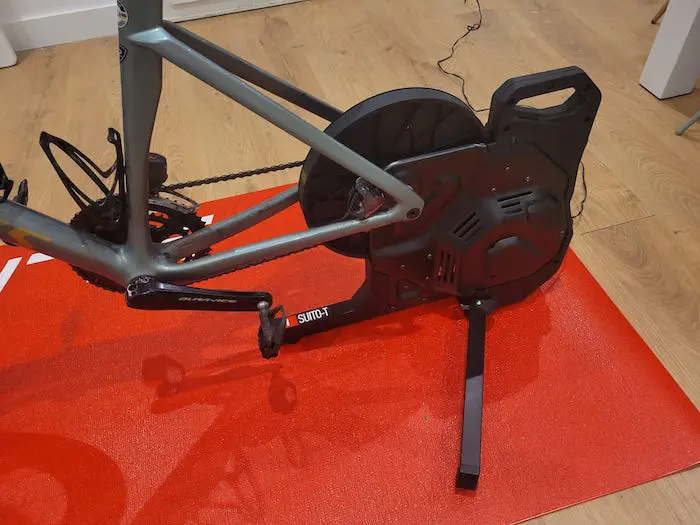
On virtual climbs, it provides realistic and responsive resistance, but this needs to be adjusted in Zwift via the “Trainer Resistance” tab in the menu. By default, Zwift sets this to 50%, which means that a 10% grade is theoretically felt as 5%. However, this sensation varies by indoor trainer, and based on our experience, we prefer to adjust the slider according to the gear ratios we typically use on the road. For the Suito-T, a resistance setting of 60% seemed ideal for using the same range of gear ratios. Note that this setting has no effect whatsoever on the power output and does not alter performance on Zwift. The maximum gradient on Zwift is 17% over a short stretch, and while the Suito-T offers a maximum simulation of 15%, this is obviously not a deciding factor when making a choice. The same applies to the maximum power the device can handle (1,900 watts), a level that even many professionals cannot reach. During a few sharp accelerations, we noticed that the Suito-T responded very quickly, with fairly consistent power spikes, although it’s important to keep in mind the specific conditions of indoor training on a stationary bike, which are less favorable than outdoor riding.
In terms of power accuracy, we compared the Suito-T’s measurements with those of a Shimano Dura-Ace 9100-P bottom bracket sensor. In some test sequences, we observed a difference of 15 watts during a sustained effort exceeding 300 watts (in favor of the Shimano sensor), and in others, a difference of only 3 watts. While both sensors were properly calibrated before each session, it’s important to note that the Suito-T claims an accuracy of +/- 2.5% and the Shimano sensor is rated at +/- 2%. This means that in the case of a 15-watt difference at 315 watts, we are in the upper range of discrepancies between the two sensors (-5% for the Suito-T), but it is difficult to draw definitive conclusions because both devices have their own margin of error. Similarly, it’s important to note that the measurement isn’t taken at the same location on the bike (at the crankset on the Shimano, and after the drivetrain on the indoor trainer). For the most serious riders—those who want to train under the same conditions indoors or outdoors—you can always connect your power meter to the indoor trainer using the Power Meter Link feature. As for cadence calculation, however, there is no difference between the two devices.
https://www.3bikes.fr/2021/12/03/test-du-elite-sterzo-smart/
That said, given its price point, we can’t expect the Elite Suito-T indoor trainer to be as accurate as certain models that cost up to €500 more—or even the Direto XR, which tops the Elite lineup at €800. It’s a mid-range model that offers most of the features needed for a fun and high-quality indoor workout, and it stands out for its compatibility with various connection and operating systems; it can be adapted to any bike and even works with accessories like the Elite Sterzo Smart (for the headset) or the Elite Rizer (incline simulator). While it may not be the best choice for tracking the most precise training methods down to the watt, it’s perfect for those who view indoor cycling as a valuable supplement to their fitness routine—whether to optimize their schedule or to work around inclement weather.
=> SEE ALSO: Buy an Elite Direto XR-T indoor trainer for €684.99
The ELITE SUITO-T indoor trainer at a glance… Rating: ****** Pros: lightweight, compact, stable, compatibility Dimensions: width 74 cm, length 57 cm (folded: 14x49x57 cm) – Connectivity: ANT+, FE-C ANT+, Bluetooth – Max resistance: 1,900 W – Grade simulation: 15% – Accuracy: 2.5% – Cassette body: Shimano 9/10/11/12-speed, Campagnolo, SRAM XRD, and optional Shimano Microspline – Included: cables, manuals, thru-axle adapters, one-year My-eTraining subscription, and one-month Zwift subscription. Weight: 14.4 kg – Price: €629.99 |
=> SEE ALSO: All our Gear articles
Share the post "Review of the Elite Suito-T Exercise Bike"