Share the post "Rotor 1×13 Groupset Review"
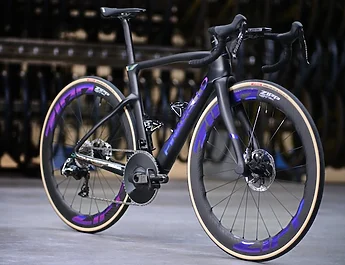
With its 1×13, Rotor offers an original single chainring drivetrain system, which proves to be the lightest of current groupsets with disc brakes. However, the Rotor requires the installation of a specific rear wheel, and gear changes are not as smooth as the competition, despite the use of a hydraulic system.
By Guillaume Judas – Photos: Vincent Lyky / DR

The single chainring for road cycling is a solution initiated by Sram in 2015, and widely adopted since by all market suppliers for cyclocross or gravel. With a single chainring and 13 cogs at the rear, Rotor offers an interesting alternative that almost rivals double chainring and 11-speed solutions, most often offering 14 different gears (and not 22 as one might expect, given the overlaps between the gears with the small and large chainrings). As a result, the Rotor offers most of the advantages of a double drivetrain in terms of range and progression of gears, but with the simplicity of a single chainring, and an interesting weight saving.
With four cassettes available (10-36, 10-39, 10-46 and 10-52) associated with a range of chainrings from 38 to 54 teeth, the 1×13 offers something for all tastes and practices. Let’s remember that the Rotor brand specializes primarily in cranksets and chainrings, and offers a very wide range of tooth counts with round or ovalized chainrings. On our test bike, a 46-tooth chainring and a cassette with 10-11-12-13-14-15-17-19-21-24-28-33-39 teeth offers the same gear range as a 51-39 chainring combination with an 11-31 cassette, but with the first six cogs following each other, which is better than the first five of an 11-28 or an 11-30 in 11 speeds. With a 50-tooth chainring and a 10-36 cassette, the Rotor offers a gear range comparable to that of a 53-39 and 11-28 combination, with only one missing gear in the range, rather towards the top of the cassette, where the gear differences are least important. From a technical point of view, the Rotor 13-speed cassette uses Shimano HG 11-speed splines, but with a 3 mm longer freehub body towards the inside and a cog spacing identical to that of 12-speed. The first 10-tooth cog locks partly on the outside of the freehub body, so that it maintains a classic diameter. The chain used is therefore identical to that of a 12-speed groupset, but the groupset requires the use of a specific hub.
Indicative weights of the Rotor groupset
| Combined levers + brakes + derailleur + rotors | 859 g + 422 g |
| Crankset (Aldhu) | 464 g + 75 g (bottom bracket) |
| Cassette (10-46) | 290 g |
| Chain | 269 g |
Comparison of gear ratios between a 53-39 / 11-28 combination and 50 / 10-36 from Rotor
| Teeth | Ratios | Teeth | Ratio | ||
| 53 – 39 | 11 | 4.81 – 3.54 | 50 | 10 | 5 |
| 53 – 39 | 12 | 4.41 – 3.25 | 50 | 11 | 4.54 |
| 53 – 39 | 13 | 4.07 – 3 | 50 | 12 | 4.16 |
| 53 – 39 | 14 | 3.78 – 2.78 | 50 | 13 | 3.84 |
| 53 – 39 | 15 | 3.53 – 2.6 | 50 | 14 | 3.57 |
| 53 – 39 | 17 | 3.11 – 2.29 | 50 | 15 | 3.33 |
| 53 – 39 | 19 | 2.78 – 2.05 | 50 | 17 | 2.94 |
| 53 – 39 | 21 | 2.52 – 1.85 | 50 | 19 | 2.63 |
| 53 – 39 | 23 | 2.30 – 1.69 | 50 | 21 | 2.38 |
| 53 – 39 | 25 | 2.12 – 1.56 | 50 | 24 | 2.08 |
| 53 – 39 | 28 | 1.89 – 1.39 | 50 | 27 | 1.85 |
| 50 | 31 | 1.61 | |||
| 50 | 36 | 1.38 |

Hydraulic braking and shifting
But the 1×13, now adopted by Campagnolo with its Ekar groupset dedicated to gravel, is not the only innovation offered by Rotor, since as early as 2016 the Spanish brand offered a groupset with an unprecedented hydraulic drivetrain, instead of a cable or electric wire drivetrain (or wireless now for Sram and partly for Shimano). It is therefore not surprising that Rotor uses the same technology on its 1×13. Hydraulic has the advantage of being completely sealed between the lever and the derailleur, of not having a cable that risks seizing or breaking, and of not requiring recharging like with a battery. The indexing system is located at the derailleur, which prevents it from getting out of adjustment, and a pusher on the mechanism is enough to move it to the right when removing the wheel. This derailleur is equipped with a kind of clutch to keep it taut in position, in order to limit the risk of chain jumps at the crankset.

Finally, in terms of weight, the system fully benefits from these two philosophies (single chainring and hydraulic derailleur) to be displayed as the lightest on the market among groupsets with disc brakes, with an average weight of 2379 g. At the high end, competitors claim 2442 g for the Shimano Dura-Ace Di2 12-speed, 2516 g for the Sram Red eTap AXS, or 2529 g for the Campagnolo Super Record Disc. At 2577 g, the Campagnolo Ekar in 1×13 speeds, created more specifically for gravel, is the most comparable to the Rotor. It is 200 g heavier, but still costs less. Because as the Rotor requires the use of a specific freehub body, it is offered for sale with different wheel options, or in 12 speeds without wheels, since the groupset is 12 and 13-speed compatible:
- 12-speed kit without wheels (ready for later 13-speed upgrade): €1999
- 1×13 SuperLight Kit (carbon wheels): €3499
- 1X13 2InPower Kit (2InPower power meter and carbon wheels, like the test model): €4499
The groupset prices can also be adjusted depending on the chosen crankset, as Rotor obviously offers several models (Vegast, Aldhu, Aldhu Carbon) and power meters (INspider, INpower and 2INpower). The pair of hubs or the rear hub alone (Rvolver) can also be added to the groupset. For our test, we tried the top-of-the-range version with the power meter. A smooth and beautifully finished crankset, which also proves to be very precise in terms of power measurement.

For braking, the Rotor groupset uses particularly high-performance Magura original models. Even if it takes a few tens of minutes to properly understand the braking modulation, it is reliable and especially formidable in the rain. On dry roads, noises are minimal, and rubbing during accelerations is almost non-existent, with two 160 mm rotors. In all cases, they are largely on par with the competition.

Ergonomics reminiscent of Sram Double Tap
In terms of ergonomics, the Rotor 1×13 groupset is distinguished by rather large levers, with soft hoods that offer good grip. It’s just a little regrettable that they don’t seem perfectly glued to the lever’s frame, and that they tend to rotate slightly when handled firmly. The brake levers are relatively accessible for average-sized hands, and they are adjustable. By lifting the top of the hood, you’ll find a screw that serves to bring the brake lever closer.

The single shift paddle – for the rear derailleur, therefore – operates like Sram Double Tap (mechanical), with a short impulse to shift down one cog on the cassette, and a longer impulse to shift up one cog. The rear derailleur proves to be very precise, and never seems to hesitate between two cogs. The lever manipulation is not as pleasant as with electronic derailleurs, and sometimes even less smooth than with a good cable system. The sensation is blurrier when changing cogs. On the lever, there is no real distinct click, since the indexing is integrated into the derailleur, and not into the lever. The “click” here is barely perceptible, especially when shifting up, and seems quite distant from the fingers’ perception. To shift up several cogs on the cassette (two or three) requires a very ample, but not really natural, inward movement. However, it is not possible to shift down more than one cog at a time. After a few tens of kilometers, one naturally gets used to the drivetrain’s kinetics, but it remains significantly less pleasant than those of Shimano, Sram, or Campagnolo. The shift lever movement always proves to be a little stiff.

The absence of a front derailleur is an advantage in terms of drivetrain noise, which always proves to be smooth and quiet, even if it seems a little noisier on the two extreme cogs. Overall, the 10-39 cassette’s gearing is correct, with slightly larger gear gaps on the last third of the cassette. This version seems more suitable for gravel riding, or at least for high mountains, than for simply hilly and windy courses.
The specific hubs, here supplied with very high-quality Enve carbon rims, prove to be very smooth, and they are distinguished by a quick-engagement freehub body that promotes the bike’s responsiveness. They seem very high-end, although we don’t know more about their durability.


However, the limitation to using these special hubs can be a hindrance to choosing this groupset, which otherwise leaves us a little wanting. Certainly, the Rotor 1×13 is lightweight, and allows for the assembly of truly high-performance bikes, below 6.8 kg with disc brakes, with a simplified drivetrain, and a range of gears capable of covering most needs. It also has the merit of being truly original, and of resolving most of the compromises necessary with a single chainring. But the gear changes are simply not as smooth and pleasant to use as the competition, especially at this price point.
The Rotor 1×13 groupset in brief… Rating: * Pros: single chainring simplicity, weight, braking, wide choice of gears Drivetrain: 1×13 – Braking and shifting: hydraulic – Available cassettes: 10-36, 10-39, 10-46, 10-52 – Chainrings: 38 to 54, round or ovalized – Compatibility: road, gravel, cyclocross, TT, 12-speed possible with any hub – Specific hubs for 13-speed. Price: from €1999 to €4499 Contact: rotorbike.com, alternativsport.com |
=> SEE ALSO: All our Gear articles
Share the post "Rotor 1×13 Groupset Review"