Share the post "Xplova Nova S Indoor Trainer Review"
The Xplova Nova S smart trainer is a mid-range connected indoor trainer that allows you to ride on Zwift and various other applications, and stands out for its stability, quiet operation, and realistic feel. However, power measurement is not as accurate as some competing models.
By Guillaume Judas – Photos: @3bikes.fr / Xplova / DR
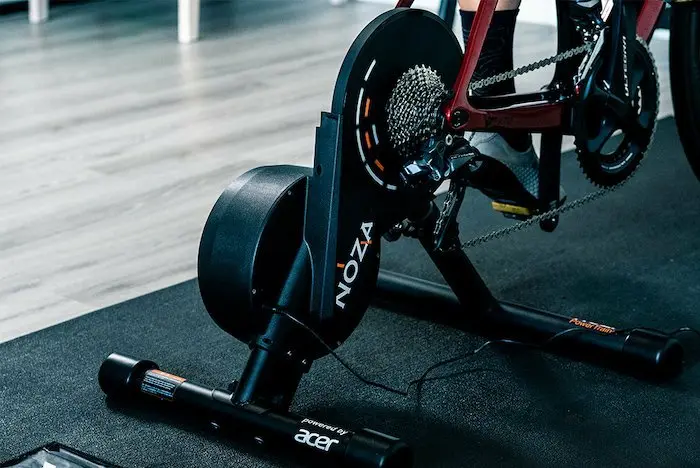
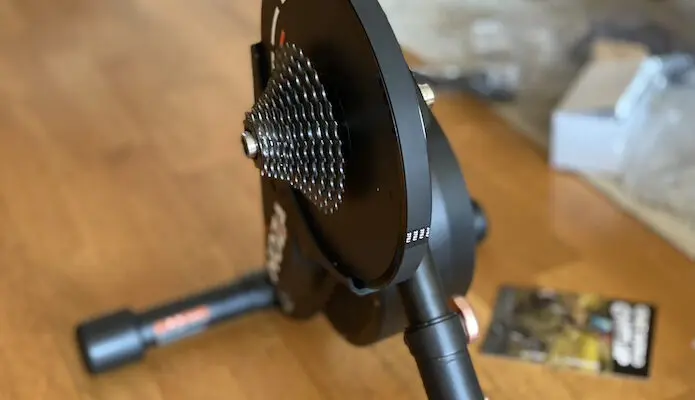
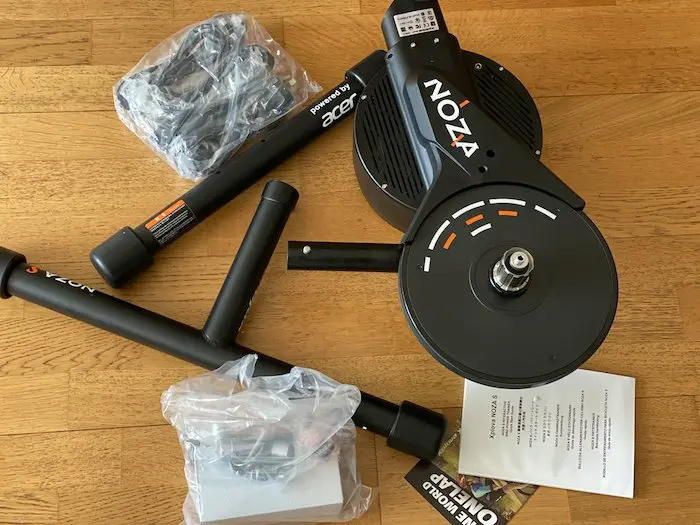
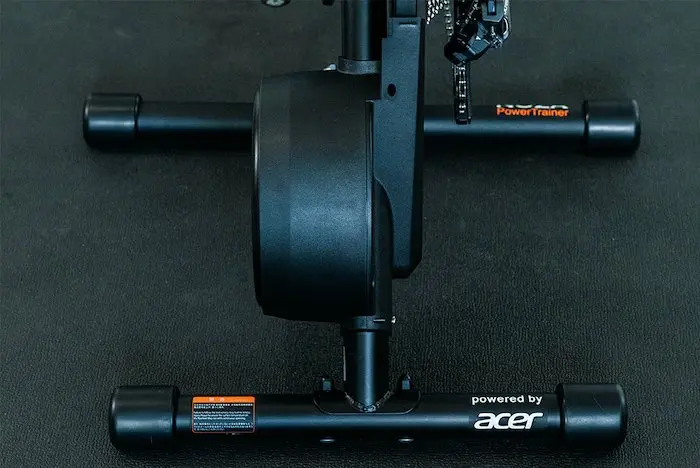
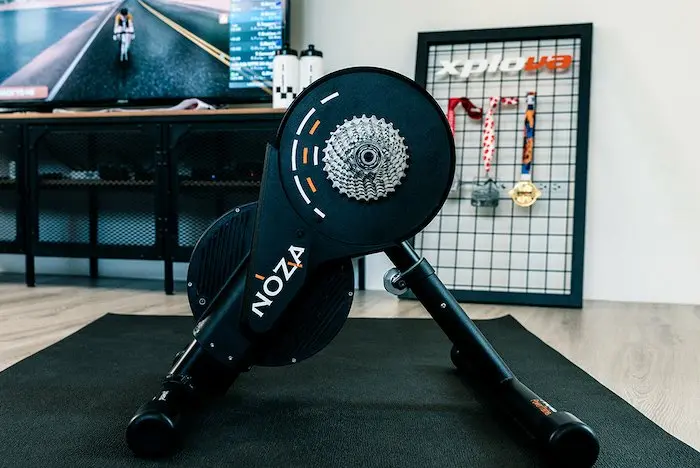
Xplova is a Taiwanese brand owned by the IT giant Acer, and the Nova S is the only indoor trainer in a range complemented by several GPS bike computers. It comes on an easy-to-assemble stand that feels solid right out of the box, with adapters for quick release or thru-axle, and compatibility with 700 or 650 wheels for road bikes, or 24 to 29-inch wheels for mountain bikes. The Nova S easily connects to applications like Zwift or Xplova Workout thanks to its compatibility with ANT+, ANT+ FE-C, and Bluetooth Smart communication systems.
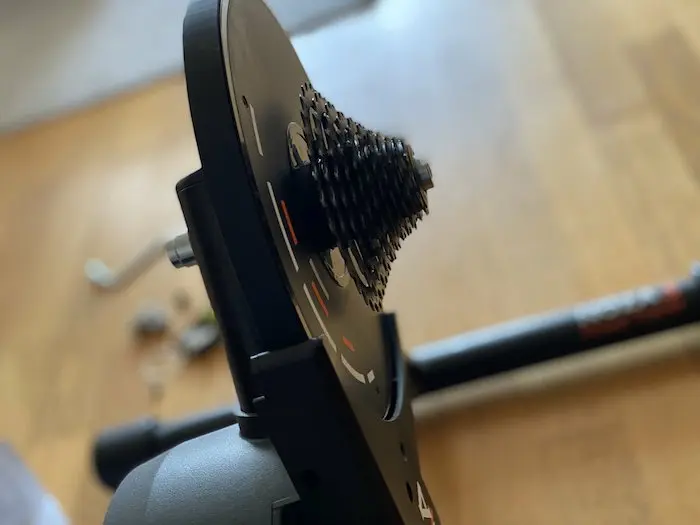
The Xplova Nova S is delivered without a cassette, and with a Shimano/Sram HG freehub body (8 to 11 speeds, and now 12-speed Shimano), and there is currently no option for mounting with a Campagnolo, Sram XD, or Shimano Micro Spline cassette. Fully assembled, the Nova S weighs 17 kg and is not foldable. Furthermore, it does not have a handle, which also makes it difficult to move. Finally, the left adapter for mounting the bike with a thru-axle tends to fall off easily when moving the device without the bike. Care must therefore be taken not to lose it.
Nevertheless, the Nova S is not without its qualities, with rock-solid stability, simulated gradients up to 18% (the maximum gradient found on Zwift is 17%), and a maximum power resistance of 2500 watts, which is far more than most riders can generate. The feet have a rubber coating that significantly reduces vibrations. In addition, its quiet operation is very noticeable, with only 58dB at 30 km/h. In other words, the noise from the drivetrain or the fan is greater than that of the device itself.
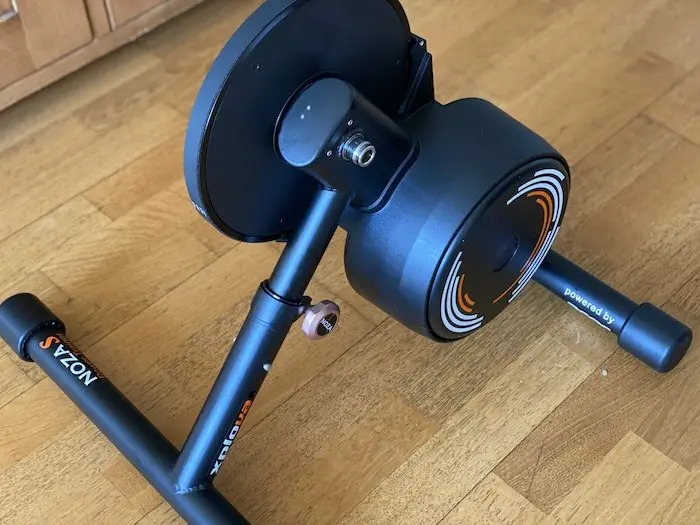
But most importantly, with a flywheel 20.5 cm in diameter and weighing 5.9 kg, the Xplova Nova S offers very realistic sensations during virtual gradient changes, in one direction or the other, which makes it very pleasant to use, regardless of the duration of the indoor workout.
Xplova Nova S Connectivity
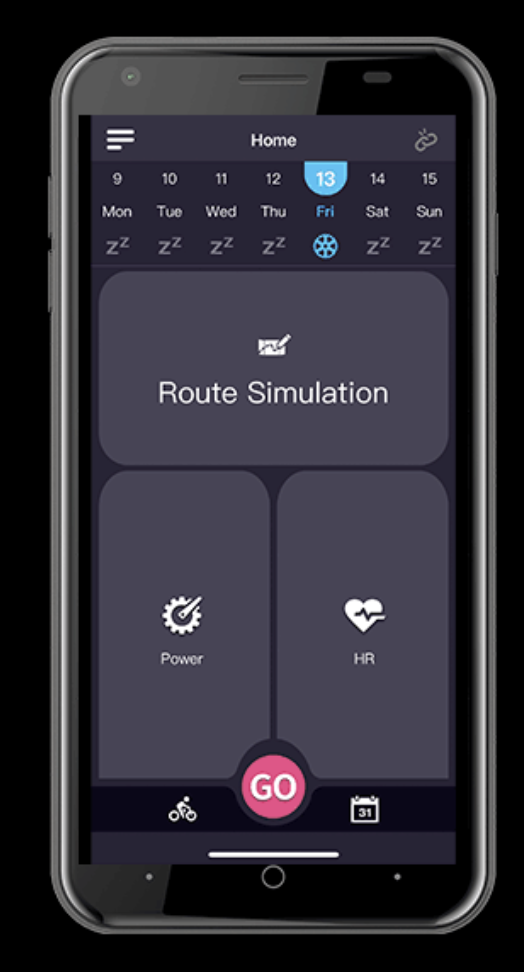
The Xplova Workout app (available for iOS and Android) allows you to update the firmware and calibrate the device. We found the connection between the smartphone and the Nova S sometimes a bit tedious, and we had to unplug/replug the indoor trainer and especially close all other applications likely to use Bluetooth to achieve our goals. Once the application is connected, calibration is quite simple to perform.
Connecting to Zwift on the computer, however, posed no problems, although we are surprised not to find a calibration procedure for this device directly on Zwift, as is the case with Elite brand indoor trainers, for example. It should be remembered that this step is essential if one seeks to establish realistic performance on the application, which depends directly on the power measured by the indoor trainer. Similarly, an accurate measurement ensures that a training plan can be followed correctly, and that there is no risk of overtraining, or conversely, undertraining.
Xplova claims a precision of +/- 2.5% for the power meter of its Nova S, a value that depends mainly on the intensity of the effort according to our own tests. We should add that the device does not have an integrated cadence sensor, but it is always possible to connect one to Zwift if it is mounted on the bike.
A Question of Accuracy
From our first tests of the Xplova Nova S on Zwift, we compared its power data with a Shimano Dura-Ace FC-R9100-P power meter, taking care to calibrate both devices according to the procedure established by each manufacturer before each session. We immediately noticed a difference with lower figures delivered by the Nova S, on moderate to medium intensity efforts. However, as it is difficult to read live data from two power meters simultaneously on two different screens and especially to draw definitive conclusions, we preferred to opt for a test with the indoor trainer’s ERG mode. ERG is the mode of controlling the indoor trainer’s resistance directly by the software – here Zwift – which provides a stable constraint according to the session’s objective, and unlike SIM mode, which offers resistance according to the course and virtual gradient. Thus, for efforts up to about 250 watts, we observe a difference of a little over 3% between the two sensors, always to the detriment of the Nova S. Note, however, that while Xplova claims an accuracy of +/- 2.5%, Shimano claims an accuracy of +/- 2% for its power meter. So ultimately, the difference between the two sensors remains within the “acceptable” range, even if it is here to the detriment of the Nova S.
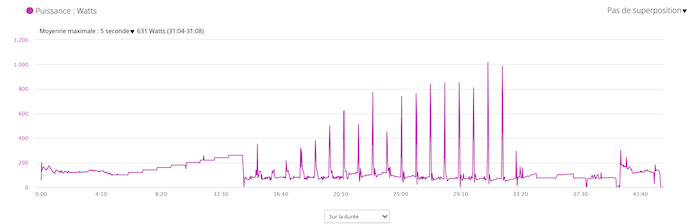
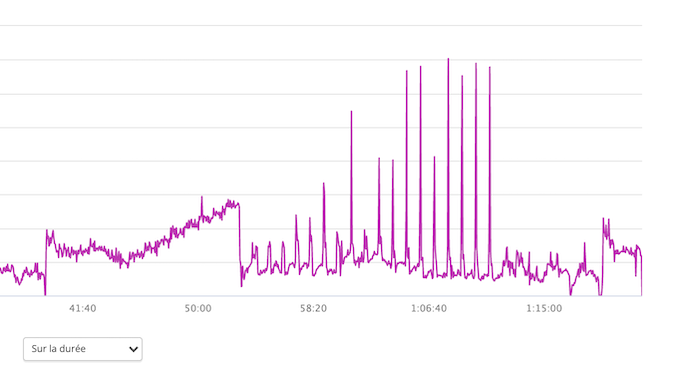
However, we also noted that while everything went more or less correctly on moderate to medium intensity efforts, the same was not true for power peaks, with a series of short sprints. In this situation, we can see that the Xplova sometimes overestimates power by nearly 30%. We also know that the Shimano power meter sometimes reacts a little slowly to very brief efforts, but in this specific case, the difference remains very significant.
There is, of course, a way to circumvent the problem on Zwift for those who seek to train with more precision: it is possible to connect the power meter installed on the bike as a power source (and cadence), and to connect the indoor trainer to feel the gradient variations, which the Xplova does very well. However, this is a costly solution that should be unnecessary in the case of an indoor trainer with an integrated power meter.
In terms of feel, the Nova S offers a truly interesting experience thanks to its imposing flywheel that is very responsive to gradient changes on Zwift. The slightest percentage variation on the different virtual worlds is perfectly felt, and even requires frequent gear changes, just like in the real world. And with a well-chosen gear, for example with the large chainring and the chain in the middle of the cassette, the relative quietness of operation can even encourage late-night sessions without disturbing neighbors.
During training sessions calibrated by Zwift or any other application, the ERG mode proves to be both fluid and responsive. The difference in resistance is clearly felt, and it is delivered stably and in accordance with the chosen pedaling cadence.
The XPLOVA NOVA S in brief… Rating: * Pros: stability, low noise, flywheel, realistic sensations Resistance control and intensity change – Claimed accuracy of ± 2.5% – Thermal compensation technology – Six-pole electromagnetic brake and integrated strain gauge – Dimensions: 593.4 x 514.5 x 465.15 mm – Weight: 17 kg – Flywheel weight: 5.9 kg – Noise level: 58 dB (at 30 km/h) – Maximum power: 2500 W (at 58 km/h) – Maximum simulated incline: 18% (for 70 kg) – Compatibility: Road (650C, 700C), MTB: 24″, 26″, 27.5″, 29″, adapter for 130 and 135 mm quick release, adapter for 12 x 142 and 12 x 148 thru-axle – Connectivity: ANT+, ANT+ FE-C, Bluetooth Smart Price: €800 Contact: xplova.com, alternativsport.com |
=> SEE ALSO: All our Gear articles
Share the post "Xplova Nova S Indoor Trainer Review"