Share the post "The Training Log, or the Cyclist’s Journal"
Many cyclists, and athletes in general, use a training log. It allows them to record performances or different sensations and compare them. It also helps to stay motivated and to observe changes. It is also very useful when it comes to creating new habits or simply when it comes to analyzing developments more globally. To look back at past elements that made it work or, conversely, that did not lead to the desired result. What is the most suitable format? What should be included? And how to archive or reread the recorded information?
By Jean-François Tatard – Photos: Depositphotos.com / JF Tatard
Effective training monitoring is an essential element of preparation for an objective. It should not only be daily, weekly, or monthly. You can now interpret it on the scale of preparation over a much longer period. And why not on the scale of a career or a lifetime. This monitoring concerns the external and internal loads of training as well as the performance level. The training log then allows the collection of important and relevant information for training and its effects. This data is essential for anyone who wants to make lasting progress.

The training log is therefore a key element of progress. Neglecting it is a mistake! It is indeed the athlete’s logbook. A valuable collection of rich, ultra-useful information. Everything can be recorded there. It thus occupies an important place in the training process because it allows the future reproduction of the positive points of preparation and avoids repeating the same mistakes. It is also a kind of personal diary on which one writes down one’s impressions, feelings, sensations or perceptions, and sometimes other internal and even external elements such as the weather.
Essential information for the training log
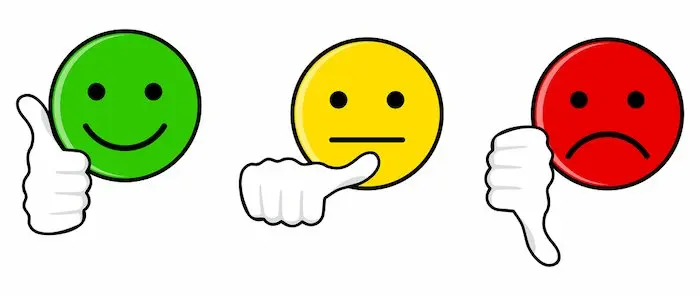
What information should be included in your training log? Of course, you can limit yourself to the number of kilometers per session, or even the associated time. This is the bare minimum. But if we draw a parallel with a real activity logbook, it’s better to go a little further. In a simplified and easy-to-read way, you can note all the details of your training that seem important to you. Some information can be highlighted by using, for example, a color code. Red or bold and uppercase for sensations, for example, if that’s the most important. It’s very subjective, but with a simple smiley (horrible, bad, average, good, great), you can, for example, note your own perception of your physical condition.
It is also just as relevant to record the theme of the session (endurance, sprints, climbs, threshold, MAP, etc.) as its content in this log, which actually looks more like a planner. To properly structure the information and see how often you have trained, you can also make the effort to always put the information in the same place or on the same line. This will help you find your way around immediately. Practitioners can also describe in detail the exercises performed, not forgetting durations, gear ratios, heart rate, watts, number of sets, recovery times, exercises performed, over what distance, what speed, what elevation, what bike, what route, what weather, what clothing (long or short), etc., and all other interesting variations.
What format to use for the training log?
Each athlete has their personal preferences and their own way of keeping their log. That’s why there are many different forms of training logs…

THE PLANNER: This is the one you ask your banker for as an end-of-year gift. You know, the planner that students also use at school. Often in A4 format or half of the famous sheet that is most commonly slipped into the printer. It’s not really in vogue anymore. And yet, with the rise of digital technology, it is still just as appreciated. It’s small, handy, and easy to carry. Placed in your sports bag with your 4-color pen, you always have it with you. It’s easy and accessible. You just have to write down what just happened.
THE PDF: The PDF document has the enormous advantage of being usable without problems in both analog and digital form. You can find it on your PC or smartphone or even print it, and record your progress there.
THE EXCEL FILE: The Excel spreadsheet is very pleasant and very clear. It offers you unlimited freedom to enter all the data important to you. The only drawback is that it can sometimes be difficult to enter all the information on a smartphone and reread it later.
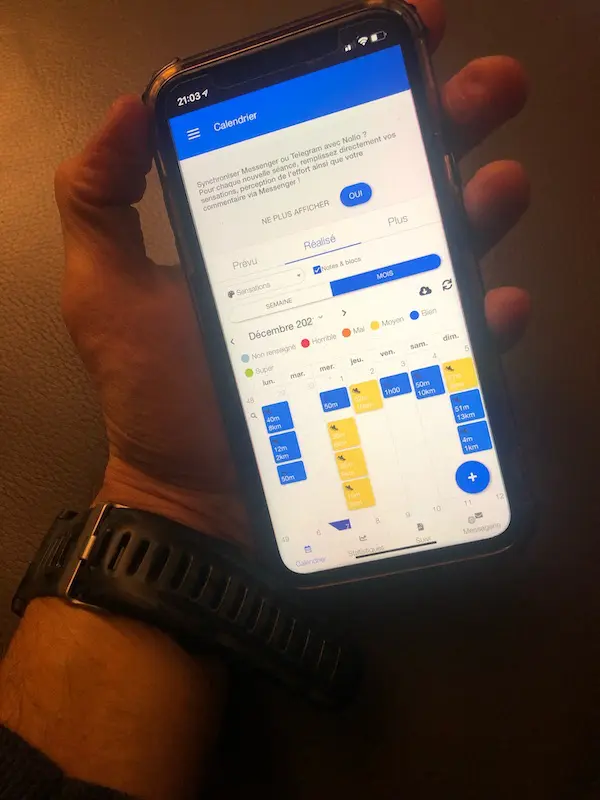
THE APP: The app is now the most modern variant. Often, it already displays your session in advance, or allows you to enter it later, as in a PDF. You can even associate external data such as the route that is directly recorded by GPS, but also the weather or other indications related to why you are doing it. And, if you have a suitable tracking device, you can even cross-reference a whole host of other indications live: temperature, altitude, pace, power, heart rate, cadence, oscillation and vertical ratio if it’s running, and even the balance of ground contact time.
Some digital interfaces allow quantifying the workload that characterizes the athlete’s efforts. This load is objectively quantifiable. It concerns the volume of training, the frequency of training, and its intensity. These interfaces also allow evaluating the effects of training loads at the internal level. And therefore here, the different physiological reactions of the body caused by the training load (external load). These effects can be assessed by subjective and objective data. Moreover, for you cyclist friends, we recommend the purchase of a power meter and for runners the purchase of a heart rate monitor or GPS, which are an excellent investment for the information to be included in the training log.
Digital or paper for the training log?
There are two schools of thought: while apps are now flourishing in tracking and programming training plans, paper aficionados are still numerous. Digital is good for noting; paper is better for understanding, learning, and taking ownership of what we do. So perhaps it’s also a generational question. You probably have to try both. But in my opinion, no, the pen and the planner have not had their last word.
Writing is starting to memorize. Whereas digital support does not simplify appropriation. In this sense, I remember almost everything I wrote on paper, whereas on the app it’s already less obvious.
With digital, you save time. It’s simpler. More fluid. Faster. More ergonomic. It doesn’t take up space. It’s simpler to supervise, manage, or interpret. To share. To transmit. On the other hand, you retain less well than when you make your own annotations by hand.
Let’s be clear, there is no standard training log. But there must be one. Everyone must build it according to their desires and sensitivities. The training log, because it represents the athlete’s “intimate” diary, must be individualized. You must feel comfortable using it. Moreover, filling out the training log, to be truly effective, must be daily. Many athletes consider it a constraint and only take it out at the end of each week, noting their training and sensations according to their memory. Using it in this way is ineffective and leads more to a waste of time than to a real training monitoring tool.
=> SEE ALSO: All our Coaching articles

Share the post "The Training Log, or the Cyclist’s Journal"