The use of connected indoor trainers has become very popular in recent months, especially since the beginning of the pandemic. This is thanks to efficient and realistic devices and applications that have provided an excellent alternative to outdoor training. Indoor training is thus more motivating, but this practice also poses its own problems.
Modern indoor trainers (or smart trainers) have revolutionized indoor training, turning a previously tedious practice into a moment of (almost) pleasure. A smart trainer transmits power data and can modify resistance to simulate virtual difficulties. These devices, when combined with a good training application, have made it possible to extend sessions and partially compensate for the constraints of outdoor training, such as weather, darkness, and lockdowns. However, this technological extravagance brings its own difficulties, which are important to be aware of before committing.
The connected indoor trainer has revolutionized winter training.
A high price
A connected indoor trainer is not cheap. You generally need to budget between €600 and €1200 to equip yourself. High-end models offer more features: precise power measurement, good stability, low noise, an effective flywheel for more realism, not to mention accessories that can be associated with the setup, such as a steering plate or a riser to simulate changes in gradient. For entry-level models of this type, the immersion is a little less complete, and the difference is mainly in terms of the precision of power measurement or the operation of the flywheel.
To use a dedicated application like Zwift, you necessarily need a computer (PC or Mac), a tablet, or an AppleTV, and possibly the necessary connection accessories, to establish the link between the Ant+ or Bluetooth signal from the indoor trainer and the receiving screen. Then you need to factor in the cost of a subscription to a training platform, with a price of €14.99 per month on Zwift, for example.
Be careful, not all so-called smart indoor trainers are supported by Zwift. Some are only compatible with their dedicated application or software, as can be the case with devices that are a few years old.
Not all indoor trainers are equal in terms of precision. @Depositphotos.com
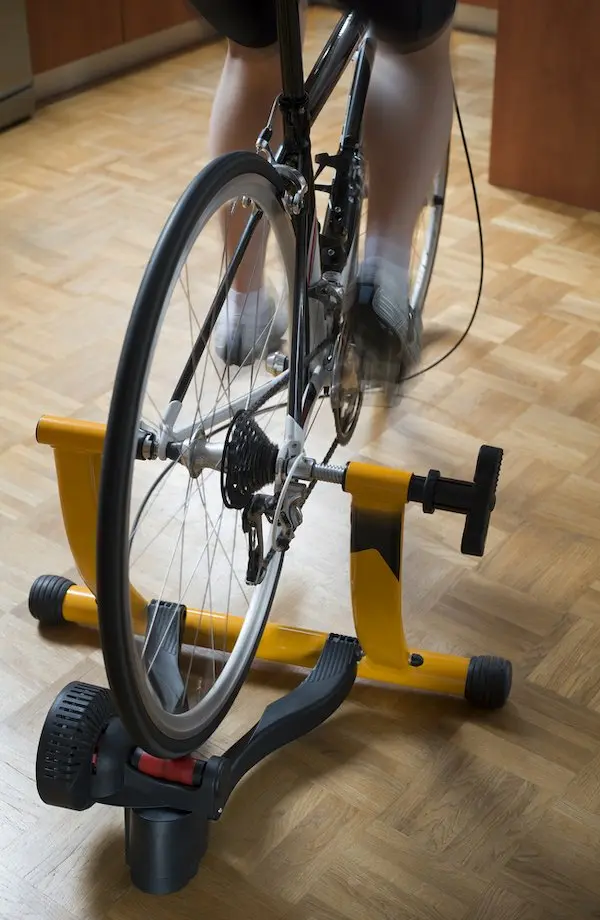
However, it is not mandatory to have a smart trainer to ride on Zwift, and it is possible to connect with a more basic model supported by the application. With this type of device, there is no resistance modification, but Zwift calculates power based on the rear wheel speed. With a power meter already on the bike and capable of communicating via Ant+ or Bluetooth, it is possible to ride on Zwift with any indoor trainer, even the simplest, although the experience is no longer the same at all.
Depending on your devices and setup, don’t always count on getting dressed in five minutes and jumping straight into an indoor training session. Technology can sometimes pose some problems, especially in terms of connection between different devices.
On an indoor trainer, you need to make sure that the device is not already connected to another application, for example after calibration on the brand’s application. If you use an Ant+ dongle for the connection between your computer and the indoor trainer, you also need to make sure that this dongle is not being used simultaneously on another program, at the risk of communication problems on Zwift. Most of the time, these problems are resolved by closing all applications likely to create connection conflicts, and by cutting the power to the indoor trainer, then restarting everything and relaunching a search.
An application like Zwift works with the internet, and it can also happen that you get cut off in the middle of a session due to the network. If you are located in the countryside and at the end of the line, the internet network may also be less efficient than in the city, which inevitably risks causing interruptions in the middle of a workout or a virtual race.
Finally, all applications require updates, which are installed automatically upon connection. And you have no way to avoid them. While this usually takes less than two minutes on Zwift, it can take up to 10 minutes on other applications. That’s how much time you lose on your session when you get on the bike.
A setup that requires space
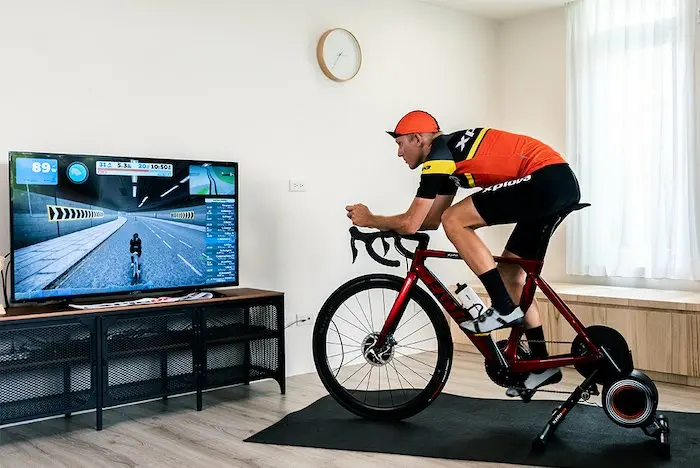
To do a connected indoor trainer session, you need your bike, the indoor trainer (placed not too far from a power outlet), your computer or tablet on a stand or furniture (also not too far from a power outlet, especially if you plan a fairly long session), and possibly a front wheel block if the device requires it, a mat to protect the floor and dampen vibrations, and a fan.
Your setup can take up some space in the apartment.
All of this takes up quite a bit of space in an apartment, and you need to factor in the setup time before each session. If you choose to ride in your garage (if you have one), you will probably need less time to set everything up between each session, but keep in mind that the connection with your internet box may be more problematic.
Some indoor trainers fold up on their feet to be stored taking up little space (but not all), but you must take into account their fairly high weight (between 10 and 20 kg generally) before each manipulation.
A constant noise
The most modern electronically controlled devices are much quieter than the first air-resistance indoor trainers, but they cannot, however, cover transmission noises, especially if you are using large gear ratios. If you add the noise of the fan and possibly that of music or television in the room, you can easily disturb other occupants of the apartment or your neighbors. It is therefore not always possible to perform an indoor trainer session at any time of day or night, which removes one of the supposed advantages of this type of device.
Bike warranty not always guaranteed
On an indoor trainer that holds the rear wheel or attaches to a direct drive, the bike frame is subjected to numerous torsional stresses during effort, especially during maximum intensities like sprints. Obviously, a frame is never totally rigid, and it is already designed to withstand deformations on the road. But some brands advise against using their bike on an indoor trainer, and may even disengage in terms of warranty. You must therefore check with your bike brand to avoid any disappointment in the event of a frame breakage.
A subject of controversy, the accuracy of different indoor trainers or power meters in terms of transmitting power in watts can greatly influence your performance on Zwift, and even the quality of your training. Some devices are imprecise (much more than the claimed accuracy), or even poorly installed or calibrated. And there are large differences in accuracy between a high-end indoor trainer and a more affordable device.
On the road, if you use a poorly calibrated power meter, you will have false data but it will not change your speed of movement. In the virtual world, the power determined by the device directly influences your speed of movement. If your indoor trainer or power meter is pessimistic, you will be disadvantaged, but if it is optimistic, you will achieve performances likely to disadvantage your competitors in virtual races, to make your friends struggle during virtual group rides, or to poorly prepare you for returning to riding In Real Life.
It is for this reason that, in terms of training quality, you must always differentiate between the power measured on the road and the power measured on your indoor trainer. If you do not want to risk overtraining or, conversely, undertraining, your MAP or FTP tests must be carried out with the power measurement system you intend to work with afterwards.
Voluntary cheating is also common on Zwift, particularly by modifying body weight data. Indeed, performance and speed of movement are determined by the famous power-to-weight ratio. By indicating a weight lower than reality, some users benefit from a more favorable ratio. Inaccurate indoor trainers and weight cheating are equivalent to digital doping. And it is also for this reason that too much importance should not be given to virtual races, or even segment rankings on Zwift, which often mean very little.
Indoor training may not be suitable for everyone. You may not tolerate being cooped up, exerting yourself in an overheated environment, not seeing any real scenery pass by, or navigating a virtual world, or even the cheating or poorly adjusted devices. Before embarking on such an investment, it might be better to test it at a friend’s house and get several opinions.
Conversely, some people really enjoy riding on an indoor trainer and immersing themselves in a virtual world. They appreciate the time savings and the effectiveness on physical fitness or body shape, with well-calibrated sessions in perfectly controlled conditions, or the fact of not being confronted with the risks inherent in traffic. If you are a fan of this type of practice and you don’t feel the need to confront the reality of the terrain from time to time, you might never want to ride outside again. You have to admit that would be a bit of a shame, wouldn’t it?