Share the post "Which GPS Computer to Choose: Garmin Edge 830 or 1030 Plus?"
Now considered essential by many cyclists, the GPS computer is still a difficult choice, especially as many brands today compete with leader Garmin. We decided to pit the Edge 830 against the Edge 1030 Plus, the most advanced models from the American brand.
By David Polveroni – Photos: DR
First of all, the first factor to consider: price. The 830 costs around €350, while the 1030 Plus is offered at around €550, both in the same package without a heart rate strap or sensors. So this may be the first hurdle for some, because forking out an extra €200 is no small matter. For the rest of the test, we will set this factor aside so we can really choose the one that suits you in terms of how you ride.
=> SEE ALSO: Buy the Garmin 830 on sale for €289
=> SEE ALSO: Buy the Garmin 1030 Plus on sale for €449
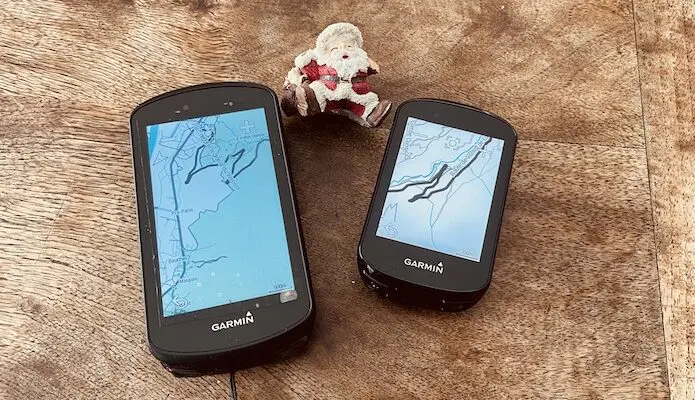
The second selection criterion: size. Some people won’t like the 1030 Plus, with its 89 mm diagonal against 64 mm for the 830. At first glance, if you’re not used to it, the 1030’s size can be a shock. But it offers better readability: the numbers are bigger (for the same data displayed, you tend to show more data on screen), the mapping is more extensive, and the resolution is even better, although already very good on the 830.
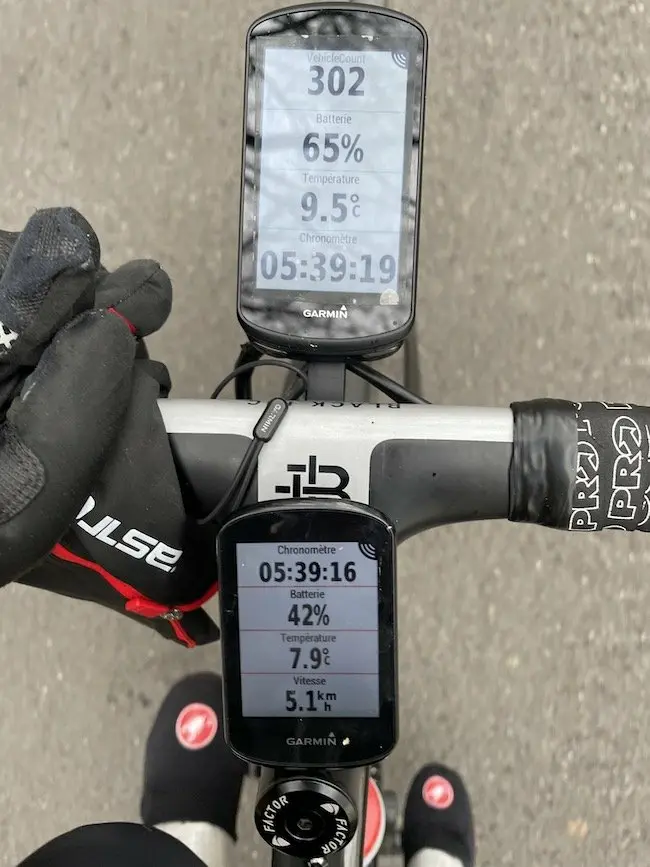
It also makes room for a slightly larger battery, with an announced 4 more hours of battery life: 20 h for the 830 and 24 h for the 1030 Plus. In practice, with a power meter, heart rate monitor and Garmin Varia radar, after 5h40 of riding in rather cold temperatures, we were at 42% battery on the 830 and 65% on the 1030 Plus. Under these conditions, that suggests roughly 16 h of battery life on the 830 and 18 h on the 1030 Plus. Note that the Garmin Varia radar uses quite a lot of battery, especially on the previous generation of computers, the 520/820/1000.
Battery life is really a strong point of the 1030 Plus. Be careful: when you ride a lot, you stop recharging it after every outing, and that can be a trap, so make sure you set out with enough charge to complete the planned ride.
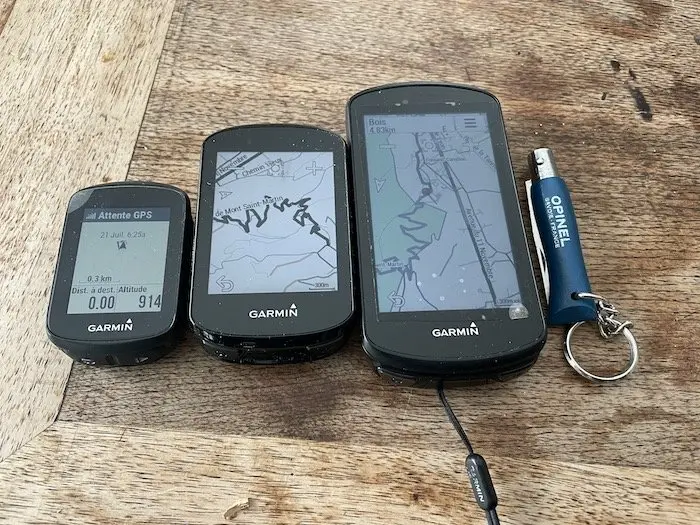
Bigger also means… heavier: there is a 45 g difference, which is a deciding factor for weight weenies. For them, the 130 Plus remains the best choice, with a 100 g difference from the 1030 Plus. When you know what you pay to save 100 g on a bike…
Similar features
When it comes to route navigation, there is no difference between the two. The 830 and the 1030 Plus both have the best that the market offers in 2021. Route loaded in Garmin Connect or a third-party app: everything is transferred to the computer. Once on the road, there are generally no nasty surprises. You can be guided at every junction, something I don’t turn on, as beeping at every turn gets a bit annoying…
But for someone who does ultras, trips, or a lot of touring on routes they rarely ride, the 1030 Plus is more comfortable thanks to its large screen, with more display area and easier scrolling.
Climb detection is very useful, especially on unfamiliar terrain, and both computers have this function, as do all the Garmin computers on offer. In terms of features, the two are really similar in use. Incident detection (very responsive), LiveTrack, compatibility with ANT+ or Bluetooth devices, or even connected indoor trainers, and workouts, whether on the trainer or on the road, all start the same way… A tie in this department.
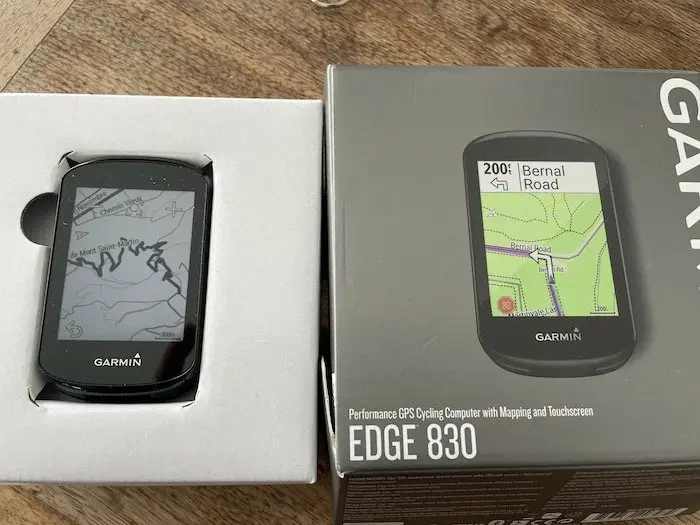
Another area where the 1030 Plus has the edge: sound. The beep during the famous countdown before the workout phase (or any other tone!) is more audible. It is clearly noticeable. The sound is crisper. It won’t make you go faster, but in our view it is more pleasant.
The touchscreens are now sorted: there are no more problems in the rain with screens navigating on their own, since you can now lock them with a simple press of the power button. However, rain remains Garmin’s weak point for the altimeter, on both computers. In these conditions, the computers no longer calculate altitude differences. Let’s hope this changes in the future range. Also worth noting is how easy it is to organize data on the pages, simpler on the 830 and 1030 Plus than on the 130 Plus and 530, the button-based models, which are not touchscreen.
To sum up
The 1030 Plus will suit those who often look at their computer, who want targeted workouts, who need maps for touring, and who need a lot of battery life.
The 830 will suit those with a less screen-focused approach, while still having access to the same functions at any time but with less speed (visually or manually, since you have to scroll through the screen).
Contact: garmin.com
=> SEE ALSO: All Our Gear Articles
Share the post "Which GPS Computer to Choose: Garmin Edge 830 or 1030 Plus?"