Share the post "First Ride Review: SRM PM9 Power Meter"
SRM, Schoberer Rad Messtechnik, named after its inventor Ulrich Schoberer in 1986, was a pioneering brand in power meters. It must be said that the brand has been somewhat outpaced in recent years by increasingly strong and sophisticated competition, but it remains the ultimate choice for enthusiasts and those seeking the ultimate watt. The latest PM9 seems to live up to the German company’s reputation, according to our initial tests.
By David Polveroni – Photos: All rights reserved
SRM’s precision is well-established, but some things were missing. There has been little evolution in the brand’s models in recent years; you don’t mess with what works. Moreover, it must be emphasized that SRM is a small company that does not have the power of large manufacturers. Each unit, head unit and crankset, passes through the hands of an employee who precisely controls what you will have under your feet… SRM is therefore a specialized brand in power meters, and its head unit, the PC8, is also a benchmark.
SRM power meters stand out from other meters on the market due to the possibility of total customization. With the Origin model, you have a multitude of possible combinations, allowing everyone to have the power meter they need according to their practice, frame standards, and also their budget… Because it must be admitted, SRM remains an expensive product compared to the competition.
There are three crank arm choices:
- Basic aluminum at 440 g for the crank arms alone and available from 165 to 180 mm
- Composite, a new feature, which we tested at 340 g and currently available in 170/172.5 and 175, but like the aluminum ones, they will be offered in more lengths.
- Look, with the possibility of having, thanks to the trilobe system, the three crank arm lengths 170/172.5 and 175 in one, for a weight of 250 g.
- THM Clavicula, which allows you to shave off another thirty grams to make a complete crankset around 600 g depending on the chainring combination adopted.
For axles, there are two possible road axles:
- A 30 mm aluminum one, the lightest, which will be compatible with BBRIGHT, BB30, Specialized type frames, or even BB86 with adapted bottom brackets (41/30).
- A 24 mm Shimano standard steel one, which adds about forty grams to the crankset.
Each crank spider can be designed, or modified by sending it back, to accommodate original Shimano chainrings to match.
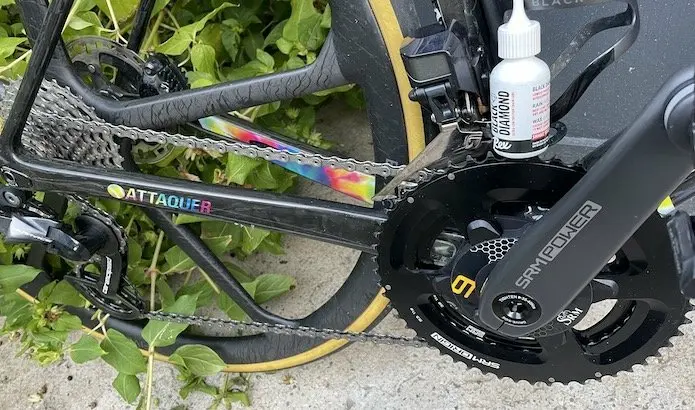
Otherwise, the standard remains the same as Shimano, namely four-arm 110 mm. Among the multitude of chainrings offered, we tested the SRM chainrings, which are made by Miche. This works perfectly; it’s just a tiny bit slower than full Shimano Dura-Ace, but that’s really splitting hairs.
The new PM9 power meter
The major new features of this version are:
- Right/left balance measurement.
- Pedaling smoothness measurement.
- Bluetooth compatibility on connected platforms. This can be useful.
But most importantly, because the first two points are, in my opinion, not very useful:
- The ability to use oval chainrings.
- No longer needing a magnet for cadence.
- A temperature sensor to compensate for variations.
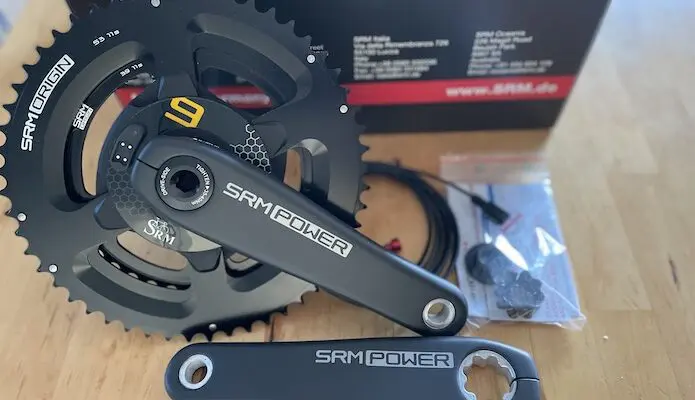
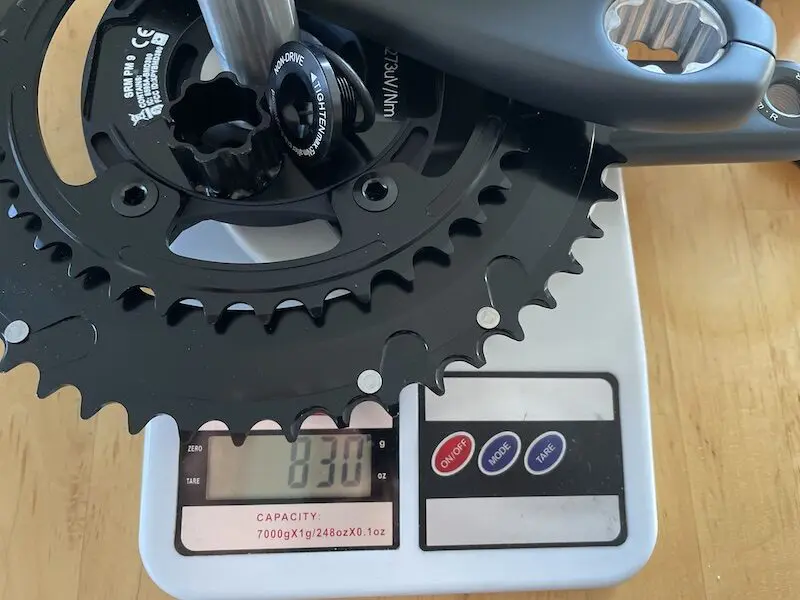
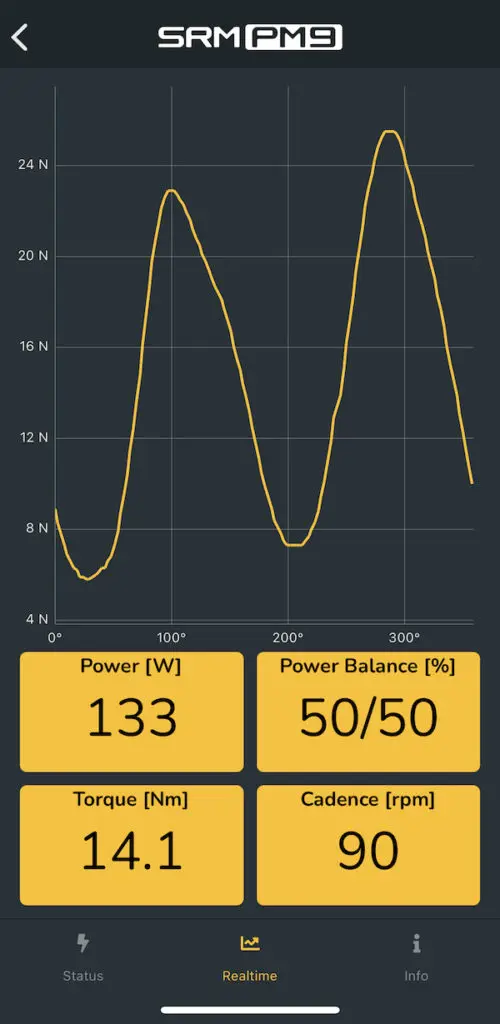
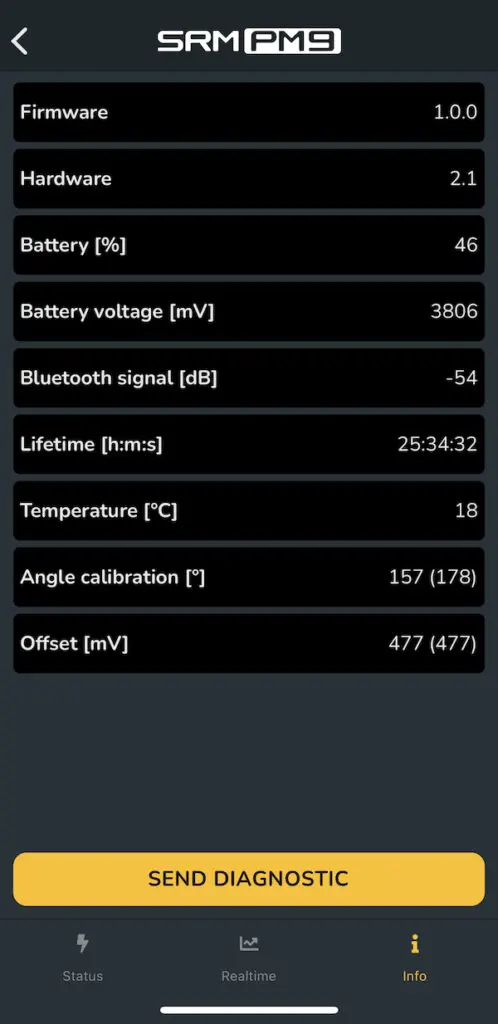
This new crank spider must be paired with the new SRM PM9 application, which allows for firmware updates, provides some live data (not very useful with a head unit), and configures certain things, such as remaining with a magnetic sensor for cadence. For the crank arms, we have the new composites. To be honest, we are disappointed with the weight, as it makes for a heavy crankset given the price: 830 g with 24 mm steel axle / SRM 53/39 chainrings / hardware / 170mm composite crank arms, for €1865
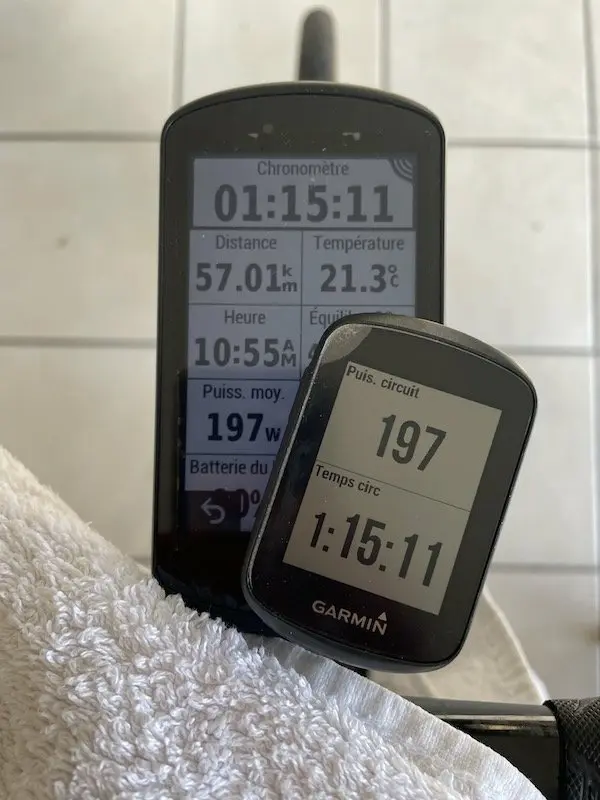
After some comparisons with the Assioma Shimano Duo
We found the same watts; the small differences that may have occurred were negligible for intense training. It’s precise… We will update the article after subjecting the crankset to waterproofing tests. I’ve had SRM units in the past that took on water, so we’ll see how this one evolves over time and if the issue is resolved.
You can configure your crankset here: https://onlineshop.srm.de
=> SEE ALSO: All our Gear articles
Share the post "First Ride Review: SRM PM9 Power Meter"