
Share the post "Competitive ranking or the frustration trap"
When we compete in sports, and even more so in cycling, our position relative to adversity and therefore our place in the race standings is THE major concern. This motivation translates into a sudden desire to feel better than the other. But isn’t there a risk of getting lost and fostering frustration? What if, to achieve fulfillment, we managed to stop worrying about the results of others? And what exactly is performance? Do we have to be performant to be happy, or do we have to be happy to be performant? Maslow’s theory offers an interesting line of thought here. I’ll give it a try!
By Jean-François Tatard – Photos: @depositphotos.com / DR
In sports, and in the business world too, performance is often expressed in the form of a ranking and therefore a comparison with others. It’s not uncommon for you to be asked what your place in the ranking is to measure your level of performance. We rarely focus on progress, and we don’t check the individual’s degree of improvement. Yet performance is multifactorial. It is never truly acquired. And it depends on so many other factors… Comparing oneself to others is not enough. And I would even say that it is, in a way, dangerous.

The psycho-sociology of sport
It’s nothing new, and I’m not telling you anything you don’t already know, the psycho-sociology of sport tells us that the essence of performance lies in the mental aspect. We can therefore deduce that the key to performance inevitably involves psychological fulfillment. And thus, this psychological approach takes a whole new turn in light of Maslow’s research on self-actualization and personal development.
How to achieve self-actualization in sport?
If there’s one fashionable question in recent years – and not just in sport – it’s how to achieve happiness. But also, how to achieve self-actualization, or how to fulfill oneself. We are inundated with theories on these subjects on social media. But ultimately, this old theory of Maslow offers us very simple, very clear, and very pragmatic answers that we, as cyclists, or more generally athletes, can very easily rely on.

Who is Maslow?
Abraham Maslow (1908 – 1970) is a famous American psychologist considered the father of the humanistic approach. He is best known for his explanation of motivation through the hierarchy of needs, which is often represented by a pyramid. Maslow was born in 1908 in Brooklyn (New York) and was the son of Russian immigrants of Jewish origin. He remains a reference for many psychologists worldwide. His pyramid theory is systematically included in all business school curricula.
Abraham Maslow thus developed a theory according to which an essential aspect of being human is to develop one’s personal potential. Each individual aspires to satisfy various types of needs, from the most primary (hunger, thirst, etc.) to the most existential (self-actualization). And the major postulate of this concept is that higher needs can only appear if lower needs are already satisfied. As I told you, it is one of the most taught motivation models, especially in management. This model has the advantage of being immediately understandable and striking.
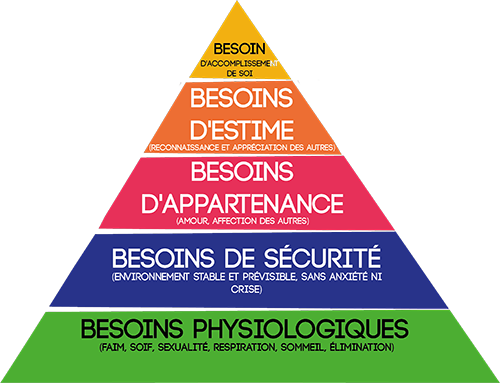
How does the pyramid work?
The hierarchy of needs in the pyramid means that man only reaches the full development of his psyche if he is satisfied on all levels: physiological, safety, belonging, esteem, and self-actualization. This hierarchy is generally represented in the form of a pyramid which, from base to summit, distinguishes five levels of needs:
- Physiological needs: eating, drinking, breathing, sleeping, dressing, sexual activity
- Safety and protection needs: good health, housing, job stability, social circle, money.
- Belonging needs: need for love, affection, social life, friends, belonging to a group, a club, a community, sharing, communicating.
- Esteem needs: self-esteem, esteem from others, respect from others, being recognized, expressing one’s skills, having independence.
- Self-actualization needs: flourishing, meditating, deepening one’s culture, being consulted and listened to, autonomy, living one’s passion, personal development.
Need or desire?
Have you ever asked yourself about the difference between need and desire? Need is expressed by the brain. But it is unconscious. It is actually an emotion that signals its presence. And this same emotion will give you satisfaction or the opposite: non-satisfaction. Whereas desire can be expressed and defined. It is in this sense that it is conscious. But its origin is also unconscious. Desires also differ from needs in that they can be satisfied in an imaginary world. The fulfillment of desires does not necessarily lead to fulfillment. This is why it is fundamental to differentiate between one’s own desires and one’s own needs. For example, it is up to adults to ensure the satisfaction of a child’s needs and not desires, which sometimes mask and distort them. In short, this pyramid can very possibly be for all of us a user manual for self-actualization, from a methodological point of view. It can provide us with a quality theoretical foundation and help us better understand the different aspects that govern what will ultimately make us happiest. It personally made me realize that the state called “happiness” is the result of a concordance of different social, personal, and psychological elements, and that we can always act on these elements to access it.

To conclude
The idea behind this article is the realization that happiness is not a coincidence but a consequence. The consequence of our choices and decisions that gradually lead us to climb, one after another, the steps of this famous Maslow’s pyramid. This very subjective and very individual progression that leads you every day to do a little better than you did the day before, to compare yourself only to what you were yesterday, to lead you, in a perpetual process of progression, to ever greater fulfillment. To stop comparing yourself to others. To forget a little more often the rankings that place you at a certain rank and impose comparison on you.

Happiness is the result of a progressive and much more thoughtful journey. It is much less primal and much more subtle. Because wanting to reach this state of grace by relying solely on results and your place in a ranking, without worrying about your own needs and without considering your “own being” in its entirety, is – I announce to you – doomed to failure! Being performant is above all being well in your head. And then, don’t forget, you who often read our articles on 3bikes.fr, I imagine you run, swim and cycle. And yet, doing sport as you already do, is an undeniable plus in your quest for happiness. It is also a question of philosophy: “happiness is not having everything you desire but appreciating what you have“.
=> SEE ALSO: All our Coaching articles

Share the post "Competitive ranking or the frustration trap"