Share the post "Garmin Rally Power Meter Pedals Review"
With its new Rally pedals, Garmin is back in the power meter race with a practical, reliable, and highly accurate product. We tested these Garmin Rally RK200 pedals over several weeks and were able to compare them with other recognized power meters.
By Guillaume Judas – Photos: DR
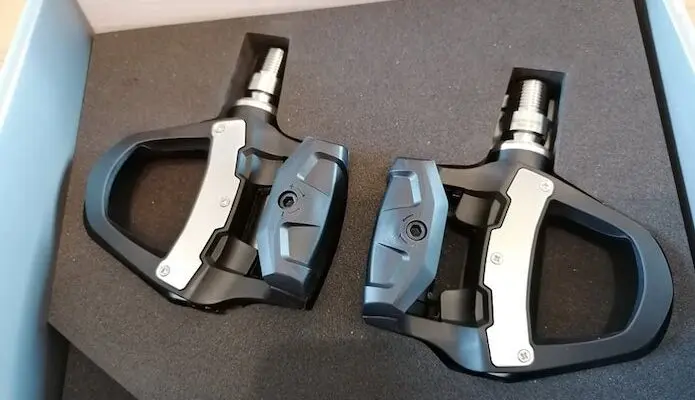
Following the Garmin Vector pedals, which did not benefit from the reputation of some competing products despite three successive evolutions, the Rally pedals are available in several versions from €649 to €1199 (€1099 for our test pair of pedals). Rally pedals are available for users of Shimano SPD-SL pedals under the RS designation, or for those who usually ride with the Look Keo system, as here with the RK. They also exist for the SPD cleat system for off-road, under the XC designation. The 100 or 200 versions indicate the difference between single-sided or dual-sided power measurement. With what Garmin calls a conversion kit, it is possible to use the same spindles and their electronic parts on different platforms, and thus switch from a Rally RS or RK road pedal to a Rally XC mountain bike pedal. These conversion kits are sold from €199 to €249. Finally, note that it is always possible to upgrade from a 100 version to a 200 version later, with a kit at €549. Garmin Rally pedals are very well finished and give the impression of a very accomplished product.

In terms of weight, we weighed our pair of Rally RK200 pedals at 332 g per pair, which is 68 g more than Keo 2 Max Carbon pedals. This is very good performance. For a power meter in the bottom bracket, you need to account for an additional 40 to 150 g compared to the classic version to benefit from a power meter. The Garmin Rally pedals are therefore not only light, but also very practical.
Easy installation of Garmin Rally
Compared to Vector pedals, Rally pedals no longer have a pod to be placed perpendicularly to the crank arm; the entire power measurement system is integrated into the spindle. The usual imprint for tightening pedals is here replaced by the Bluetooth/ANT+ transmitter, which requires a 15 mm open-end wrench for mounting on the bike. The operation is very quick and does not require the use of a torque wrench. You can therefore very easily move the pedals from one bike to another in less than five minutes.
Depending on the crank arms used, it is possible that the transmitter may protrude very slightly inwards, which could touch the bike chain in the large chainring/small cog position. Garmin therefore provides an additional washer to be placed between the pedal spindle and the crank arm, which has the effect of increasing the Q-Factor from 53 to 55 mm. Nevertheless, we are here exactly on the same values as the Look Keo 2 Max Carbon pedals, with also the same height relative to the spindle and the same support surface. The Garmin Rally RK200 will therefore require no adjustment adaptation for a user accustomed to the Look system. Note that the adjustment system for the spring tension of cleat engagement or disengagement is also very efficient. In terms of simple use, the Rally pedals are as effective as any high-end pedals.

On the outer part of the pedal spindle, there is a cap that opens with a 4 mm Allen key, and which hides the battery compartment. Garmin announces a battery life of approximately 120 hours, which seems largely plausible given the duration of our test. The only drawback: the CR1/3N battery reference is not found everywhere, especially in tobacconists or supermarkets. So, plan ahead. The thread of the caps also seems a bit short, and to avoid losing them on the road, we advise you to regularly check their tightness.

Garmin Rally Connectivity
Once on the bike, the gyroscopic sensor in the pedal spindles tensions them, making them available to be connected via ANT+ to any compatible bike computer (Garmin preferably) or via Bluetooth to be linked to a computer on Zwift, for example. In a few seconds, they are detected by the Garmin bike computer, which immediately offers an additional screen to display in your usual menu. This is ideal if you are new to the concept of power in cycling, as it offers the display of various data such as instantaneous power, cadence, left/right balance, or time spent out of the saddle or seated. More experienced cyclists can, of course, configure their screens differently, so as to only display what is essential for their training. Or, conversely, delve into the bike computer menus to analyze data concerning pedaling dynamics, and then see them displayed on Garmin Connect.
Like many power meters, Garmin Rally pedals require calibration before each ride, to avoid erratic measurements, mainly due to temperature variations between inside and outside your home. The procedure requires tensioning the pedals by rotating them, placing the left pedal in the low position (at 6 o’clock), and initiating the procedure via the bike computer’s settings screen. An operation that generally takes between 10 and 15 seconds.
The Garmin Rally RK200 put to the test
On the road, the Garmin Rally pedals display consistent, reliable data that does not seem to drift over time, except in case of forgetting the daily calibration, as seen above. The initial values observed are plausible with the current fitness level and our capabilities, whether on flat terrain or in the mountains, during several repeated climbs.
For all efforts performed at a steady pace, we do not observe display variations different from those seen with other power meters. However, we can notice a slight display lag of about 2 seconds at each restart, after a traffic light or a stop sign, for example. This obviously does not change the quality of the ride, but in terms of statistics, we can thus note a very slight difference in average power compared to another power meter. This is particularly noticeable on a route with a start and return in the city, amidst traffic. The average power observed with the Garmin Rally is slightly lower than that recorded with the SRM, on the same ride (by 2 or 3 watts).

When comparing the Rally with a Power2Max, the difference in each effort is always around 3 watts, whether more or less. Nothing abnormal concerning an instantaneous measurement, as each power meter is given with a relative measurement accuracy (1% for Garmin, 2% for Power2Max). At high intensities or during sprints, the trend is always the same, and it is only at power peaks that the differences become much more noticeable. But in this specific case, it is difficult to know which of the two systems is more reliable.
Then, comparing the Rally with an SRM crankset freshly returned from factory revision – and considered a benchmark – the accuracy of the pedals seems even more impressive. On series of efforts lasting 3 to 10 minutes, at stabilized powers of 250 to 400 watts, we never saw more than one watt difference between the two systems! Up to about 800 watts, the two sensors seem very close. But then, on a maximum power sprint, we can observe a difference of up to 200 watts more with the Garmin. This remains anecdotal from our point of view, especially if one is looking for this type of device for serious training monitoring.
Where the Garmin Rally clearly distinguishes itself from the SRM, however, is in its ability to indicate the power difference between the two legs. And this is not a simple calculation per half-crank revolution as on most cranksets that offer this option, but a true measurement of the deformation of each pedal spindle. This is very interesting for detecting potential position problems and trying to remedy them. However, based on our experience, the values indicated are the same as those already noted with other systems.
Reliable and efficient
Let’s admit it: we had a bad impression of Garmin power meters, after a first bad experience with Vector pedals a few years ago, and with the bad reputation that followed the product. But the Rally pedals show us that the system is truly perfected today, and that in terms of accuracy, they are on par with the most renowned products in the field.

These pedals also stand out for their very practical aspect, like Assioma pedals, which is a real advantage compared to a power meter installed in the bottom bracket. However, the price must be weighed against the fact that pedals are particularly exposed in the event of a fall. A price that is also quite significantly higher than that of Assioma pedals, even if many parts are also interchangeable (and notably the pedal bodies) and with the Rally, there is no difference in height or spacing compared to classic pedals.
=> SEE ALSO : Buy Garmin Rally RK200 (Look) on sale at €999
=> SEE ALSO : Buy Garmin Rally RS200 (Shimano) on sale at €999
=> SEE ALSO : Buy Garmin Rally XC200 (Shimano SPD) at €1099
The GARMIN RALLY RK 200 pedals in brief… RATING: ***** PROS: Accuracy, transfer from one bike to another, additional weight of only 68 g compared to Look pedals, possibility of changing pedal bodies CONS: Price Battery type: LR44/SR44 (x4) or CR1/3N (x2) – Battery life: up to 120 hours – Maximum cyclist weight: 105 kg – Accuracy: +/- 1 % – Sensor calibration – Adjustable tension – Measurement: on the spindle – Connectivity: ANT+ and Bluetooth – PWeight: 332 g – Water resistance: IXP7 – Cleat type: KEO – Q Factor: 53 mm (55 mm with the supplied 2 mm washer) – Distance between pedal spindle center and shoe sole surface: 12.2 mm – Price: €1099.99 CONTACT: garmin.com |
Share the post "Garmin Rally Power Meter Pedals Review"