Share the post "In the Wheel of… Kevin Le Cunff, Paralympic Road Cycling Champion"
An appointment in unknown territory to experience a training session with the recent Paralympic road cycling champion from the Paris region, Kevin Le Cunff, 33. This was an opportunity for us to fully grasp his motor weakness as a real disadvantage, to accept the difficulty his discipline demands, to understand the rigor he dedicates to it, and to discover a talented young man with an extraordinary destiny…
By Jean-François Tatard – Photos: @3bikes.fr / flickr.com / Instagram @kevinkunf
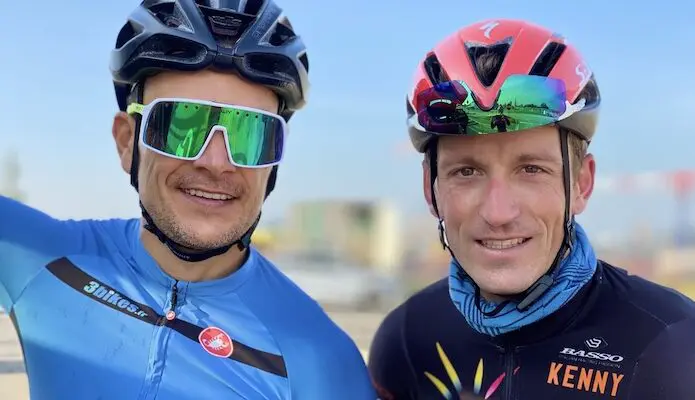
For this episode, 3bikes.fr has the privilege of riding a few km on the training roads of one of Tokyo’s Paralympic champions. We thus discover the remarkable journey of Kevin Le Cunff, who looks back on his best memories as a professional cyclist, then talks about his new world, and finally reveals his future projects.
A solo victory in the style of the greatest: this is how Kevin won on September 3rd on the demanding Paralympic Games course. An arrival identical to that of Richard Carapaz ahead of Wout Van Aert and Tadej Pogacar a few weeks earlier. The Parisian offered himself, in the most beautiful of island nations, the most sumptuous victory of his career.
https://www.instagram.com/p/CTjsjaTMTby/
Pain-free ankles at the cost of irreversible immobility
But before getting on the bikes and starting our interview, let’s go back to the question everyone is asking. What allows Kevin Le Cunff to race with disabled athletes? Kevin was born with two clubfeet and underwent two ankle arthrodeses. Ankle arthrodesis consists of surgically fusing the joint, which itself involves removing cartilage from the ankle and thus fusing two bones (the tibia and the talus). This fusion allows Kevin to no longer feel pain, but this arthrodesis severely limits all ankle movement. However, arthrodesis is permanent. And so, clearly, in addition to a very visibly atrophied calf, our champion’s disability distinctly prevents him from being able to pedal “normally”. It’s difficult to assess the deficit, but in his pedaling, one can sense a significant resistance that prevents this talented young man from developing his full power. And yet, this did not prevent him, earlier, from racing three seasons as a pro (from 2017 to 2019).
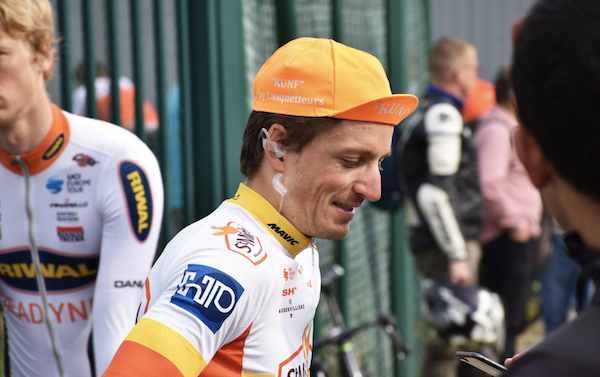
Professional with the Saint-Michel-Auber 93 team
Before turning to para-sports in 2020, Kevin had already distinguished himself among able-bodied athletes. In 2018, while riding for Saint-Michel-Auber 93, a Continental team (the equivalent of the third division), he managed to win the Boucles de l’Aulne in the French Cup, ahead of former French champion Arthur Vichot and Guillaume Martin. But at the end of the 2019 season, the rider who had until then hidden his disability found himself without a contract for the following season. It was at this point that the future Paralympic champion decided to return to amateur racing. This time with the Dunkerque Grand Littoral Cofidis team. And it was also during this same season that the para-sports world opened its arms to him…
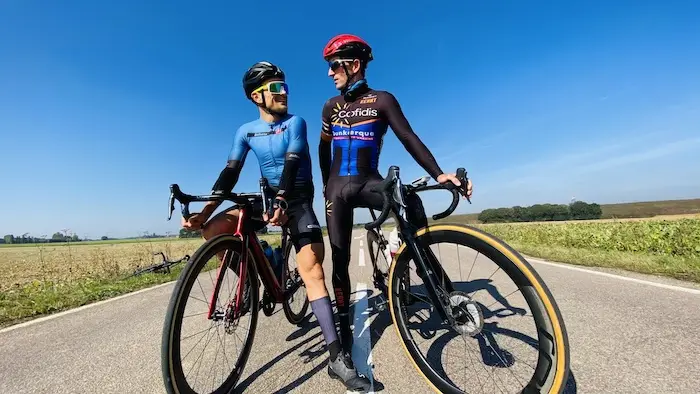
A newcomer to para-sports
With para-sports, Kevin Le Cunff finally realized a project he had been developing for several years. And the results were quick to follow. This trained engineer won a bronze medal at the Para-cycling Road World Championships last June before taking gold on the first Friday of September 2021, at the Tokyo Paralympic Games… Let’s go back with him to the genesis of this adventure, and to the prospects that lie ahead for him in the future.
3bikes.fr: So explain to us, Kevin… How did the opportunity for para-sports come about for you?
KLC: It only came very recently. Even though I was born with my disability, when I started cycling, I never thought about para-sports. I always remained discreet. I never spoke publicly about my disability. Even though everyone has always seen it. And ultimately few people ask me questions like you are…
3bikes.fr: I’ve been pedaling behind you for almost two hours, that’s not possible… You can’t deny your disability, can you?
KLC: I tried never to consider my disability as something truly bothersome. But obviously, I am at a disadvantage. My ankles are completely restricted. I don’t have much mobility and therefore my pedaling motion is not complete. Among “able-bodied” athletes, I am really penalized in time trial events. But a little less when it comes to riding out of the saddle when the ankle needs to be more locked.
3bikes.fr: What did you aspire to when you discovered cycling in the youth categories?
KLC: I’ve always been full of ambition. What mattered to me was to go as far as possible without worrying about my motor and physical difficulties. My quest was to succeed in exploiting my maximum athletic potential, regardless of my disability.
3bikes.fr: You won a pro race in 2018 and even finished 17th in your last pro race at Paris-Tours 2019. How do you end up in the para-sports category the following year?
KLC: I saw the end of a cycle coming. My contract was ending, and at the end of 2019, I still had no professional team offers that matched my results. Three years earlier, I had taken a leave of absence from my company. My position was waiting for me. Choices had to be made. So, when I saw my professional career was going to end, I looked into it a bit more… And it was one of my former teammates who enlightened me and opened the door to the Paralympics.
https://www.instagram.com/p/CPimDK9H_rC/
3bikes.fr: Am I wrong, or are you confirming that one cannot make a living from para-sports? In the sense that you have to work alongside it. Where are you at with that?
KLC: I’m already used to balancing the two. Before turning pro, as an amateur, I already combined my passion with a job as a technician in a Snecma factory. After a three-year break, I resumed cycling in 2014 in the 3rd category. I was 25, but already had a partner, a job, an apartment, a settled life, and I had enjoyed myself. In 2016, when I was recruited by the Auber 93 reserve team, I was able to benefit from a full afternoon per week to train by arranging with my employer. I won seven races, and I had the opportunity to turn pro.
3bikes.fr: What is your strength? In which register is it most evident for you to express yourself?
KLC: I’m more comfortable in road races. I also like sprint finishes. And especially uphill. It’s a register in which Guillaume (Editor’s note: his coach) made me understand and managed to convince me that I needed to invest. We made it a specialty together.
3bikes.fr: You won a great victory as a pro at the Boucles de l’Aulne in 2018, and you also finished second in the last stage of the Tour de la Mayenne in 2019, overtaken on the line by one of the best sprinters in the peloton…
KLC: The sprinter in question is Bryan Coquard. I thought I was winning. I sat up too early. He came back like a bullet.
3bikes.fr: What is the connection between Dunkerque’s DN1 and para-sports?
KLC: The connection is Laurent Thirionet. He is the head coach of para-cycling within the French Handisport Federation (FFH). He was the one who took charge of welcoming me into this new world.
3bikes.fr: And who exactly is he?
KLC: Laurent had a leg amputated at 23. He then became a double Paralympic champion, with the last of his seven medals in London in 2012, and now he manages the DN1 in Dunkerque, which I joined at the beginning of last season.
3bikes.fr: What would he say about you if he had come to ride with us this morning?
KLC: I hope he likes me! But I think he sees me as a good rider. I know that at first, he immediately understood my distress and disillusionment after my premature end to my pro career. I aspired to more, and I wasn’t much over thirty. I still had time to prove myself. But he also very quickly understood that my disability was ultimately an opportunity. He opened up a world of possibilities for me…
3bikes.fr: So you started your new life at the same time the world was hit by the Covid-19 pandemic? What impact did that have on what followed?
KLC: This unforeseen event had advantages and disadvantages. The postponement of the Olympics gave me a little more time to work on my weaknesses with Guillaume, who has been following me for several years. He helped me identify my areas for improvement, and at the same time, he managed to consolidate my strengths. We took our time to intellectualize all aspects of a discipline that is ultimately different from what we knew. But the disadvantage is that this postponement did not allow me to capitalize on the form of my end of pro career. The federation also supported me well. This delay was taken philosophically. As a new para-athlete, I had to go through the classification stage, a thorough medical examination that assigns me a category based on my disability.
3bikes.fr: Do you think this delay gave you an extra year to approach things more calmly? Physically and therefore psychologically?
KLC: Not immediately. At first, the more competitions were canceled, the more I despaired of being able to get classified. Because to be eligible for the Paralympic Games, I had to compete either in the World Cup round scheduled for Italy at the end of April 2020, or in the World Championships that were to take place in May of the same year in Belgium.
3bikes.fr: So the transition from professionalism to para-sports happened less quickly than you thought… And am I wrong, or is your new world an environment where one is sometimes not yet considered a true high-level athlete and where races receive less media coverage? If so, how do you assimilate that?
KLC: I had to accept it, but I’m arriving at a time when para-cycling is becoming professionalized. Thanks to Paris 2024, we have more resources.
3bikes.fr: And speaking of Paris 2024, what are your plans?
KLC: I feel like my title in Tokyo will help me. With the other Paralympic medalists, we had the immense opportunity to meet the President of the Republic last week at the Elysée. Several of us will receive financial support as real medal hopes for Paris.
https://www.instagram.com/p/CT0JAluMJBr/
The positive meaning of a situation
What a wonderful encounter! If Kevin managed to be eligible for para-sports, it’s also because he meets a minimum level of disability according to the strict criteria of the Paralympic committee. And even if he cultivates discretion along with the art of perseverance that shapes the destiny of the greatest champions, it is indeed the same kind of physical inferiority that the best disabled riders in the world, Asian, Brazilian or American, also have. And these few pedal strokes shared together in the Chevreuse valley made us discover that it was a truly enormous performance to have been a pro with this notorious hindrance. Without it, he probably would have been at a very, very high level. Perhaps the same as where we find Benoit Cosnefroy or Julian Alaphilippe today.
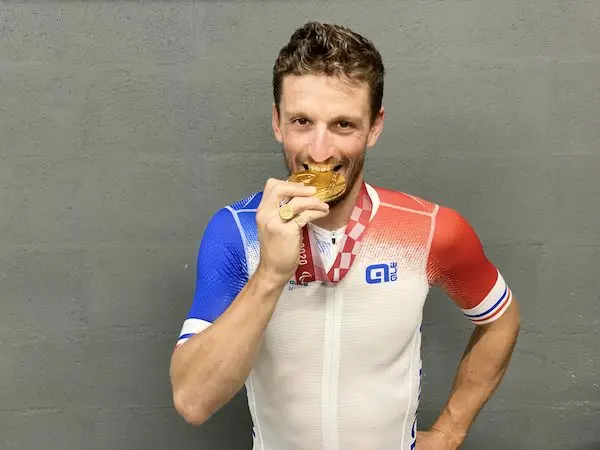
This talented thirty-something still has many good years ahead of him. Cycling and sport in general can draw inspiration from the philosophy of our new Paralympic champion. And beyond performance, pugnacity, perseverance, and extraordinary willpower, what this encounter taught me today is that most of the time, and for most of us, we see difficulty in every change. In every transformation. In every modification. In most new things. Whereas what makes the difference with great champions is that they very quickly manage to identify the positive meaning of a situation. And to make it obvious that there is a new opportunity in every difficulty. And yet it is precisely in the midst of this difficulty, as terrible as it may be, that the opportunity lies to realize one’s full potential and to fully achieve self-fulfillment in one’s existence. This is what I learned from these 100 kilometers shared with Kevin Le Cunff…
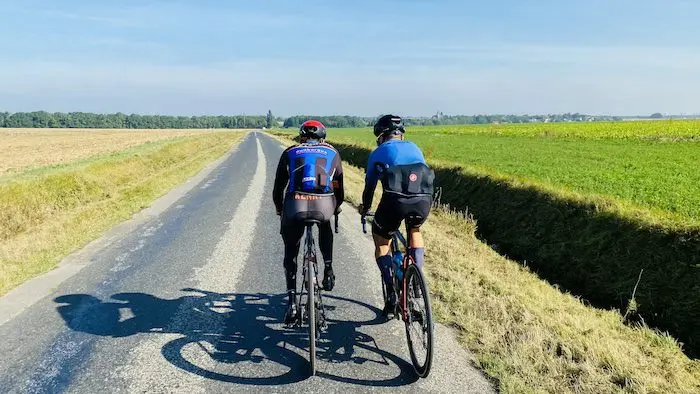
All great accomplishments in this world were once considered impossible. First, let’s forget the possibility of success and focus solely on what would allow us to achieve self-fulfillment. Thank you, Kevin, for enlightening us and making us understand that this was the best path to, paradoxically, achieve success. And now, good luck and the best career continuation to you, champion…
=> SEE ALSO: All our MAG articles
Share the post "In the Wheel of… Kevin Le Cunff, Paralympic Road Cycling Champion"