Share the post "First ride review of the new Shimano Dura-Ace Di2 12-speed groupset"
We have already had the opportunity to carry out a first test ride of the new 12-speed Dura-Ace Di2 on three mountainous rides, with a bike equipped with the new Dura-Ace C50 wheels. On the program: 12 speeds, a new range of gear ratios, optimized braking, lighter wheels, and even more customization possibilities.
=> SEE ALSO: All about the new Shimano 12-speed groupsets
By Guillaume Judas – Photos: Irmo Keizer / Andreas Dobslaff – Shimano.
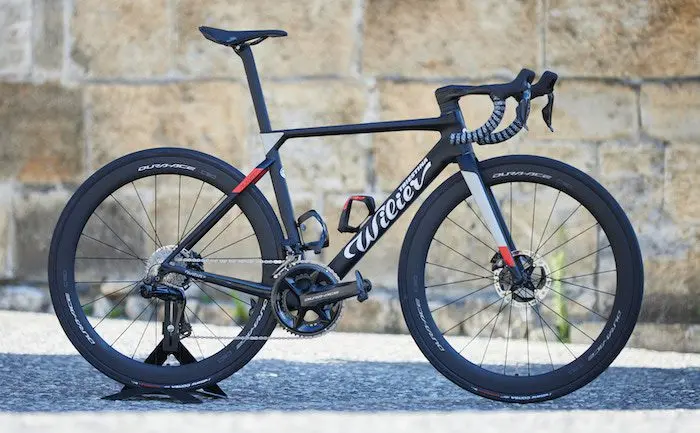
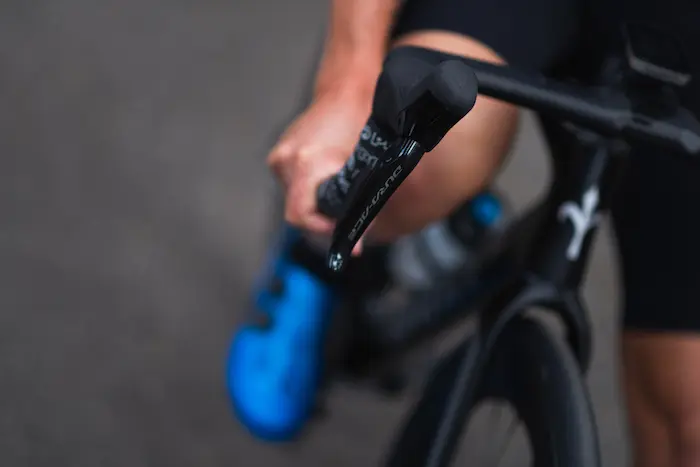
The first contact with the new Shimano Dura-Ace Di2 12-speed R9200 groupset is primarily visual: from just a few meters away, upon discovering the bikes prepared by the brand for these three days of testing, it is very difficult to distinguish what has changed aesthetically compared to the R9100 version. The color of the two groupsets is almost identical. The new crankset (tested here without a power meter) has a slightly more angular shape, and the chainrings are slightly darker, maintaining exactly the same shade as the crank arms, whereas on the 9100, they are slightly lighter. The new hoods are a little longer, and it is by getting closer that one can distinguish their slightly inward-curved shape on their upper part. At the derailleur level, it is primarily the slimness of the front derailleur that stands out when one is already used to riding with Di2.
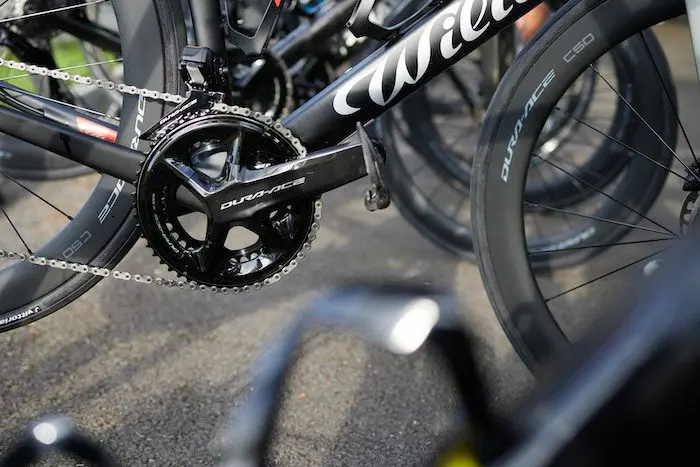
The wheels now feature a matte finish, rather than glossy. The Dura-Ace branding is very discreet. They are significantly wider than the previous versions, and as they are fitted with 28 mm Vittoria tubeless tires, it is noticeable that these are perfectly aligned with the rim sidewalls.
=> SEE ALSO: All about the new Shimano Dura-Ace and Ultegra wheels
Evolved ergonomics
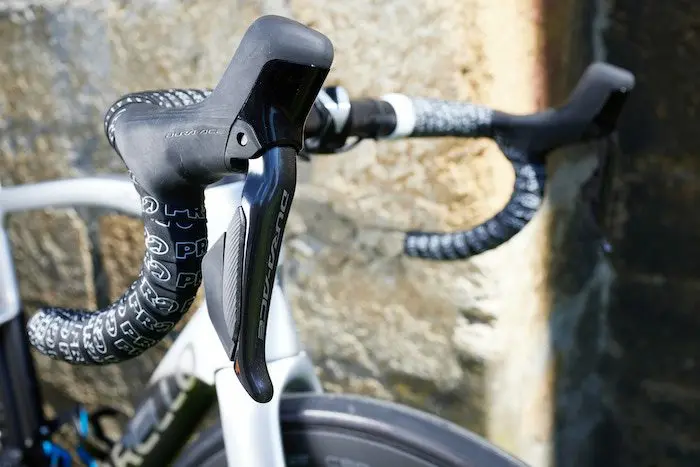
The main interaction one has with a drivetrain groupset is through the hoods, whether with hands on the hoods or with hands in the drops. The finish here appears to be of an excellent standard, with a grippy yet soft-touch rubber. At the lever pivot, there is no sharp part likely to injure the index or middle finger when gripping the hoods, as is the case on Shimano mechanical levers or some Sram hoods.
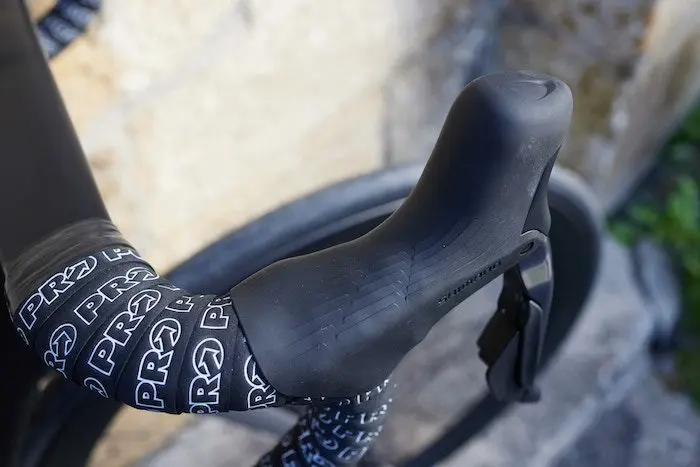
The longer body of the shifter compared to the 11-speed version is an asset for large hands. For others, it may be useful to slightly modify the angle of adjustment of the hoods on the handlebars, so as not to feel more stretched out on the bike, with hands resting on the hoods.
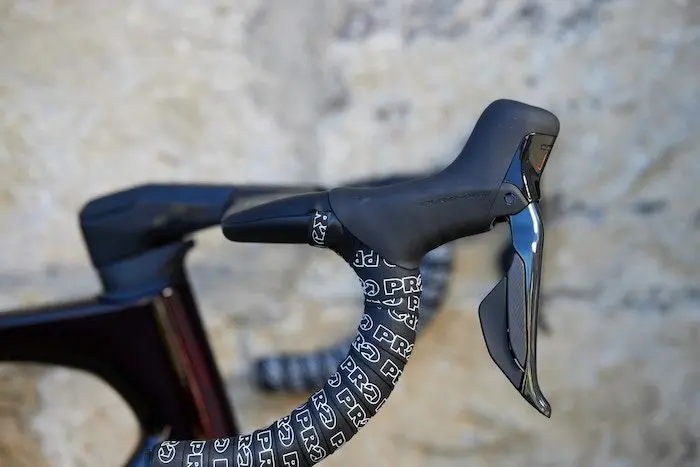
The slightly inward-curved part of the top of the hood does not change the feel when riding out of the saddle or simply with hands on the hoods, but proves interesting if one chooses to adopt an aerodynamic position with elbows resting on the handlebars. It is thus possible to keep hands on the top of the hoods, while slightly tucking in the elbows for more efficiency against the wind. Regarding the shift buttons, the slight additional offset given to the smaller one (the one generally used to shift down the cassette cogs) is noticeable and prevents mis-shifts, both with hands on the levers and with hands in the drops.
The reach of the brake levers can of course be adjusted to make them more accessible, for greater comfort and control, and to adapt them to finger size. But the big novelty here with the new 12-speed groupset for hydraulic disc brakes is the ability to adjust the lever stroke, until the brake pads make contact with the rotor. Some like a long stroke to more finely adjust braking modulation, others appreciate a quicker response to the slightest lever action. Braking therefore becomes customizable with the new Dura-Ace and Ultegra 12-speed levers.
Smoother shifting
From the very first few hundred meters, the derailleurs are manipulated in all directions, as if to check if the performance lives up to the technical specifications. All the bikes made available to the journalists present for this first hands-on were equipped with 52-36 chainrings and an 11-30 cassette. While the Di2 system still prevents shifting down to the last two cogs with the small chainring (for chain length management and to avoid derailments), it accepts extreme cross-chaining with the large chainring and the large cog without complaint. The 52/30 ratio makes no noise, as the front derailleur automatically adjusts its position according to the chain’s position on the cassette. Forcing a shift from the small to the large chainring poses no problem, even from a low pedaling cadence, and despite the 16-tooth difference between the two chainrings here.

Shimano announces faster rear shifting, despite the absence of electric wires between the hoods and the derailleurs. Honestly, this is hardly perceptible at first glance, compared to the previous version. It’s true that we’re talking about a tenth of a second difference here! On the other hand, while it seems risky to talk about a real evolution in this regard, it is easier to notice that shifting between cogs is even smoother than on already known Shimano groupsets. Gear changes are smooth and, above all, quieter, probably due to the shape of the cogs.

Regarding the wireless communication system between the shifters and derailleurs, we observed no interference within a small peloton of about twenty cyclists. Adopting synchronized or semi-synchronized shifting modes also demonstrates that one can have complete confidence in the smoothness and precision of the system. In semi-synchronized mode, the derailleur automatically shifts two cogs after a chainring change. It’s fluid and almost silent. In synchronized mode, where one changes gears with a single shifter like with a sequential gearbox, the automatic shift from one chainring to another is really smooth, and the cog change at the rear seems a little more fluid than on the 11-speed groupset (which was already very high-performing).
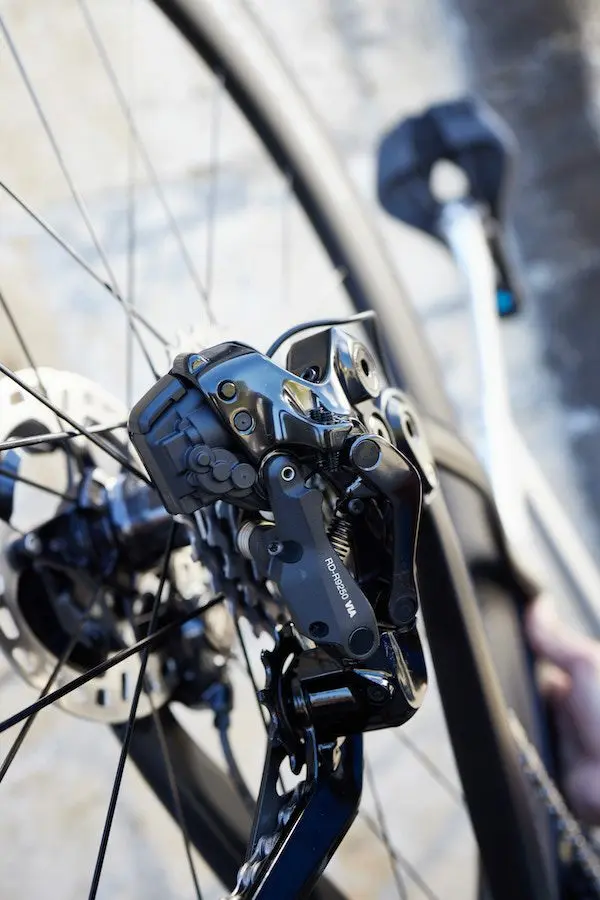
The only downside: the adjustment button is now located on the rear derailleur, and no longer on the cockpit, the frame’s down tube, or the seatpost. These were accessible locations while pedaling, for changing shifting modes, or for making micro-adjustments to indexing while riding. With this new 12-speed groupset, you now have to stop and get off the bike to activate this button.
12 speeds, what for?
In the history of bicycle drivetrains, each additional cog on the cassette has undeniably brought comfort and versatility. This is still the case here, even if Shimano has chosen, unlike Sram, to keep cassettes with an 11-tooth start for road bikes, rather than a 10-tooth. This is a plus in terms of chain efficiency. For the new Dura-Ace groupset, the brand retains the two 11-28 and 11-30 cassettes, but by revising the cog spacing, thanks to the addition of a twelfth speed. If we compare the new 11-30 with the previous one, Shimano adds a 16-tooth cog between the 15 and 17, a cog that was often missing for most riders on flat or moderately hilly courses, while maintaining the versatility of a gear range extending from 11 to 30 teeth.

Moreover, thanks to the analysis capabilities of the E-tube software, Shimano was able to decipher the use of the different gear ratios during these three days of testing, and for all the journalists present. Thus, it appears that the 16-tooth cog is by far the most used (more than a quarter of the time), but that the other cogs are not neglected either, especially on a mountainous course.
Shimano has chosen to keep cassettes with an 11-tooth start for road bikes. This is a plus in terms of chain efficiency.
If we look at the new 11-28 cassette, a widely used gear range, we notice that Shimano has revised its spacing thanks to the addition of the twelfth cog. Compared to the 11-28 in 11 speeds, here a 16 and an 18 have been added, which allows for nine cogs that follow tooth by tooth, from 11 to 19. The subsequent 21, 24, and 28 allow riding with the large chainring on fairly short climbs, and are in any case less used in gently rolling regions. This cassette is not, however, offered in Ultegra.
Finally, Shimano adds an 11-34 to its range, which takes the spacing of the 11-30 in 11 speeds, but with the 34 in addition, a cog accepted by the new Di2 derailleurs with a slightly longer derailleur cage. This cassette can be appreciated by professionals (less bothered in races by the absence of the 16-tooth cog, as they ride faster on the flat than amateur riders) who have to face extreme gradients on certain stages of the Grand Tours, as well as by cyclosport riders who are looking for a very flexible gear ratio in the mountains. Indeed, with a 50-34 double chainring, they can thus benefit from a minimum ratio of 1, which means that one crank revolution corresponds to one wheel revolution. This choice of tooth counts is of course also offered in the Ultegra version.

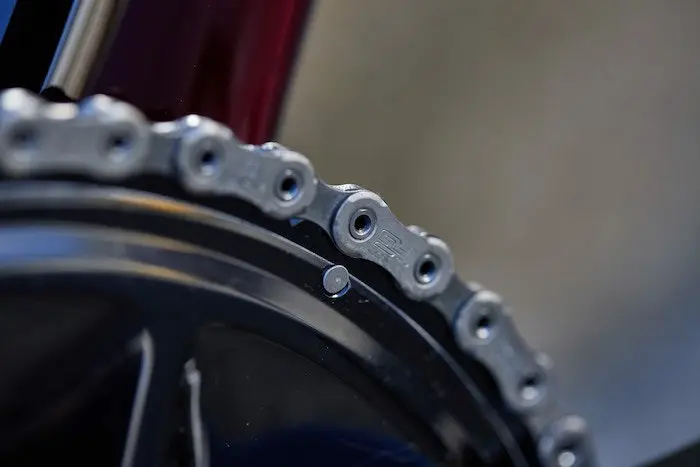
On the chainring side, we were unable to test the new 54-40 offering, which now replaces the 53-39 combination. Shimano made this choice by observing the constant increase in average speed in professional races and among amateurs, and because many pros already ride with a 54. The 52-36 combination, offered in both Dura-Ace and Ultegra, will undoubtedly be the most requested. It’s a shame, however, that you can’t adapt another small chainring size with this large 52-tooth chainring. The two chainrings are designed to work as a pair, and any other setup can cause damage, with derailments or the chain getting stuck between the two chainrings. For well-trained riders living in a gently rolling region, the 36 is therefore likely to be very rarely used.
Even better braking feel
In terms of braking, the few improvements made to the disc brake system are noticeable. The action of the levers seems a touch smoother than on the 11-speed version, but still consistent enough to be modulated effectively. The ability to adjust the lever stroke is now a huge advantage, and adds a lot of confidence on long descents.

We were unable to test the brakes in the rain. However, even after a long, fast 13 km descent, attacking hard on every brake application, we noted no squealing or noise, which were previously quite common with heavily used disc brakes. We did feel some rare rubbing during accelerations just after heavy braking, while the pads returned to their position, but this was marginal. And on flat sections, with less aggressive brake use, we observed no noise or rubbing.
Versatile wheels
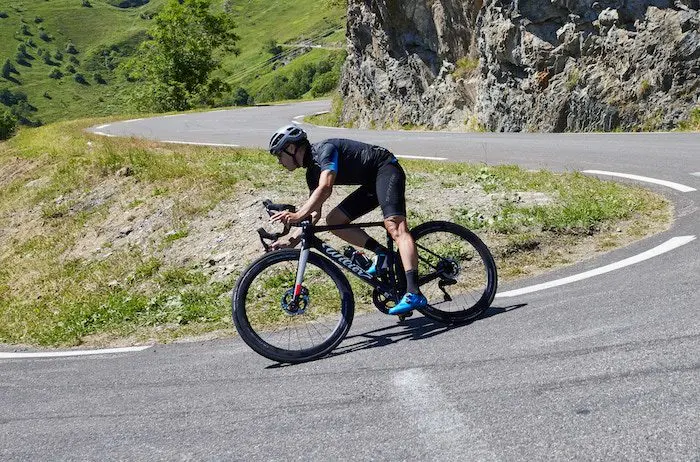
Finally, a last word on the new Dura-Ace C50 wheels, mounted on the test bike with 28 mm tubeless tires. Under gusts of wind in the valleys, taking strong pulls with our riding companions, or on the 10% gradients of the Luz Ardiden climb, they appear to be particularly versatile.

You don’t feel “carried away” coming out of a corner, and you can easily maintain a trajectory on a fast descent. On a long climb at a steady pace, they don’t appear to be extremely stiff. While the 28mm tires are super reassuring when cornering and descending, they do seem to add a little weight to the periphery of the wheels, and therefore lack a tiny bit of punch on sharp accelerations, even if the freehub body is very responsive and allows you to feel perfectly connected to the bike’s drivetrain very quickly. All of this, however, needs to be tempered by the fact that we tested the wheels on a bike we had never ridden before, and it is ultimately difficult to compare them to other models.

A very high-end and desirable groupset
With this new 12-speed Dura-Ace groupset, Shimano succeeds in improving a drivetrain already praised for its reliability and precision, thanks to a sum of small details that goes beyond the simple addition of a twelfth cog.
Beyond a perfect finish and a sleek aesthetic due to the absence of electric wires in the cockpit, we note a very high level of comfort that owes much to the customization possibilities offered by the Di2 drivetrain and hydraulic disc braking.
There are still some characteristics of this 12-speed groupset that may bother some: the definitive abandonment of mechanical shifting, the choice of chainring combinations, the location of the system’s adjustment button on the rear derailleur, and especially the price of the groupset and components, which are once again very high-end. However, it should not be forgotten that the Ultegra 12-speed groupset has the same characteristics, and weighs only 200g more.
The Shimano Dura-Ace R9270 12-speed groupset in brief… Rating: * Pros: operation, smoothness, precision, customization, finish Crank arm lengths: 160, 165, 167.5, 170, 172.5, 175, 177.5 mm – Chainrings: 50-34, 52-36, 54-40 – Cassettes: 11-28, 11-30, 11-34. – Total weight (Di2, disc brakes): 2442 g – Price: €3999.99, with power meter: €5199.99 Contact: bike.shimano.com |
=> SEE ALSO: All our Gear articles
Share the post "First ride review of the new Shimano Dura-Ace Di2 12-speed groupset"