Share the post "The Public at Cycling Races: Between Curiosity and Fascination"
The relationship between the Tour de France and its public oscillates between curiosity, love, hate, and fascination. Amidst this primarily popular event, which owes much to its position in the calendar, some vocations are also born.
By Guillaume Judas – Photos: Pixabay.com, Pxhere.com, Flickr.com, commons.wikimedia.org

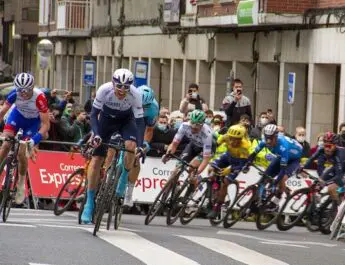
Since its creation in 1903, the Tour de France has generated popular enthusiasm that places it third among the most-watched sporting events in the world, after the FIFA World Cup and the Olympic Games. Along the roadside, approximately 12 million spectators gather each year to watch the riders pass. But not only that. While the Giro d’Italia, for example, claims the same number of spectators (though images don’t seem to confirm it), there’s a definite difference between those who turn out in July and those in May. Riders are unanimous on this point: Giro spectators are far more passionate than those of the Tour, many of whom are drawn more by the publicity caravan and the sheer scale of the organization than by the race itself. To be convinced, one only needs to attend any other race organized in France, except Paris-Roubaix. While there’s certainly a knowledgeable crowd in the West or North – and this is also true for many amateur events – most professional races generate only relative interest elsewhere. Traditionally held in July, the Tour benefits from this prime spot in the calendar to draw crowds, because it’s summer and it’s vacation time.
As for the publicity caravan, “a fantastic exhibition of commercial intelligence” according to the late Jacques Goddet, director of the Tour between 1936 and 1987, it has given way to a colorful and nauseating spectacle, halfway between supermarket promotions and Disney’s grand parade. Nevertheless, it continues to attract onlookers of all ages, from the child delighted to bring home precious goodies to the grandmother who prefers a bob hat or a piece of sausage to snack on, the latter accompanying the former, or vice versa.

Various Motivations
There are also those who are interested in the race, of course, but whose knowledge of cycling is limited to discussions with their pub buddies, or certain internet forums. Suffice it to say that it doesn’t always reach great heights, especially when it comes to distinguishing affinities based on the rider’s nationality, or cynically insisting on the supposed lack of performance of their own compatriots. The French public is as chauvinistic as it is critical of its dashed hopes. Especially when it comes to shining in their reference race, their Grand Tour. With some excesses, because big mouths are likely to put their money where their mouth is. In France, a flamboyant loser is preferred over a flawless winner.
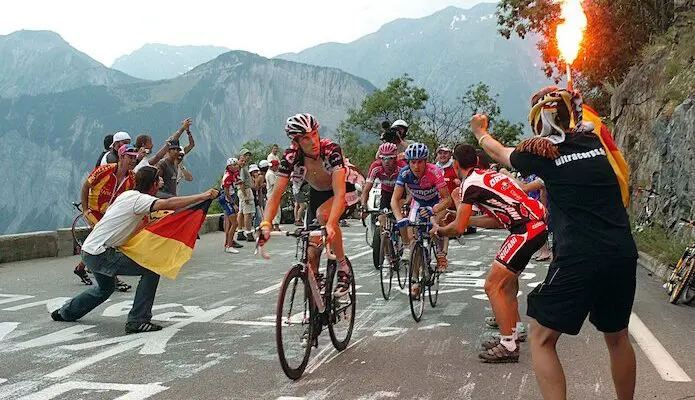
Then there are the real groupies, those who support a rider or a team, who don’t hesitate to unfurl banners or write their idol’s name with white paint on the road. Noisy but friendly, these fans form the core of spectators at many races. There are also the jokers, or rather those who think they’re funny, and who take advantage of the Tour and its immense media coverage around the world to hope to appear on TV. The Tour is broadcast in nearly 190 countries! Running 100 meters in their underwear or an improbable disguise next to the riders, even if it means being dangerous, doesn’t scare them.

More discreet are the true practicing cyclists, those who love cycling 12 months a year, and who respect all the riders when they attend the Tour, both the leaders battling for the yellow jersey or stage victory and the gregari struggling in the gruppetto. For them, the Tour is primarily a spectacle, an opportunity to see close-up riders with toned calves, if only fleetingly. Neither excess nor surprise: climbing to the top of a pass by bike instills respect, for oneself as well as for those who face the same slopes.
A Revelation
Amidst this diverse crowd with varied motivations, there is this child, who could be you, who could be me, a few years ago of course. He finds himself there almost by chance, swept up by who knows which category of spectators mentioned above. Small in stature, he takes advantage of his father’s or uncle’s shoulders to catch a glimpse of this unusual commotion, of this event whose importance he only perceives from afar.
If he is a little more independent, he slips to the front row, first amazed by the atmosphere, then stunned by the noise of the crowd and the rising sound of the race, before being fascinated by the passing of the riders. The fleeting movement of dozens of oiled and tanned legs, the collective rustle of tubulars on the asphalt, the resonance of carbon rims clattering during gear changes, and the rush of air that hits the body: he has only a few seconds to try to glimpse weathered faces half-hidden behind helmets and glasses. A striking impression of intensity, power, and mastery from these giants of the road, which quickly gives way to a feeling of wanting more, especially when the line of team cars and organization vehicles follows, and he finally perceives the danger associated with this proximity between spectators and the race. The encounter lasts only a few tens of seconds, but he is marked forever.

He doesn’t care about the caravan and its plastic gadgets, about those barstool discussions between supporters of one team or another, about those nostalgics who endlessly rehash that things were better before and who mostly regret the passage of time. He will have his favorites, his preferred riders or teams, but what he will want most is to be one of them someday, to belong to this caste of Gods of the asphalt, who master trajectories and gear changes. Pro rider or long-distance cyclo, whatever he becomes afterwards doesn’t matter. He will be a cyclist. The Tour de France is not just a spectacle to be enjoyed for more or less good reasons. For some of us, it was a revelation, and it will be the same for future generations.
=> SEE ALSO: All our MAG articles
Share the post "The Public at Cycling Races: Between Curiosity and Fascination"