Share the post "Mood: The Realities of Virtual Cycling"
Since the beginning of 2020, we have been living through a particular and uncertain period that has forced many cyclists to constantly adapt. This has highlighted the emergence of a new category of practitioners: armchair cyclists, or more precisely, those who ride in a virtual world thanks to their connected indoor trainer, on Zwift for example. From pros to beginners, including amateur competitors who discover a great real or supposed potential, all types of cyclists are encountered. Just like in real life.
By Guillaume Judas – Photos: Flickr.com / Zwift.com
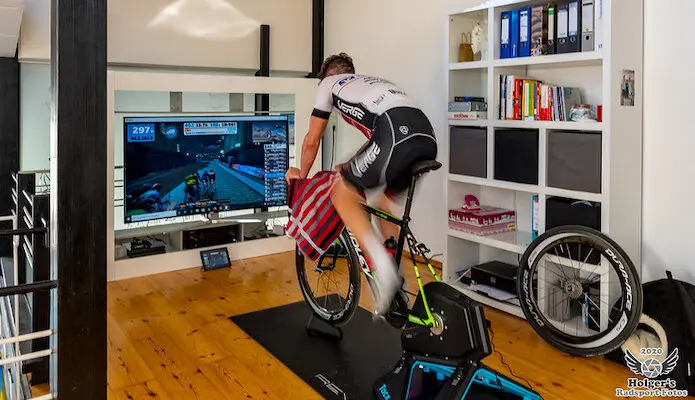
It was the hit of the year for many confined cyclists around the world in 2020: Zwift has experienced enormous success since the beginning of the pandemic. The application has existed since 2015 and already had many loyal followers, especially among Anglo-Saxons. But given the situation we have experienced, it has allowed many practitioners to maintain an almost normal sports activity, riding on an indoor trainer without getting bored. A true training or competition application, Zwift mixes a certain degree of realism with an undeniable fun aspect. Not only are there now many “addicts” to the game, but it has also been observed that the benefits on physical condition could be very real after successive lockdowns. A paradox of our time, it is alone in one’s living room that one can meet or confront cyclists from all over the world, as Zwift encourages the community aspect of the practice, with events that can be organized remotely and allow riding among the avatars of acquaintances or strangers. Obviously, all the possibilities of the application sometimes lead to some excesses. There are different profiles (non-exhaustive list) each worthy of a small description. In all subjectivity.
The Professional Rider
Using Zwift sparingly, he was mostly seen during the first lockdown, when he was not allowed to ride on the road, at least in France. He participated in virtual and promotional rides organized by his team with hundreds of other participants to make an appearance, and in a few races reserved for professionals. With equipment verified and validated by the brands (indoor trainer or power meter calibrated for transparency and fairness), he avoided confronting the true Zwift specialists too regularly, who master the particular technique of the game and whose power source is not always known. The pro, however, did a lot for the application’s reputation, as shown by television commercials. The first e-cycling world championship was even organized in early 2020, with the participation of some renowned riders. But it was a true champion from another sport who won: Germany’s Jason Osborne had already won a world title, but in rowing! Proof that indoor trainer cycling requires very extensive physical capabilities.
The Competitive Zwifter
A few rare specialists of the application have almost become stars of the virtual world, winning races and trophies and even beating some pros along the way. Among them are former riders of excellent level or individuals who reveal their physical qualities within the very particular framework of the game. The intensity level in a 45-minute to 1-hour race, for example, is very close to that of a cyclocross race. Some do nothing else, leaving their living room for rare road rides on sunny days, but for relaxation. True hamsters, or dragsters, we no longer know. The community around the true Zwifter takes itself very seriously, and is gradually putting in place a whole series of firewalls to prevent cheating, even if the principle of performance, based on a power device such as an indoor trainer or a sensor, will always be a source of controversy depending on the brand or its calibration.
The Granfondo Fanatic
This one is addicted to long distances, and re-enacts challenges on the indoor trainer that he can’t do in winter or during lockdown. Without limits, he chained 5-hour rides on Sundays, sweating in front of auto-moto, téléfoot, and until the end of the 1 PM news, circling Watopia, often in a group, and sometimes climbing the Alpe du Zwift three times. He first wanted to win his virtual pair of Lightweight wheels before tackling the Everesting Challenge and its almost 9000 m of elevation gain, which are well worth the reality of the terrain in virtual form. Some pros like Mark Cavendish or Richie Porte shared this challenge with him. He doesn’t care about watts; what he wants is to rack up the km.
The Category C Rider
He signs up for many events, hoping not to get flagged for too high a power output, which would mean moving up to B or A. He enjoys 20 or 30 km full-throttle events, but generally he rides on Zwift by feel, without a structured training plan. He just hopes to be done with remote work by 6 PM before moving from the office to the living room to “drop bombs” on the flat London circuit. Some Category C riders don’t like climbs much, so from time to time they shave a few kilos off their profile to maintain a favorable power-to-weight ratio on the percentages. This type of rider isn’t loyal to the application for very long, and as soon as he can go back outside, he prefers to go back to playing town signs with his friends.
The Cyclo-Engineer
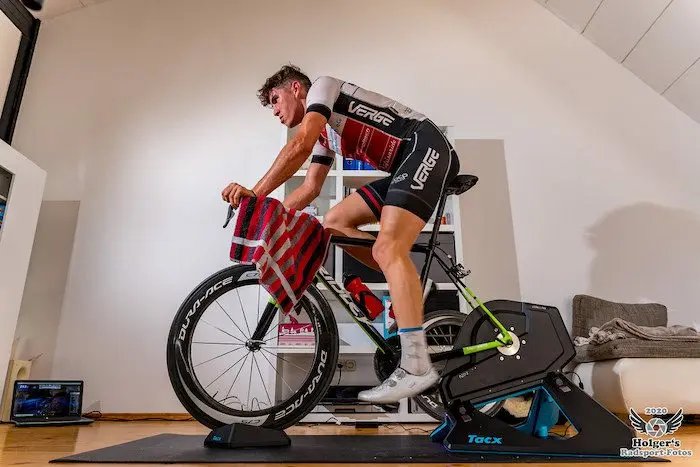
He has understood everything about training by reading books or specialized websites, and despite being well into his forties, he has all the tools to progress. This, of course, includes a super connected indoor trainer because for him, there’s no question of cheating on his abilities. A long-time follower of Zwift programs, he is recognized by his phosphorescent bike, a sign of the many kilometers accomplished on the application. For him, not a single session without an exercise, and he precisely masters his FTP, even if he has been plateauing for some time now from doing too difficult workouts. Because by trying too hard to do well, he sometimes forgets the simple pleasure of riding in the countryside with friends without looking at his bike computer.
The One Who Always Rides Full Throttle
For him, there’s no sport without effort. His motto is No Pain, No Gain. Whether he’s riding on Zwift or outdoors, it’s always full gas. Every session is a struggle against himself, against others. He constantly has one eye on the watts and on his average speed. He signs up for group rides, Social Rides when there’s no virtual race, but doesn’t follow the pace setters’ instructions. He crushes the pedals, and what he wants is to always finish ahead of others. But by always riding at the same intensity, he risks eventually getting bored, realizing that he is no longer progressing.
The Old-School Racer
He started Zwift for lack of anything better, grumbling at first, then telling himself it wasn’t so bad for passing the time during lockdown. He tried a race or two, then decided it was silly to be dropped by a Japanese or a New Zealander with no track record. So he spins his legs while waiting to regain his freedom, but doesn’t disdain to test himself alone from time to time on some benchmark climbs. All the while convincing himself that if he wanted to, he could do better.
The True Beginner
He decided to take advantage of the lockdowns to take control of his health and physical condition, and quickly got tired of running in circles a kilometer from home. He equipped himself with a sometimes basic indoor trainer and retrieved an old bike that was lying around in his garage. He first tested his FTP, understanding that he would have work to do before he could push it to 3 watts/kg. He uses discussion forums on social media to ask questions in order to progress. He first managed to ride for an hour straight, and is aiming for 100 km soon. He might be a future true enthusiast.
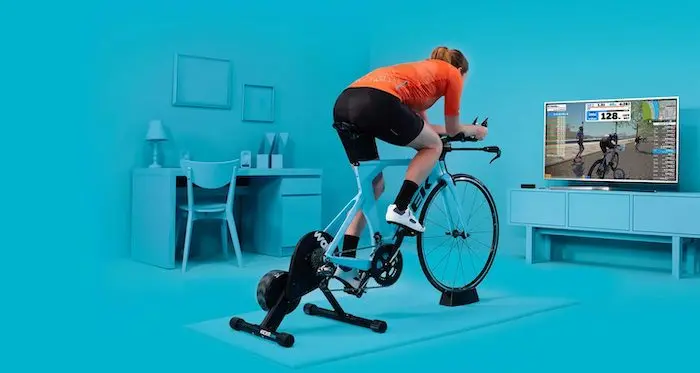
The Mother Who Wants to Burn Calories
There are, of course, a number of women on Zwift, most of whom fall into the previous categories. But there is also a new category of users, greatly inconvenienced by the closure of gyms and the impossibility of doing their two weekly “RPM” sessions. They discover the application on an improved exercise bike or on their partner’s bike with the saddle lowered, and find good interval sessions to follow to continue fitting into their size 36 jeans throughout the lockdown.
The Big Jerk Who Makes Fun of Everyone
There are those who respect nothing, starting with the serious users of the application. To open its game to as many people as possible, Zwift allows connection with a basic indoor trainer and a simple speed sensor, sources of many calculation errors. So there are always smart alecks who blow everyone away on the slightest climb, go up a pass at an average of 45 km/h, and break all segment records. And, of course, boast about it on social media.
The One Who Develops 400 Watts for 30 Minutes at 130 Heartbeats Without Effort…
… and who assures, with barely feigned false modesty, “that he has checked everything, and that everything is properly configured.“
=> SEE ALSO: All our CQFD articles
Share the post "Mood: The Realities of Virtual Cycling"