Share the post "Review of the Wahoo Speedplay Pedals"
Since its creation in the 1990s, the Speedplay brand had changed very little, likely because its unique cleat-and-pedal system was already optimized—and as we know, a product that works doesn’t need to be changed much… But Wahoo’s recent acquisition of Speedplay has changed the game, allowing for improvements in a few key areas, such as the pedal body.
By David Polveroni – Photos: @David Polveroni / DR

First look and first impressions (or rather, first “foot” impressions):
Wahoo is best known for its bike computers and smart trainers. But since acquiring Speedplay, the brand has been able to resolve a few issues that some users may have encountered—as we’ve observed after riding more than 10,000 km with these pedals. Wahoo will also finally bring to market a pair of power-meter pedals, scheduled for release by the end of summer.
For those unfamiliar with Speedplay—now Wahoo Speedplay—these are pedals where the platform is located on the shoe rather than on the pedal itself. This creates a unique feel when switching from a traditional system (Shimano or Look) to Speedplay. Although different, I find that a pair of Time pedals comes close in terms of foot support and angular freedom.

At first, it feels a bit like stepping on bars of soap—the stability is less than with Shimano—but as a result, your foot is always positioned exactly where your body needs it to be. You also feel like you’re one with the axle—that’s something I particularly appreciated. At least, that’s how I felt. With these pedals, I used cleats to correct varus on both the right and left sides, as well as a 2-mm riser on the right shoe to compensate for a difference in leg length.

All shoes are compatible with the 4-hole Speedplay cleat using the included adapter to convert from 3 to 4 holes, which increases the height relative to the axle by 2 mm. However, the stack height stays at 11.5 mm, compared with 14.5 mm for Shimano pedals, for example.
Pedals | Height above axle (mm) |
All Speedplay models | 8.5 / 11.5 with adapter |
All Time models | 13.5 |
Shimano Dura-Ace R9100 | 14 |
Look Kéo Blade | 14 |
All Look Kéo Blade Carbon models | 14.8 |
Shimano Ultegra R8000 | 15.3 |
Look Kéo Classic 3 | 15.7 |
Speedplay pedals offer excellent biomechanical customisation with a wide range of adjustments: laterally (8 mm), front-to-back (14 mm), and angular freedom from 0° to 15°.
It’s really nice to be able to adjust the right and left feet independently. For example, in my case, my left foot requires less freedom than my right foot, although I had gotten used to it (I was using Shimano, mainly with cleats offering 0 to 6° of freedom). It’s more comfortable, and I’ve even noticed that a callus on one of my toes has disappeared thanks to the Speedplay cleats.
It’s also worth noting that the Speedplay Zero is available with different axle lengths to best match your Q-factor: 53, 56, 59, and 65 mm, while the rest of the lineup—Nano, Comp, and Aero—comes standard at 53 mm.
The cleats
The cleats haven’t changed; they’re walkable (meaning you can walk in them without damaging them), and they’re now black instead of yellow. With the adapter, the verified weight is 118 g.
On the Road
I’ve had a pair of Wahoo Speedplay Zero pedals for personal use since they hit the market, and a pair of Nano pedals for this test. After 9,000 km with the Zero pedals, I’ve noticed that they perform just like the brand-new Nano pedals. Even after extensive use in wet conditions, I’ve noticed that progress seems to have been made in this area. At any rate, that’s what Wahoo has aimed for with new seals on the needle bearings.
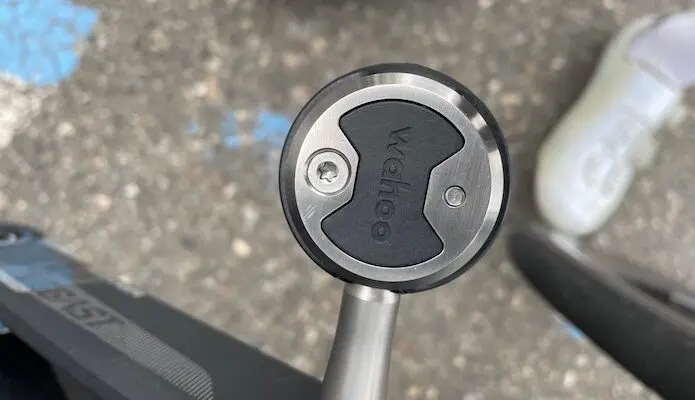
Another change in the new generation: the platform is now circular rather than X-shaped, which seems more mechanically sound to me and results in a body that’s less prone to wear.
Assembly wasn’t complicated at all. However, a few recommendations: be sure to grease the threads on the Nano version well, or you may encounter some squeaking. Also, be sure to apply threadlocker to the screws on the 3-hole plate. My screws came loose without it.
The Lineup
Our test model, the Nano, is the brand’s top-of-the-line model. Although the cleat is heavier than the competition, these pedals weigh (verified weight) 168 g per pair, which is 70 g less than the Shimano Dura-Ace 9100.

These feature a carbon pedal body and a titanium axle, unlike the Zero model, which has a stainless steel axle—just like the Aero model, which offers only a single engagement side, with the reverse side forming a single unit with the cleat to improve aerodynamics. The Comp models feature a Cr-Mo axle and a more flexible cleat. The Light Action model has been discontinued. We appreciate this simplification.

Overall, the test proved very positive and highlighted numerous advantages of this type of pedal, particularly in terms of ergonomics. A redesigned platform and better-protected bearings offer a real benefit in terms of durability. We can’t wait to test the version with a power meter.
Wahoo Speedplay Pedals at a Glance… Rating: ***** Pros: Biomechanical customization (lateral / front-to-back / angular), more robust platform than the previous generation, backward-compatible cleats, softer cleats available and included with the Comp model, increased durability, dual-sided engagement, low axle height, power meter planned for summer/fall 2021 Cons: Difficult to adapt to if you’ve been using Shimano for a long time; no customization (axles from other companies) possible; limited selection of 4-hole shoes – Nano (Titanium): 168 g per pair and €449.99 – Zero (Stainless Steel): 222 g per pair and €229.99 Contact: sportpulsion.com |
=> SEE ALSO: All our Gear articles
Share the post "Review of the Wahoo Speedplay Pedals"